Here’s a harsh truth: investors don’t fund ideas, they fund stories. And your pitch deck is the story that decides whether your startup gets a chance to grow or gets lost in the pile.
The odds aren’t in your favour either. Around 90% of startups fail within the first five years. One of the biggest reasons isn’t always the product—it’s the inability to convince investors to believe in that product.
Now add this to the mix: venture capitalists review hundreds of decks every month, but they spend less than four minutes on each one. If your slides don’t spark interest immediately, your chances of getting that callback shrink fast.
That’s why a startup seed funding pitch deck isn’t just about slides with numbers and charts. It’s about creating a narrative that makes investors lean in, not zone out. A clear problem, a bold solution, a credible team, and visuals that stick; these are the ingredients of a winning deck.
In this blog, we’ll walk through how to build one that works. You’ll learn how to tailor a pitch deck for seed funding, how to create a sales pitch deck that doubles conversions, and how to choose the right pitch deck design agency to bring your story to life.
What is a Pitch Deck & Why It Matters?
Let’s keep it simple. A pitch deck is your startup’s story on slides. Nothing more, nothing less.
It’s not a 50-page business plan. It’s not a data dump. It’s the short version of who you are, what you’re building, and why it matters. Usually 10–12 slides. Sometimes fewer.
So why does it matter so much?
Because investors don’t invest in ideas—they invest in clarity. If you can’t explain your problem, your solution, and the opportunity in front of you in a handful of slides, you’ll lose them before the second coffee sip.
Think about Airbnb’s original deck. It didn’t try to wow investors with endless numbers. It focused on one thing: the travel experience was broken, and they had a better way. That clear story, paired with clean visuals, got attention.
Here’s why a pitch deck matters for startups:
- It’s your first impression. Before anyone reads your business plan, they see your deck.
- It forces clarity. A tight deck makes you cut the fluff and get to the point.
- It builds trust. A clean, well-structured deck signals professionalism and seriousness.
And here’s the kicker: around 70% of decks get rejected simply because they’re unclear or poorly designed. That means the way you tell your story matters just as much as the story itself.
If you’re raising seed funding, applying to an accelerator, or pitching at a demo day, your pitch deck is often the key that unlocks the next stage of growth. Nail it, and you get a meeting. Miss it, and you’ll be back at square one.
Key Elements of a Winning Pitch Deck (Slide-by-Slide Breakdown)
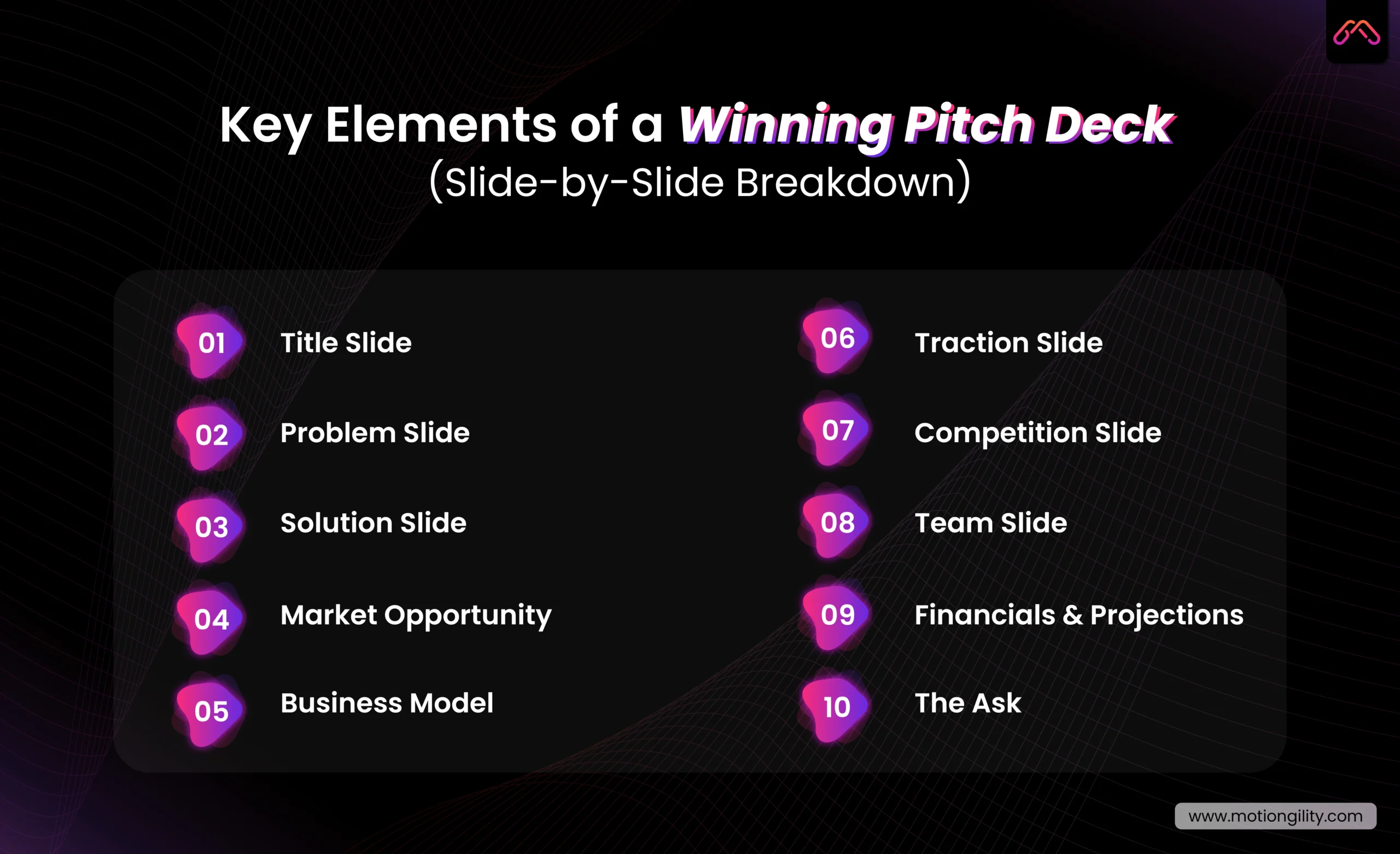
If you search for pitch deck examples from successful startups, you’ll probably come across Airbnb’s, Uber’s, and even Sequoia Capital’s recommended structure. They all look different, but they follow the same principle: clarity beats complexity.
Your pitch deck isn’t meant to answer every question an investor has. It’s meant to spark interest, build a strong brand identity, and secure a meeting. That’s it. If you overcomplicate it, you’ll lose them. If you keep it sharp and well-structured, you’ll stand out.
Here’s how to build a pitch deck slide by slide:
1. Title Slide
- What to include: Startup name, logo, tagline, and your contact info.
- Pro tip: Think of your tagline as a “tweet-length elevator pitch.” For example, Airbnb’s original tagline was: “Book rooms with locals, rather than hotels.”
- Pitch Deck Design tip: A clean, professional layout instantly sets the tone. This is where a pitch deck design agency can elevate your first impression.
2. Problem Slide
- Goal: Show investors the pain point clearly. Don’t just say “the industry is broken”—make it relatable.
- Practical example: Airbnb used “Price is an important concern for customers booking travel” backed with real numbers.
- Do: Use stats, stories, or quotes to show the pain.
- Don’t: Be vague. If the problem isn’t obvious, investors won’t see the need for your solution.
3. Solution Slide
- Goal: Introduce your product/service as the hero.
- Keep it visual—screenshots, mockups, or a 30-second demo clip work better than paragraphs.
- Pro tip: Frame your solution as a before vs. after. Show the pain, then show how you solve it.
4. Market Opportunity
- Why it matters: Investors want scale. A big problem with a tiny market isn’t attractive.
- Break it down into TAM (Total Addressable Market), SAM (Serviceable Available Market), and SOM (Serviceable Obtainable Market).
- Keep it real—overblown market numbers are a red flag.
5. Business Model
- Question investors ask: How do you make money?
- Lay it out clearly: subscription, marketplace fees, ads, freemium upgrades, etc.
- Use one simple chart or example. Don’t flood this slide with financial jargon.
6. Traction Slide
- The most powerful slide for seed funding. If you have proof that people want your product, show it.
- Examples:
- Early users or sign-ups
- Monthly revenue or growth rate
- Partnerships or pilots
- Early users or sign-ups
- Look at Buffer’s original pitch deck—their traction slide was just a simple chart showing user growth. Nothing fancy, but highly effective.
- For a startup seed funding pitch deck, even waitlist numbers can make a strong case.
7. Competition Slide
- Reality check: Every startup has competitors. Saying “we don’t” is a red flag.
- Use a simple 2×2 matrix or comparison table. Highlight your differentiator.
- Example: Uber showed how they were different from taxis and traditional car rentals.
8. Team Slide
- Investors bet on people more than products. Show your founders and core team with short bios and relevant experience.
- Highlight what makes your team uniquely qualified to win.
9. Financials & Projections
- Rule of thumb: 3–5 years of projections. Keep it realistic.
- Show revenue, costs, and growth assumptions.
- Do: Base your numbers on logic and benchmarks.
- Don’t: Promise unicorn-level returns in year one. Investors see through it.
10. The Ask
- What investors look for: How much are you raising and what will you use it for?
- Break down your “use of funds” in simple percentages (e.g., 40% product development, 30% marketing, 20% hiring).
- Tie it back to growth—show how this funding helps you hit the next milestone.
Pro Tips for a Standout Pitch Deck
- Keep it short: 10–12 slides max.
- Tell a story: Start with the problem, build tension, then deliver your solution.
- Pitch Deck Design matters: Poor visuals can kill great ideas. A professional pitch deck design company can make your slides not only look better but also flow better.
- Practice delivery: A good deck is useless if you can’t present it with confidence.
Quick Takeaway
A winning pitch deck is less about dazzling with design and more about telling a clear story. But here’s the kicker, pitch deck design and visual storytellingwork together.
You could have the best pitch deck for seed funding, but if it looks like a messy college project, investors won’t take it seriously. That’s why startups often lean on pitch deck design services to get that edge.
How to Make the Best Pitch Deck for Seed Funding?
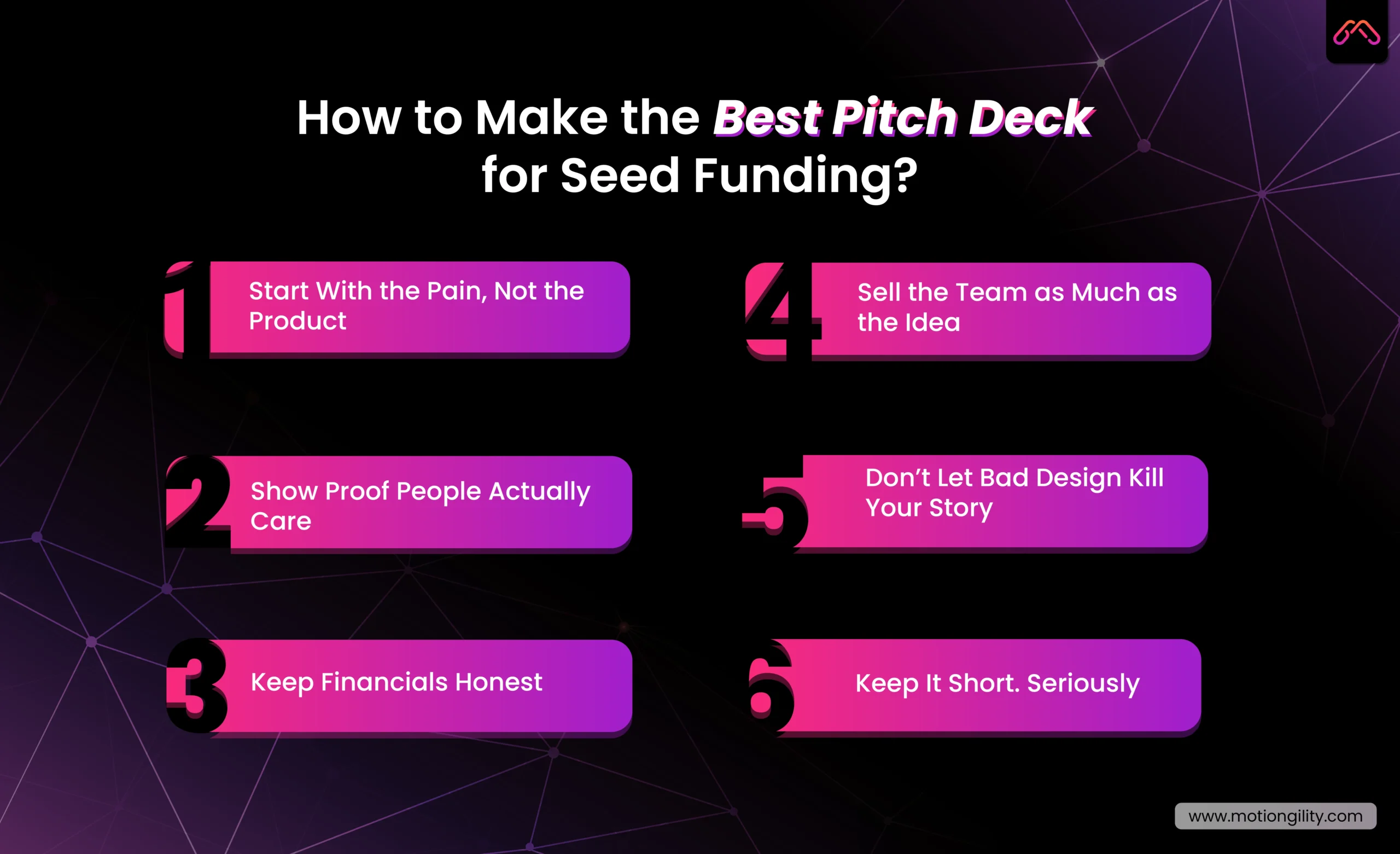
Here’s the thing: at the seed stage, nobody expects you to have it all figured out. You don’t need a Fortune 500 client list. You don’t need a perfect revenue model. What you do need is a story investors can believe in — and that story lives inside your pitch deck.
So, how do you build the best pitch deck for seed funding? Let’s get real:
Start With the Pain, Not the Product
Seed investors care more about the problem than your shiny features. If you can’t make them nod along on the “Problem” slide, the rest of your deck doesn’t matter.
- Talk about the pain in plain English.
- Show numbers if you have them, but don’t bury them in charts.
- Example: Airbnb didn’t start with “we’re a platform for short-term stays.” They started with: “Hotels are expensive and limited. Travellers need better.”
See the difference?
Show Proof People Actually Care
No traction? No funding. It’s that simple. But traction doesn’t always mean revenue. At the seed stage, it could be:
- A waitlist of 1,000 users who signed up without paid ads.
- 200 beta testers who keep giving feedback.
- A pilot with one paying customer.
Investors love signals. Even small ones. If you can show demand, your startup’s seed funding pitch deck suddenly carries weight.
Keep Financials Honest
This one’s huge. Too many founders fill slides with unrealistic hockey-stick graphs. Don’t do it. Seed investors don’t expect you to have a crystal ball, but they do expect you to think about how you’ll make money.
- Explain your revenue model in one slide.
- Show realistic growth paths.
- Avoid buzzwords like “next unicorn” — they hurt you more than they help.
Sell the Team as Much as the Idea
Here’s the truth: investors are betting on people, not slides. If your team has relevant experience, put it front and center. If you don’t, highlight grit, execution speed, or unique insight into the problem.
Remember — Airbnb’s founders weren’t hotel executives. They were just scrappy entrepreneurs who understood travelers better than anyone else.
Don’t Let Bad Pitch Deck Design Kill Your Story
This might sound shallow, but it’s real: if your deck looks sloppy, investors assume your startup is too.
- Use visuals, not walls of text.
- Stick to one font, one colour palette.
- Make it easy to skim.
And if pitch deck design isn’t your thing? That’s where professional pitch deck design services can help. Good design doesn’t just make your deck pretty; it makes your story clearer.
Keep It Short. Seriously.
If you walk in with 30 slides, you’ve already lost. The best pitch decks for seed funding are short and punchy — 10 to 12 slides max. Investors should get the story in five minutes, not fifteen.
Seed Deck Checklist
- Clear problem
- Believable solution
- Real signs of traction
- Honest financials
- A team worth betting on
- Clean, professional pitch deck design
At the seed stage, your pitch deck isn’t about proving you’re the next billion-dollar company. It’s about proving you’re worth a bet. Keep it real.
Keep it simple. Make it memorable. And don’t let bad pitch deck design or messy slides ruin your shot — because investors don’t forgive sloppy storytelling.
How to Make the Best Sales Pitch Deck for 2X Conversions?

Not every pitch deck is about investors. Sometimes, the audience isn’t a VC firm, it’s a potential customer sitting across the table. That’s where the sales pitch deck comes in, and trust me, the rules are different.
An investor deck is about vision and potential. A sales deck? It’s about proof and value. If you want conversions, you can’t rely on the same “problem → solution → ask” formula. You need to flip the spotlight onto your customer.
Here’s how to do it right:
1. Lead With the Customer’s Pain
Don’t start with your product. Start with their problem. Customers don’t care how brilliant your tech is; they care about how it saves time, cuts costs, or drives revenue.
2. Show Results, Not Just Features
This is where most founders slip. They list features instead of outcomes.
- Instead of saying: “Our platform automates reporting.”
- Say: “Clients save 10 hours a week on reporting — that’s two and a half days back every month.”
See the difference? One is a feature. The other is ROI.
3. Add Proof Socially and Visually
Testimonials, case studies, screenshots, this is where your sales deck builds trust.
- In fact, 92% of B2B buyers say they’re more likely to purchase after reading a trusted review. That means adding customer quotes or testimonials to your sales pitch deck isn’t optional — it’s a conversion driver.
- Use visuals: before-and-after charts, simple infographics, customer logos.
4. End With a Clear Call-to-Action
Every sales deck should finish with one thing: a clear next step. Whether it’s “Book a demo”, “Start your free trial”, or “Sign the contract today”, don’t leave the customer guessing.
Why Pitch Deck Design Still Matters
A sales deck isn’t just about words — it’s about flow. Busy decision-makers won’t read heavy slides. Clean visuals, easy-to-follow storytelling, and a professional look can double your impact. This is exactly where professional pitch deck branding services can give you a competitive edge.
Quick Takeaway
If the best pitch deck for seed funding is about getting investors to believe in your vision, the best sales pitch deck is about getting customers to believe in your results. Keep it customer-focused, outcome-driven, and visually sharp — that’s how you turn slides into sales.
How to Find the Best Pitch Deck Design Agency for Your Startup?
You can have the sharpest story in the world, but if your slides look cluttered or amateur, investors may never take the next step. That’s where a professional pitch deck design agency comes in. But not every team out there will fit your startup’s needs. Here’s what to look for:
- Portfolio speaks louder than promises – Review their past decks. Do they look clean, clear, and investor-ready? A strong pitch deck design company will showcase work that builds trust at first glance.
- Startup experience matters – Many agencies know pitch deck design, but few understand fundraising. The best pitch deck design agency know how to balance storytelling, numbers, and visuals so investors get what they need quickly.
- End-to-end support is a game-changer – Great agencies don’t just design slides; they refine your messaging, structure, and sometimes even guide you on delivery. That’s the difference between “nice-looking” and “effective.”
- Proven track record – Ask about past clients and results. Agencies that have helped startups raise capital or close deals are the ones worth trusting.
Why MotionGility?
We’ve worked with 450+ startups and enterprises, helping them turn complex ideas into pitch decks that raise funding and win customers. By combining pitch deck design and storytelling, MotionGility makes sure your deck doesn’t just look good — it delivers results.
Conclusion
Your pitch deck is more than slides; it’s the story that makes investors or customers believe in you. For seed funding, the best pitch deck focuses on the problem, early validation, and the team behind the idea. For sales, it’s about showing results and building trust.
And remember: design matters. A professional pitch deck design agency can turn a simple idea into a deck that gets attention and drives action. Don’t treat it as decoration — treat it as your startup’s growth tool.
FAQs
1. What is a pitch deck, and why is it important?
A pitch deck is a short presentation that highlights your startup’s vision, problem, solution, market, and business model.
It’s important because it helps investors or customers quickly understand your idea and decide if they want to engage further.
2. How many slides should a startup’s seed funding pitch deck have?
The ideal startup seed funding pitch deck should have 10–12 slides. This length is enough to cover the essentials without overwhelming investors.
3. What should be included in the best pitch deck for seed funding?
The best pitch deck for seed funding should include: problem, solution, market opportunity, business model, traction, competition, team, financials, and the funding ask.
4. How do I choose the right pitch deck design agency?
When selecting a pitch deck design agency, check their portfolio, experience with startups, and whether they offer storytelling support along with design. Agencies that combine design and strategy deliver the most effective results.
5. What is the 10/20/30 rule for pitch decks?
The 10/20/30 rule by Guy Kawasaki suggests a pitch deck should have no more than 10 slides, last no longer than 20 minutes, and use a font size of at least 30 points. This rule keeps presentations clear, focused, and easy to follow.