MRR stagnation is one of the most frustrating and dangerous situations for any SaaS business. It doesn’t happen overnight, which makes it even more risky. Growth slows down gradually, your dashboard appears stable, and everything seems fine until you suddenly realize your business has stopped scaling. This silent slowdown is exactly why MRR stagnation becomes a serious threat if not addressed early.
If your monthly recurring revenue (MRR) has been flat for weeks or months, you are already dealing with MRR stagnation. In today’s SaaS landscape, where AI-driven competitors are emerging rapidly, and efficiency matters more than ever, stagnation is not just a phase; it’s a warning signal that your growth engine is weakening.
In this guide, you’ll understand what causes MRR stagnation, why most SaaS companies struggle to fix it, and what proven strategies can help you break the plateau and scale again
1. Understanding MRR Stagnation in 2026
At its core, MRR stagnation happens when your revenue stops growing despite continuous efforts in marketing, sales, and product development. This situation usually arises when the balance between customer acquisition, expansion, and churn breaks down.
Every SaaS business operates on three key revenue drivers: new MRR, expansion MRR, and churned MRR. When the revenue you gain from new customers and upgrades gets canceled out by the revenue you lose from churn, your growth stops. This is the exact point where MRR stagnation begins.
In earlier SaaS growth models, companies relied heavily on acquisition. Even with high churn, new customers kept revenue moving upward. However, in 2026, this strategy no longer works. Customer acquisition costs (CAC) have increased significantly, competition has intensified due to AI tools, and users expect faster value delivery.
If your retention is weak, no amount of marketing spend can fix MRR stagnation. Another critical factor here is Net Revenue Retention (NRR). If your NRR is below 100%, you are losing revenue every month. At 100%, your business is stagnant, and only when it crosses 100% do you achieve sustainable growth. Many high-performing SaaS companies often maintain an NRR above 105%, allowing them to grow even without aggressive acquisition.
2. The Core Reasons Behind MRR Stagnation
Most SaaS businesses face MRR stagnation due to multiple underlying issues, not just one. Poor onboarding is a major factor. If the onboarding process is confusing or focused on features instead of outcomes, users fail to see value and drop off early. Reducing friction and guiding users toward quick wins can significantly improve this.
Slow time-to-value also increases churn. The longer users take to experience results, the more likely they are to leave.
High churn is one of the biggest contributors. Even small increases can cancel out growth. For example, if your MRR is $50,000 with 6% churn, you lose $3,000 monthly, which means zero growth. Improving the user experience and fixing drop-off points helps reduce churn.
Weak product-market fit is another key issue. If your product doesn’t solve a clear problem, users won’t stay or pay.
Pricing strategy also plays a critical role. Outdated or rigid pricing models limit growth. A strong SaaS pricing strategy with upsell opportunities can unlock expansion revenue.
Many companies also ignore expansion revenue and focus only on new users. Sustainable growth comes from increasing revenue per customer. Finally, AI disruption is reshaping SaaS. In some cases, AI tools replace traditional workflows at lower costs. Without strong differentiation, users may switch, leading to MRR stagnation.
3. How to Diagnose MRR Stagnation
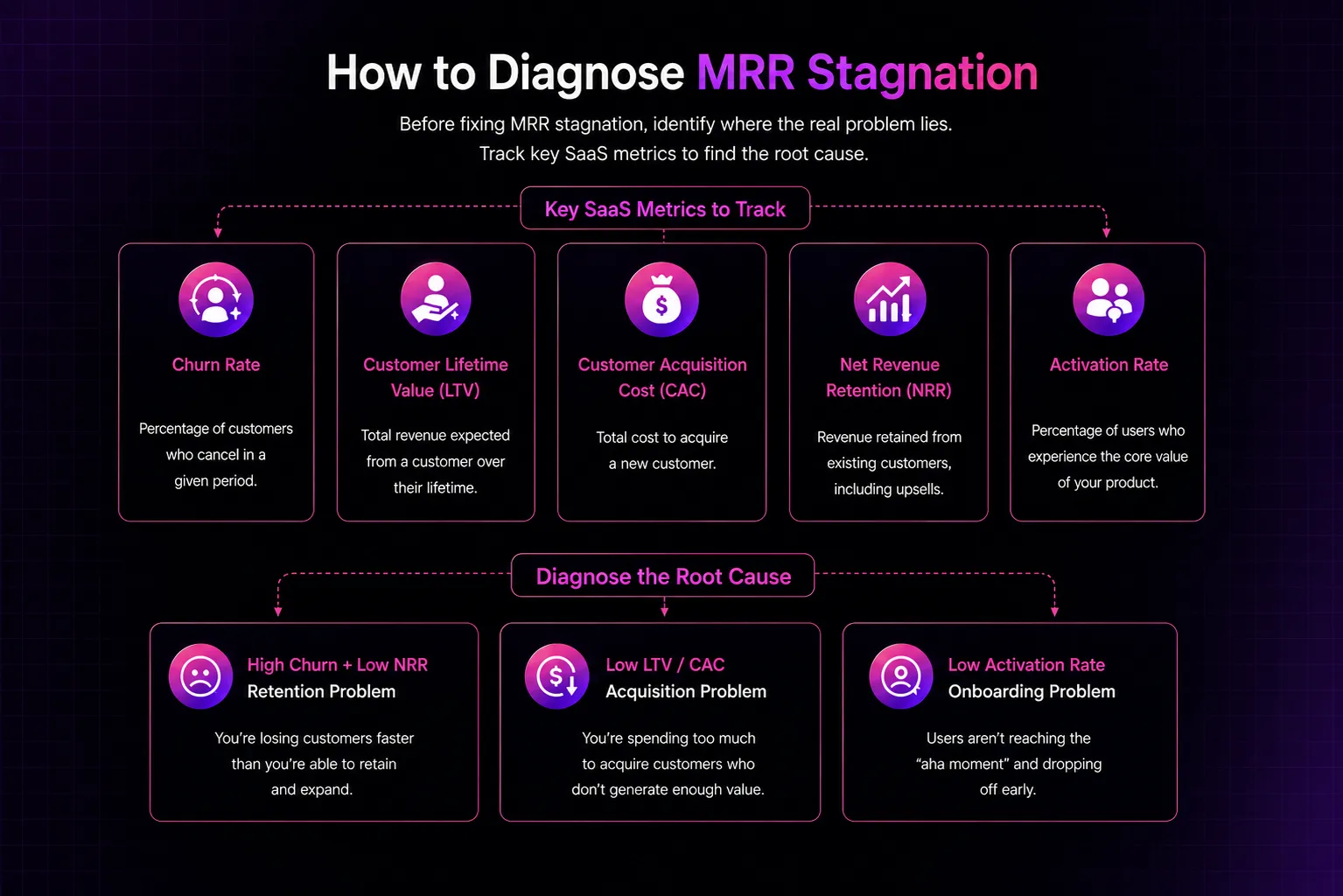
Before fixing MRR stagnation, you need to identify where the actual problem lies. You should track key SaaS metrics, including reducing churn rate, customer lifetime value (LTV), customer acquisition cost (CAC), net revenue retention (NRR), and activation rate.
These metrics help you understand whether your issue lies in acquisition, retention, or expansion.
For example:
- High churn + low NRR → retention problem
- Low LTV/CAC → inefficient acquisition
- Low activation → onboarding issue
Understanding these insights allows you to take targeted action instead of guessing.
4. How to Fix MRR Stagnation
Fixing MRR stagnation requires a structured approach.
A. Improve Onboarding
Guide users toward outcomes instead of features. Use clear steps, checklists, and product walkthroughs to help users reach value quickly.
You can significantly improve onboarding with visual guidance like product demos and explainer videos.
B. Reduce Churn
Identify why users are leaving and fix those issues. Offer flexible plans, improve support, and re-engage inactive users.
Focusing on churn reduction strategies gives the fastest impact on revenue.
C. Increase Expansion Revenue
Introduce premium features, add-ons, or usage-based pricing. Encourage existing users to upgrade based on their needs.
D. Improve Product Positioning
Clearly define the problem your product solves and who it is for. Strong positioning increases retention and conversions.
E. Optimize Pricing Strategy
Align pricing with value delivered. Test different pricing tiers and ensure your pricing grows with your customers.
5. How Explainer Videos Help Reduce MRR Stagnation
One of the most effective strategies to improve onboarding and reduce MRR stagnation is using explainer videos. Explainer videos help users understand your product quickly and clearly. Instead of reading long instructions, users can visually see how your product works, which reduces confusion and improves activation.
They also:
- Increase landing page conversion rates
- Improve onboarding experience
- Reduce support queries
- Boost user engagement
When users understand your product faster, they are more likely to stay, upgrade, and continue using it. This directly improves retention and helps reduce MRR stagnation.
6. Real-World Growth Insight
A SaaS company struggling with stagnation identified key issues:
- Low activation
- Weak onboarding
- No upsell strategy
After improving onboarding, introducing usage-based pricing, and adding video-based product explanations, they saw:
- Higher retention
- Better conversions
- Revenue growth within months
This shows that fixing MRR stagnation is about improving the core user experience, not just increasing marketing spend.
7. How to Prevent MRR Stagnation
To prevent stagnation in the future, focus on long-term systems.
- Build strong customer success processes
- Track user behavior and optimize continuously
- Focus on retention over acquisition
- Invest in product experience
Companies that prioritize retention and user value are far less likely to face MRR stagnation again.
Conclusion
MRR stagnation is not the end of growth; it’s a signal that your strategy needs improvement.
To break the plateau, focus on:
- Better onboarding
- Lower churn
- Strong expansion in revenue
- Smarter pricing
- Clear positioning
Among these, improving user understanding through explainer videos can significantly enhance onboarding, conversions, and retention. If you want to scale your SaaS business and overcome MRR stagnation, adopting a visual-first approach can give you a strong competitive advantage.
1. What is MRR stagnation?
MRR stagnation is when your SaaS revenue stops growing because new revenue is offset by churn or lack of expansion.
2. What is a good MRR growth rate?
A healthy SaaS company typically grows around 20–30% annually, while high-growth companies may achieve 50% or more depending on stage and market conditions.
3. How do I reduce MRR stagnation?
Focus on improving onboarding, reducing churn, increasing expansion revenue, and optimizing pricing strategies.
4. What causes high churn in SaaS?
Poor onboarding, slow time-to-value, weak product-market fit, and strong competition are common reasons.
5. How do explainer videos help SaaS growth?
Explainer videos improve product understanding, increase conversions, and reduce churn by helping users reach value faster.