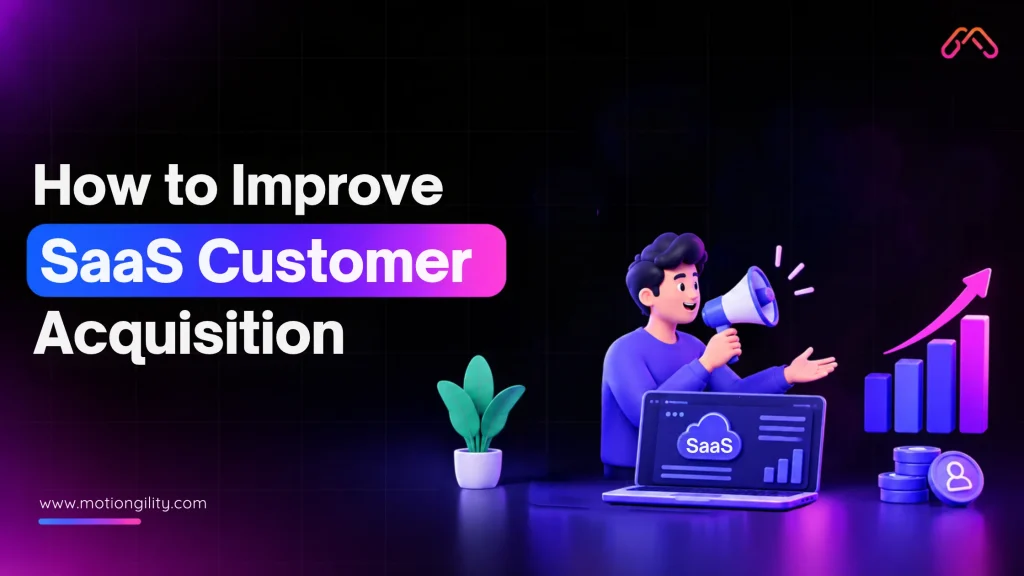
Acquiring customers is one of the biggest challenges for SaaS businesses. Even when a software product solves a genuine problem, attracting the right audience and convincing people to pay for it can take time, effort, and a well-planned marketing strategy.
Many SaaS companies invest in paid advertising, SEO, social media, and email marketing but still struggle to generate consistent results. Sometimes, the problem is not the product itself.
The company may be targeting the wrong audience, communicating its value unclearly, or making it difficult for prospects to take the next step.
SaaS customer acquisition involves the strategies and activities a software business uses to attract potential customers and convert them into paying users. A strong acquisition strategy connects audience research, useful content, conversion-focused landing pages, and effective follow-up.
For SaaS companies, the goal is not simply to gain more sign-ups. It is to attract customers who understand the product, see its value, and are likely to continue using it.
In this guide, we will explore six practical ways to improve SaaS customer acquisition and explain how video marketing can support the process.
1. Define Your Ideal SaaS Customer Before Investing in Marketing
One of the first steps toward improving customer acquisition is understanding exactly who should buy your software.
Without a clear target audience, marketing campaigns can attract visitors who have little interest in the product or cannot afford it. This wastes resources and makes it harder for sales teams to identify qualified opportunities.
Start by defining your ideal customer profile (ICP). Consider the type of company that benefits most from your software, its size, industry, business challenges, and purchasing process.
For example, a SaaS platform designed to automate financial reporting may target finance teams at growing B2B companies. A project management tool might focus on agencies, software development teams, or businesses coordinating remote employees.
These audiences have different priorities, so they require different messaging.
Understand your customers' actual problems
Go beyond basic demographic information. Identify the problems that encourage customers to search for a solution.
Ask questions such as:
- What challenge does the customer want to solve?
- How does the customer manage this problem today?
- What makes existing solutions frustrating?
- Which features influence the buying decision?
- What concerns might prevent the customer from purchasing?
Use customer interviews, sales conversations, support questions, and website analytics to find useful answers.
Once you understand these challenges, you can create marketing messages that connect your product with the outcomes customers want.
For example, instead of promoting a tool as offering “advanced workflow automation,” explain how it can help teams reduce repetitive manual tasks and manage approvals more efficiently.
This makes the value proposition easier to understand and helps attract people who are more likely to benefit from the product.
2. Use SEO and Content Marketing to Attract High-Intent Prospects
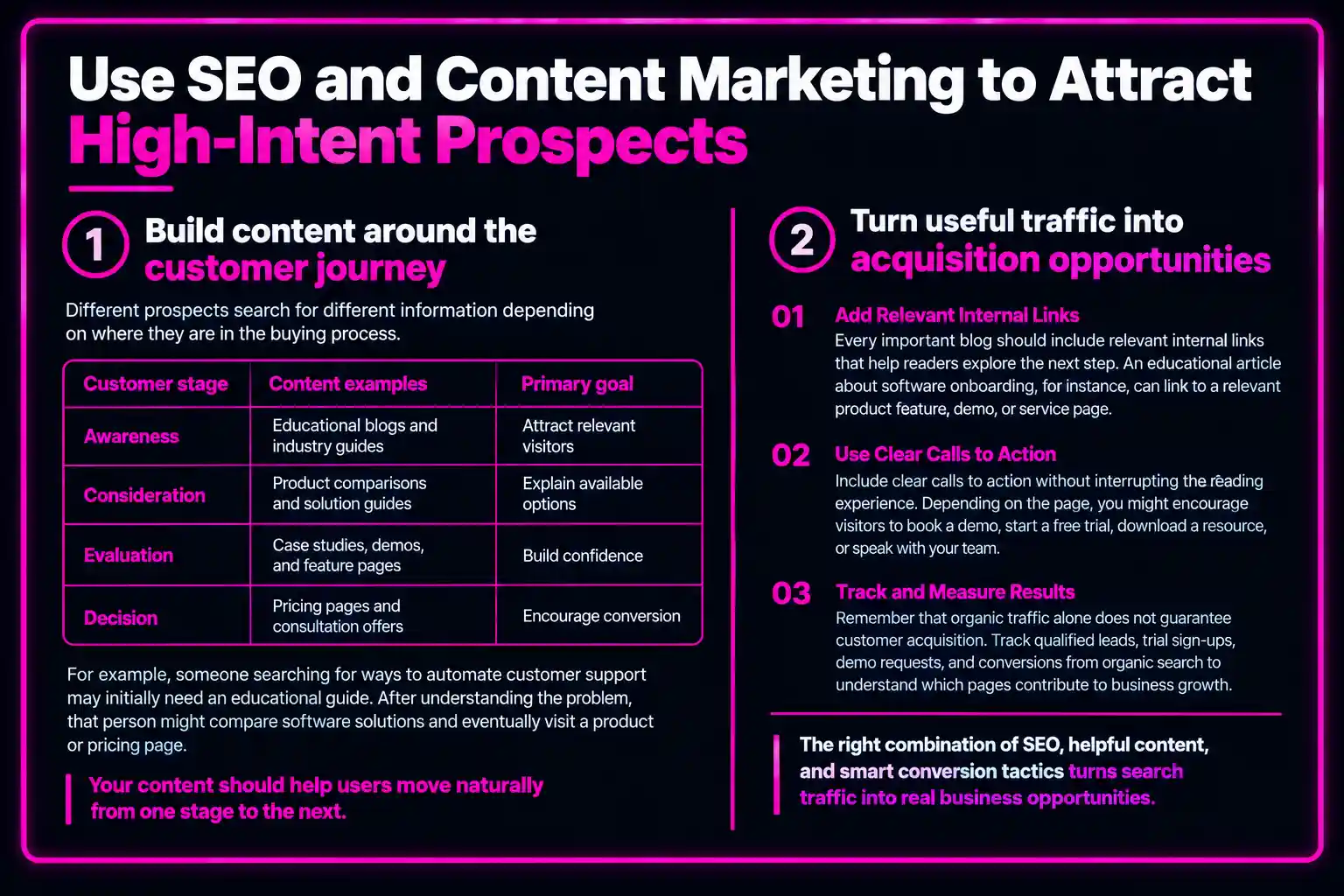
Search engine optimization helps SaaS companies reach people who are already looking for answers, products, or solutions related to their business problems.
Rather than relying entirely on paid campaigns, companies can create useful content that attracts relevant organic traffic over time.
However, effective SaaS SEO requires more than publishing blog posts. The content should match the search intent behind the keywords your target customers use.
Build content around the customer journey
Different prospects search for different information depending on where they are in the buying process.
Customer stage | Content examples | Primary goal |
Awareness | Educational blogs and industry guides | Attract relevant visitors |
Consideration | Product comparisons and solution guides | Explain available options |
Evaluation | Case studies, demos, and feature pages | Build confidence |
Decision | Pricing pages and consultation offers | Encourage conversion |
For example, someone searching for ways to automate customer support may initially need an educational guide. After understanding the problem, that person might compare software solutions and eventually visit a product or pricing page.
Your content should help users move naturally from one stage to the next.
Turn useful traffic into acquisition opportunities
Every important blog should include relevant internal links that help readers explore the next step. An educational article about software onboarding, for instance, can link to a relevant product feature, demo, or service page.
Use clear calls to action without interrupting the reading experience. Depending on the page, you might encourage visitors to book a demo, start a free trial, download a resource, or speak with your team.
Remember that organic traffic alone does not guarantee customer acquisition. Track qualified leads, trial sign-ups, demo requests, and conversions from organic search to understand which pages contribute to business growth.
3. Improve Your SaaS Website and Landing Page Conversion Rate
Your website often plays a major role in the customer acquisition process. It may be the first place prospects visit after discovering your brand through Google, social media, an advertisement, or a referral.
If visitors cannot quickly understand your product, they may leave without exploring its features or contacting your sales team.
A conversion-focused SaaS website should explain what the product does, who it helps, and why it is worth considering.
Make your value proposition clear
Your main headline should communicate the product’s core benefit instead of relying on vague marketing language.
For example, a generic headline such as “The Future of Business Productivity” does not tell visitors what the software actually does.
A more specific headline, such as “Automate Team Approvals and Track Projects in One Place,” provides a clearer explanation of the product’s purpose.
Support the headline with concise copy, relevant product screenshots, customer evidence where available, and a visible call to action.
Reduce friction in the buying process
Review your website from the perspective of a first-time visitor.
Check whether your pricing is easy to understand, forms request only necessary information, and product demonstrations are straightforward to access. Make sure the website works well on mobile devices and loads quickly enough to provide a smooth experience.
You can also test different headlines, calls to action, page layouts, and form lengths to identify what works best for your audience.
For instance, a landing page offering a free trial may perform differently from one encouraging visitors to book a personalized demo. The right option depends on product complexity, pricing, and how customers prefer to evaluate the software.
Use analytics to measure the results rather than assuming a particular design will perform better.
4. Use SaaS Explainer Videos to Communicate Product Value
Some SaaS products are difficult to explain through text alone. They may include technical workflows, multiple features, integrations, or processes that customers need to understand before making a purchase decision.
This is where video marketing can support customer acquisition.
A well-planned SaaS explainer video combines visuals, narration, and storytelling to show how a product works and why it matters. Instead of asking prospects to interpret long feature descriptions, it presents the problem and solution in a more accessible format.
Help prospects understand the product faster
Imagine a company offering AI-powered analytics software. The platform may include data integrations, dashboards, automated reports, and predictive insights.
A short explainer video can show how information moves through the platform and how users can turn it into useful business insights. This gives potential customers a clearer starting point before they explore detailed features.
Different video formats can support different acquisition goals:
- Animated explainer videos: Simplify technical or abstract concepts.
- SaaS product demo videos: Show actual features and workflows.
- Product launch videos: Introduce new software or important features.
- Landing page videos: Explain a product’s value to incoming visitors.
- Customer testimonial videos: Share authentic customer experiences when available and approved.
The key is to match the video format to the customer’s needs and the page’s purpose.
Place videos at important conversion points
A product explainer video can sit on a landing page, appear in an email campaign, support a sales presentation, or introduce a product through social media.
Pair it with a relevant call to action, such as “Book a Demo,” “Start Your Free Trial,” or “Explore the Product.”
The video should support the conversion process, not distract from it.
If your software is difficult to explain or your website visitors need more clarity before requesting a demo, explore MotionGility’s explainer video services. A professionally produced video can help communicate your product’s value through a clear, audience-focused story.
5. Build a Consistent Lead Nurturing and Follow-Up Process
Not every visitor will become a customer immediately. Some prospects need more information, while others must compare competitors, obtain internal approval, or wait for a suitable budget.
A structured lead-nurturing process helps your business stay relevant while prospects evaluate their options.
Email marketing, educational resources, personalized follow-ups, and product demonstrations can all contribute to this process.
Segment leads according to their interests
Avoid sending every prospect the same message. Instead, use available information to group leads by factors such as industry, product interest, behavior, and buying stage.
For example, someone who downloads a guide about workflow automation may benefit from educational emails explaining common automation challenges. A prospect who has already requested a demo may need a product walkthrough or information about implementation.
Relevant communication helps prospects find the information they need without overwhelming them with unrelated promotions.
Use follow-ups to answer real questions
A useful follow-up email should offer something relevant, whether that is a product explanation, a case study, a feature overview, or an invitation to discuss specific requirements.
Video can also help. A short walkthrough can explain a feature that came up during a sales conversation, while an onboarding video can help new customers understand the first steps after purchase.
Make sure your email process respects applicable consent and privacy requirements. Track engagement and conversions to understand which messages support progress through the buying journey.
Most importantly, coordinate marketing and sales teams so that leads receive consistent information and timely follow-ups.
6. Measure Customer Acquisition Costs and Improve Your Strategy
Improving SaaS customer acquisition is an ongoing process. A campaign that generates many leads may not necessarily produce profitable customers, while a smaller campaign may attract people who are a better fit for your product.
This is why SaaS businesses should measure acquisition quality as well as volume.
Track the metrics that connect marketing with revenue
Customer Acquisition Cost (CAC): Measures the cost of acquiring a customer. A simple calculation divides the relevant sales and marketing costs by the number of new customers acquired during the same period.
Conversion rate: Measures the percentage of visitors or leads who complete a desired action, such as signing up for a trial or purchasing a subscription.
Customer Lifetime Value (CLV or LTV): Estimates the revenue or value a customer generates over the relationship, depending on the calculation method used.
Lead-to-customer rate: Shows how effectively the business converts qualified leads into paying customers.
Trial-to-paid conversion rate: Helps subscription businesses understand how many trial users become paying customers.
Retention and churn: Show whether acquired customers continue using the product or cancel their subscriptions.
CAC should be interpreted alongside retention, customer value, gross margin, and the time needed to recover acquisition costs.
A low CAC is not necessarily good if the customers leave quickly or generate little value.
Test, learn, and refine
Use campaign and website data to identify where prospects drop out of the buying journey.
If organic traffic is growing but demo requests remain low, review the relevance of your content, landing page messaging, and calls to action. If many users start a trial but few become paying customers, examine onboarding, product usability, and the value users experience during the trial.
You can also compare marketing channels to understand which sources produce the strongest customer outcomes.
For video campaigns, measure more than views. Where tracking permits, examine qualified inquiries, demo requests, landing-page conversions, and the quality of leads generated.
Use these insights to prioritize the channels, content, and experiences that deliver meaningful results.
Conclusion
Improving SaaS customer acquisition requires a connected strategy rather than a single marketing tactic. Businesses need to understand their ideal customers, attract relevant traffic, communicate product value clearly, and make it easy for prospects to take the next step.
SEO and content marketing can attract people who are actively looking for solutions. Conversion-focused landing pages help visitors understand the offer, while lead nurturing supports prospects who need more time to make a decision.
Explainer videos can strengthen this process by simplifying complex software and showing customers how a product fits their needs. When supported by clear calls to action and consistent performance tracking, video can become a useful part of a broader SaaS acquisition strategy.
The best approach is to identify the biggest barrier in your current customer journey and address it first. Focus on qualified leads and paying customers rather than traffic or engagement alone.
If your SaaS business needs a clearer way to communicate its product and engage potential buyers, explore MotionGility’s explainer video services to discuss a video strategy aligned with your product and marketing goals.
Frequently Asked Questions (FAQs)
1. What is SaaS customer acquisition?
SaaS customer acquisition is the process of attracting potential customers and converting them into paying subscribers for a software-as-a-service product. It can involve SEO, content marketing, paid advertising, email campaigns, referrals, product demos, and other sales and marketing activities.
2. How can SaaS companies improve customer acquisition?
SaaS companies can improve customer acquisition by defining their ideal customer profile, targeting relevant search terms, optimizing landing pages, creating helpful content, nurturing leads, and tracking conversion performance. The most effective strategy depends on the product, audience, pricing model, and sales process.
3. How does video marketing help SaaS customer acquisition?
Video marketing helps explain complex software, demonstrate product features, and communicate business value in an accessible format. Explainer videos and product demos can support landing pages, sales presentations, and email campaigns, helping prospects understand the product before taking the next step.
4. What is Customer Acquisition Cost (CAC) in SaaS?
Customer Acquisition Cost is the amount a business spends to acquire a new customer over a defined period. It is commonly calculated by dividing relevant sales and marketing costs by the number of new customers acquired during that period. Businesses should define which costs they include to make comparisons meaningful.
5. Which marketing channels work best for SaaS customer acquisition?
SEO, content marketing, paid search, social media, email marketing, referral programs, and product-led growth can all support SaaS customer acquisition. The right mix depends on the target audience, customer buying behavior, product complexity, and available budget.