Software products are becoming more powerful, but that also makes them harder to explain.
A SaaS platform may include dashboards, integrations, automation, analytics, AI features, workflows, and multiple user journeys.
While these features can create strong product value, explaining them through text alone can be difficult.
Potential customers do not always have the time or technical knowledge to read lengthy product pages before understanding how a software solution works.
This is where SaaS video animation can make a difference.
Instead of relying only on written explanations, SaaS companies can use animation, motion graphics, interface visuals, and storytelling to show how their products work.
A well-planned animated video can take a complicated software concept and turn it into a simple visual experience.
For SaaS startups, B2B software companies, and established technology brands, this can make product communication clearer across marketing, sales, onboarding, and customer education.
What Is SaaS Video Animation?
SaaS video animation is the use of animated visuals to explain, promote, demonstrate, or educate audiences about a software-as-a-service product.
These videos can include animated interfaces, motion graphics, characters, icons, data visualizations, product screens, transitions, and voiceover.
The format can vary depending on the purpose.
For example, a SaaS company may create an animated explainer video to introduce its platform.
Another company may use product animation to demonstrate a specific feature. A sales team might use an animated product video to explain a workflow during a presentation.
The common objective is simple: make software easier to understand.
Why Is SaaS Software Sometimes Difficult to Explain?
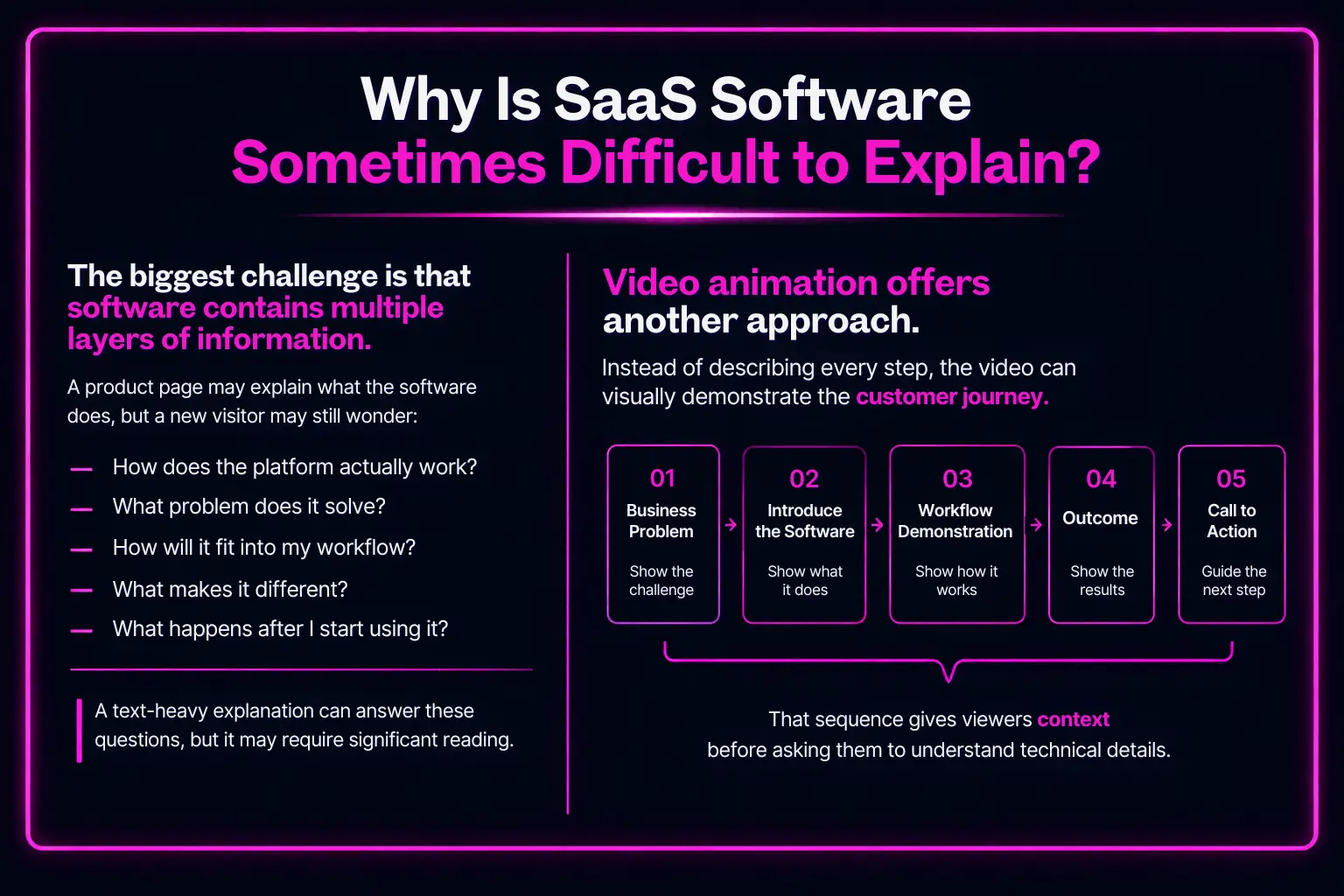
The biggest challenge is that software contains multiple layers of information.
A product page may explain what the software does, but a new visitor may still wonder:
- How does the platform actually work?
- What problem does it solve?
- How will it fit into my workflow?
- What makes it different?
- What happens after I start using it?
A text-heavy explanation can answer these questions, but it may require significant reading.
Video animation offers another approach.
Instead of describing every step, the video can visually demonstrate the customer journey.
For example, an animated SaaS video might show a business problem first, introduce the software, demonstrate the workflow, highlight the outcome, and finish with a clear call to action.
That sequence gives viewers context before asking them to understand technical details.
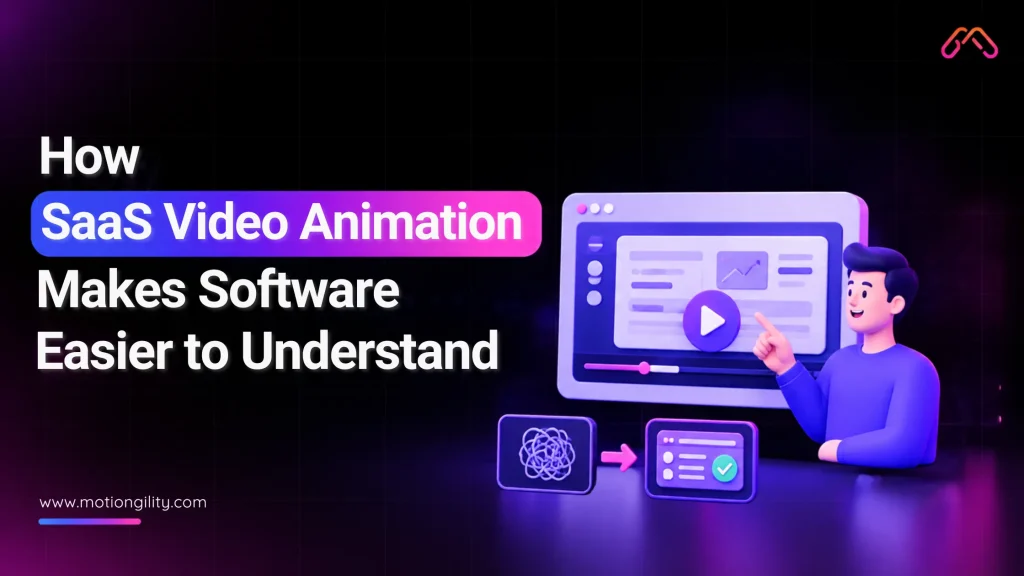
How SaaS Video Animation Makes Software Easier to Understand
It Turns Features Into Visual Stories
A list of features does not always communicate product value.
Suppose a SaaS platform offers automated reporting, real-time analytics, workflow management, and third-party integrations.
A website can list these features, but a video can show how they work together.
The animation can begin with a user manually collecting data. It can then show the SaaS platform connecting different sources, organizing information, generating reports, and presenting the final result.
Now the viewer is not simply reading about automation. They are seeing the process.
This storytelling approach makes SaaS product animation particularly useful for products with complicated workflows.
It Shows Instead of Only Telling
One of the strongest advantages of video is demonstration.
If a product has an advanced dashboard, an animated video can show the dashboard in action.
If the product automates a repetitive process, animation can visualize that process.
If multiple systems connect through an integration, the video can show how information moves between them.
This can reduce the mental effort required to understand the product.
For example, instead of explaining that a platform “centralizes customer data from multiple sources,” the animation can show several data sources moving into one central platform.
The concept becomes visual.
It Makes Technical Concepts More Accessible
SaaS products often target different types of users.
A developer may understand technical terminology immediately, while a marketing manager or business owner may not.
A professional SaaS video animation can bridge this communication gap.
The video can use simple visuals and conversational narration without removing the core message.
This is especially valuable for B2B SaaS businesses where multiple stakeholders may participate in a buying decision.
The technical team may want to understand functionality, while decision-makers may care more about efficiency, cost, scalability, and business outcomes.
A well-structured video can address both perspectives.
Where Can SaaS Video Animation Be Used?
SaaS animation is not limited to one marketing channel. Different videos can support different stages of the customer journey.
Website and Landing Pages
A SaaS landing page has a limited amount of time to communicate value.
A short animated video near the top of the page can introduce the product before visitors move into detailed sections.
It can explain the problem, introduce the solution, and provide a quick overview of the product.
This makes video especially useful for software products that require more explanation than a simple headline can provide.
Product Launches
Launching a new SaaS product or major feature often requires more than a written announcement.
A launch video can visually introduce what has changed, explain the new functionality, and demonstrate why customers should care.
A best SaaS video animation strategy should therefore consider the launch objective before deciding on the visual style.
Sales Enablement
Sales representatives frequently need to explain the same product concepts to different prospects.
An animated video can provide a consistent explanation.
Sales teams can use these videos during presentations, follow-up emails, online meetings, and proposal processes.
This can help prospects understand the product before a deeper sales conversation.
Customer Onboarding
Video can also continue supporting customers after they purchase a SaaS product.
An onboarding animation can explain how to get started, while feature-specific videos can introduce important tools.
This can make customer education more visual and easier to revisit.
Social Media and Marketing
Short SaaS videos can also be adapted for social media.
Instead of explaining an entire product, a short video can focus on one problem, feature, workflow, or customer question.
This gives SaaS brands more opportunities to communicate their expertise and product value.
SaaS Video Animation vs Traditional Product Explanation
Traditional product communication often depends on a combination of text, screenshots, and documentation.
These formats remain useful, but they do not always provide the same visual experience as animation.
Approach | Best Use | Main Strength |
Text | Detailed information | Easy to search and reference |
Screenshots | Interface explanation | Shows the actual product |
Live demo | Detailed product walkthrough | Demonstrates real functionality |
SaaS video animation | Complex concepts and storytelling | Simplifies ideas visually |
Product documentation | Customer education | Provides detailed reference |
The strongest SaaS marketing strategy does not necessarily need to choose only one format.
Instead, businesses can use each format where it works best.
For example, a landing page may combine an animated explainer with screenshots, while the documentation provides deeper technical information.
What Makes a High-Quality SaaS Animation Video?
Creating an animated video is not simply about adding motion to graphics.
The communication strategy matters just as much as the animation.
Start With the Audience
Before creating the video, identify who will watch it.
Is the audience a founder, marketer, IT manager, developer, sales professional, or everyday software user?
The answer affects the language, visuals, pacing, and level of technical detail.
Focus on One Main Message
Trying to explain every product feature in one video can make the content difficult to follow.
A better approach is to decide what viewers should understand after watching.
For example:
“Our platform helps sales teams automate lead management.”
Once the central message is clear, supporting features can be selected around it.
Build a Strong Script
The script should create a logical journey.
A common structure is:
Problem → Solution → How It Works → Benefits → Call to Action
However, the structure can change based on the purpose of the video.
A product launch video may begin with the new feature, while an onboarding video may begin directly with the user’s first task.
Match Visuals With Narration
The visuals should support what the voiceover is saying.
If the narration explains a dashboard, show the dashboard.
If it explains automation, visualize the workflow.
If it describes a result, show that result.
This connection between audio and visuals helps viewers process information more naturally.
How to Choose a SaaS Video Animation Company
Choosing a production partner requires more than searching for the best SaaS animated explainer video.
Start by reviewing the company’s portfolio.
Look for examples involving SaaS, technology, software, or complex products. A portfolio can show whether the company understands how to communicate technical concepts visually.
Next, review its production process.
Ask whether the team provides:
- Script development
- Storyboarding
- Visual design
- Animation
- Voiceover
- Sound design
- Revisions
- Final video formats
Communication is also important.
A good production partner should be able to understand your product before suggesting a creative direction.
For companies searching for a SaaS video animation company, the right choice should be based on creative quality, strategic understanding, process, communication, and project requirements—not price alone.
How Much Do SaaS Video Animation Services Cost?
The cost of SaaS video animation services can vary depending on the project’s complexity.
Factors that can affect the budget include:
- Video duration
- Animation style
- Number of scenes
- Character design
- UI animation
- Voiceover
- Scriptwriting
- Sound design
- Revision requirements
- Production timeline
A simple motion graphics video may require fewer resources than a detailed character-based animation with custom illustrations and complex transitions.
Therefore, businesses should define their objective and required deliverables before comparing quotes.
If you are evaluating professional SaaS video animation, ask production companies for a project-specific estimate rather than relying on a generic price.
Common Mistakes SaaS Companies Should Avoid
Even a visually attractive animation can fail if the communication is unclear.
One common mistake is trying to explain too many features in one video.
Another is using complicated terminology that the target audience may not understand.
Some companies also focus heavily on animation quality while giving less attention to the script.
A beautiful video with a confusing message will not solve the communication problem.
The visuals, narration, pacing, and message should work together.
It is also important to avoid creating a video without a clear purpose.
Before production begins, decide whether the video is designed for product awareness, lead generation, sales enablement, onboarding, feature adoption, or another objective.
Why Custom SaaS Video Animation Can Be Valuable
Every SaaS product has a different audience, workflow, and value proposition.
That is why a generic template may not always communicate the product effectively.
Custom SaaS video animation allows the visuals, storytelling, product interface, and messaging to be designed around the specific software.
For example, a CRM platform may need to visualize lead management, while an analytics platform may need to focus on dashboards and reporting.
A custom approach can make the video more relevant to the product and its audience.
How Can Businesses Measure Video Performance?
Creating a video is only the beginning.
Businesses should also track how audiences respond to it.
Depending on where the video is published, useful metrics can include:
- Video views
- Average watch time
- Completion rate
- Click-through rate
- Landing page engagement
- Demo requests
- Trial sign-ups
- Video views
The most useful metric depends on the video’s objective.
For example, an awareness video may focus on reach and watch time, while a product video on a landing page may be evaluated through engagement and conversion activity.
This helps businesses understand whether their SaaS video animation is supporting the intended marketing goal.
Conclusion
SaaS products can be powerful, but their complexity can make them difficult to communicate.
SaaS video animation gives software companies a visual way to explain complicated products without overwhelming their audience.
By combining storytelling, animation, product visuals, and clear narration, businesses can show how their software works and why it matters.
From landing pages and product launches to sales presentations and customer onboarding, animated video can support multiple stages of the SaaS customer journey.
The most effective videos are not simply visually impressive. They are built around a clear message, a specific audience, and a defined business objective.
For SaaS companies considering professional production, the right approach is to choose a creative partner that understands both video animation and software communication.
FAQs About SaaS Video Animation
What is SaaS video animation?
SaaS video animation is animated video content created to explain, demonstrate, promote, or educate audiences about SaaS software and its features.
Why do SaaS companies use animated videos?
SaaS companies use animated videos to simplify complex software concepts, demonstrate workflows, communicate product value, and support marketing, sales, and onboarding.
What is the difference between SaaS product animation and an explainer video?
SaaS product animation can focus on specific product features or interface interactions, while an explainer video generally uses storytelling to explain the product, problem, solution, or overall value proposition.
How long should a SaaS animated explainer video be?
The ideal duration depends on the purpose and complexity of the message. A short marketing video may be concise, while a detailed product or onboarding video can be longer.
Where can SaaS video animation be used?
SaaS animation can be used on websites, landing pages, social media, sales presentations, product launches, email campaigns, onboarding platforms, and customer education resources.