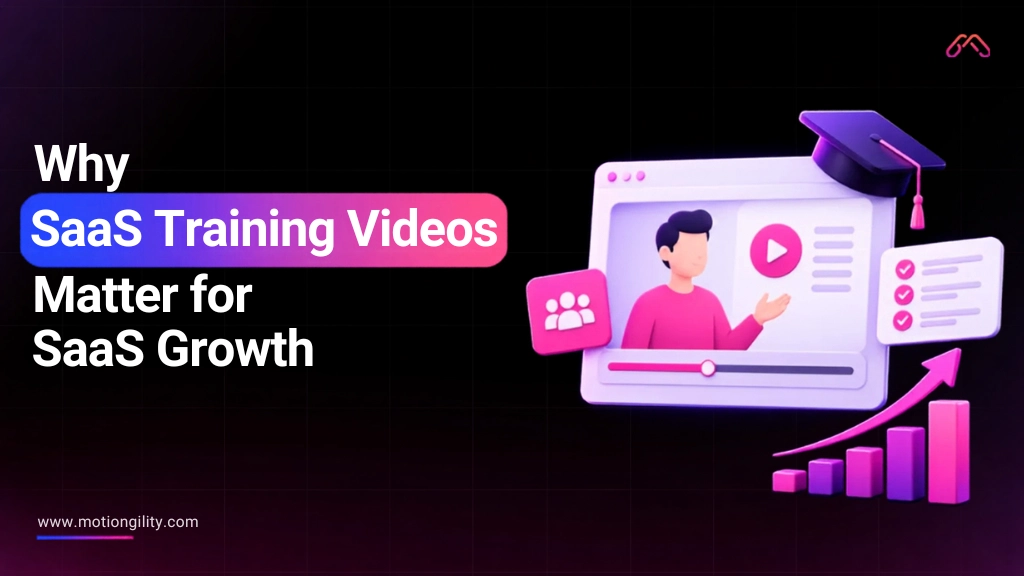
A great SaaS product can solve real problems. However, even the best software can struggle if users do not understand how to use it.
This is where SaaS training videos make a major difference.
Modern SaaS platforms often include multiple features, dashboards, workflows, integrations, and advanced settings.
Therefore, users need simple guidance to understand the product quickly.
Long documentation can help, but it is not always the easiest way to learn.
Video makes software education more visual, engaging, and easier to follow.
With the right training content, SaaS companies can improve product onboarding, increase feature adoption, reduce support requests, and build stronger customer relationships.
As a result, training videos can become an important part of a SaaS growth strategy.
In this guide, we will explore why SaaS training videos matter for SaaS growth, how they improve customer experiences, and how SaaS companies can use them effectively.
What Are SaaS Training Videos?
SaaS training videos are educational videos designed to teach users how to use a software product or specific features.
These videos can explain everything from basic onboarding steps to advanced workflows.
For example, a SaaS training video can show users how to create an account, navigate a dashboard, configure settings, or use a specific feature.
Unlike traditional software documentation, video combines visuals, narration, demonstrations, and animations.
Therefore, users can see exactly what they need to do.
SaaS companies can use training videos for:
- Product onboarding
- Feature education
- Customer support
- Employee training
- Product adoption
- New feature launches
- Software tutorials
- Customer success programs
The goal is simple: help users understand the product faster and use it with confidence.
1. SaaS Training Videos Make Product Onboarding Easier
The first few interactions with a SaaS product are extremely important.
When new users sign up, they need to understand the product quickly.
If the interface looks complicated, they may become confused or stop using the software.
A well-designed training video can simplify this process.
Instead of asking users to read several pages of documentation, companies can show them how the product works step by step.
1.1 Explain the Product Quickly
A short training video can introduce the most important parts of a SaaS platform.
For example, it can explain:
- How to access the dashboard.
- How to complete the first setup.
- How to use the core features.
This creates a smoother onboarding experience.
Moreover, users can pause, replay, or revisit the video whenever they need help.
Therefore, training content remains useful even after the initial onboarding process.
1.2 Reduce the Learning Curve
Every SaaS product has a learning curve.
However, visual demonstrations can make complex workflows easier to understand.
Users can watch an action instead of trying to imagine it from written instructions.
This is especially useful for B2B software.
Business software often contains advanced features that require some technical understanding.
Consequently, software training SaaS videos can help users understand those features without overwhelming them.
1.3 Create Consistent Onboarding
Another advantage is consistency.
Every customer receives the same basic explanation of the product.
This helps SaaS companies maintain a consistent onboarding experience across different customer segments.
As the customer base grows, this becomes even more valuable.
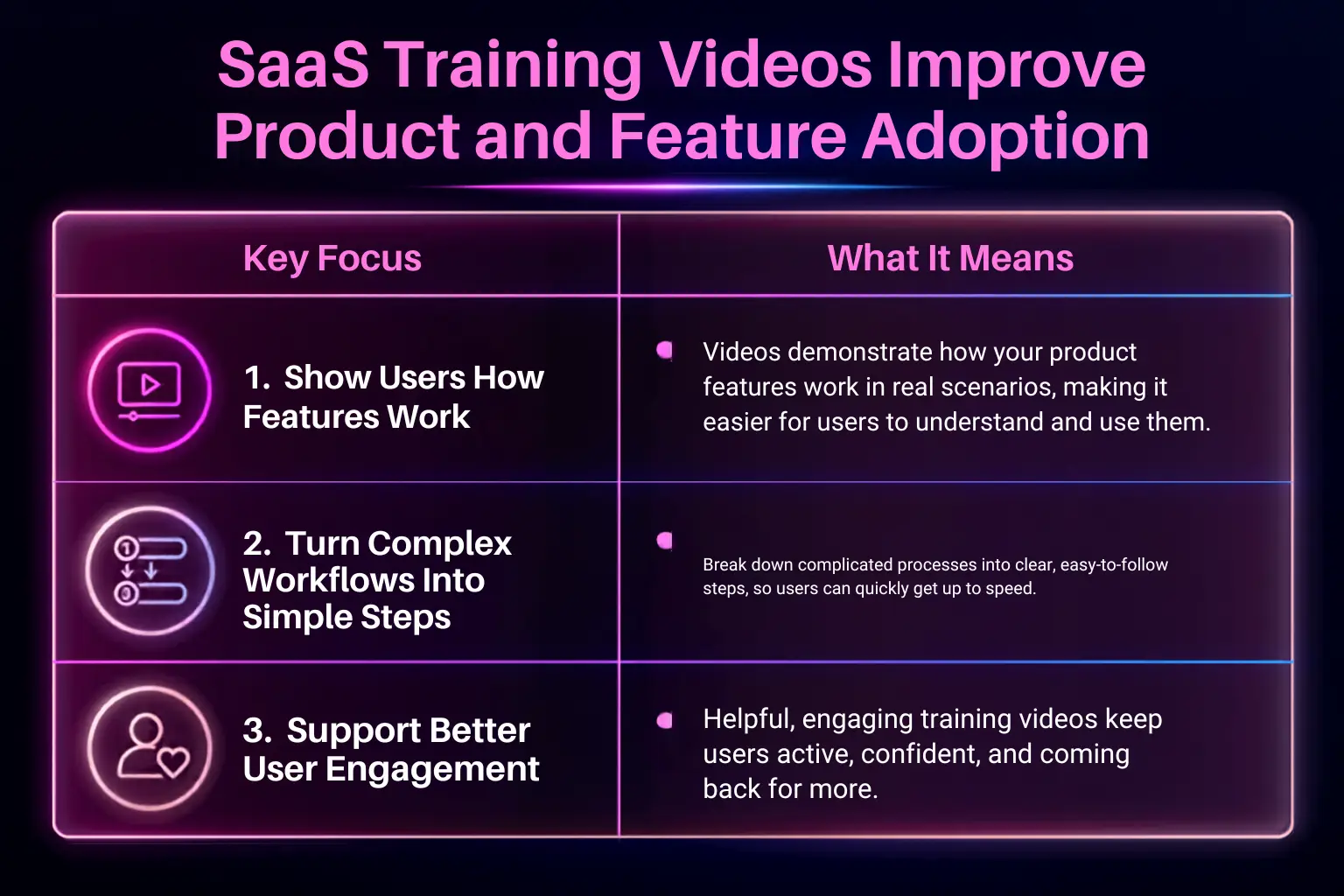
2. SaaS Training Videos Improve Product and Feature Adoption
Creating a great feature is only half the job.
Users also need to discover and understand that feature.
Unfortunately, many SaaS users only use a small portion of the functionality available to them.
This can reduce the perceived value of the product.
Training videos can help solve this problem.
2.1 Show Users How Features Work
A feature page can explain what a feature does. A video can demonstrate how it works.
For example, imagine a SaaS platform launches an advanced reporting feature.
Instead of simply announcing it through an email, the company can create a short training video.
The video can show how users can access the feature, configure it, and generate reports.
As a result, users are more likely to understand the feature and try it.
2.2 Turn Complex Workflows Into Simple Steps
Some SaaS workflows involve multiple actions.
Users may need to navigate through different menus, settings, and dashboards.
A training video can connect these actions into one clear process.
This makes learning more practical.
For SaaS companies, this approach can also support customer success teams.
Customers can independently follow the process instead of asking support teams the same questions repeatedly.
2.3 Support Better User Engagement
Video is naturally more engaging than large blocks of technical documentation.
However, engagement should not mean adding unnecessary effects or animations.
The content should remain focused on the user’s goal.
The best SaaS training video explains the right information at the right time.
Therefore, SaaS companies should focus on clarity, relevance, and practical demonstrations.
3. SaaS Training Videos Reduce Support Costs
Customer support is an important part of SaaS growth.
However, repetitive support questions can consume a significant amount of time.
Users may ask how to reset settings, configure a feature, create reports, or complete basic workflows.
Many of these questions can be answered through training videos.
3.1 Create a Self-Service Learning Experience
A video library allows customers to find answers without contacting support.
For example, a SaaS company can create separate videos for:
- Getting started
- Account setup
- Feature tutorials
- Troubleshooting
- Advanced workflows
- Integrations
- Frequently asked questions
This creates a self-service knowledge system.
Users can find the right video and solve simple problems themselves.
Meanwhile, support teams can spend more time handling complex customer issues.
3.2 Make Technical Support Easier to Understand
Written support articles are useful. However, technical instructions can sometimes be difficult to follow.
A video can visually highlight buttons, menus, settings, and workflows.
For example, instead of saying “go to your account settings and select the integration tab,” a video can show the exact navigation path.
This reduces confusion.
As a result, customers can resolve problems faster and experience less frustration.
3.3 Build a Scalable Support System
SaaS companies want to grow without increasing operational costs at the same rate.
Training content supports this goal.
Once a high-quality video is created, it can educate thousands of users.
Therefore, it becomes a scalable customer education asset.
This is one reason many companies invest in SaaS training video solutions for product onboarding and support.
4. SaaS Training Videos Build Customer Confidence and Retention
SaaS growth is not only about acquiring new customers.
Retention is equally important.
When users understand a product, they are more likely to get value from it.
When they consistently get value, they are more likely to continue using the product.
Training videos can support this entire journey.
4.1 Help Users Feel More Confident
Complex software can make users feel uncertain.
They may worry about making mistakes or changing the wrong settings.
A clear video demonstration can reduce that hesitation.
Users can watch the process before performing it themselves.
Therefore, training videos can create a stronger sense of confidence.
4.2 Increase Product Value
Customers usually want one thing from SaaS software: results.
If customers only use basic features, they may not experience the full value of the platform.
Training videos can introduce advanced functionality and useful workflows.
For example, a CRM platform may offer automation, analytics, integrations, and reporting.
A training video can teach customers how to use these features together.
This helps customers get more value from their subscription.
4.3 Support Customer Retention
Customer retention depends on many factors.
Product quality matters. Customer support matters. Pricing matters.
However, product understanding also plays an important role.
When users know how to use a product effectively, they are more likely to integrate it into their daily workflow.
As a result, the product becomes more valuable and harder to replace.
This can contribute to stronger customer loyalty and lower churn.
5. Professional SaaS Training Videos Support Long-Term SaaS Growth
As a SaaS company grows, its training requirements also become more complex.
New features are launched. New customers join. Existing customers need advanced education.
Internal teams also need updated product knowledge.
Therefore, SaaS training videos should be treated as a long-term content strategy rather than a one-time project.
5.1 Create Different Videos for Different Users
Not every customer needs the same information.
A beginner may need a basic product introduction.
An experienced customer may need an advanced feature tutorial.
Therefore, SaaS companies can create different video categories.
For example:
Beginner training videos can cover account setup, navigation, and basic features.
Intermediate videos can explain workflows, integrations, and productivity features.
Advanced videos can cover automation, analytics, customization, and complex use cases.
This approach creates a better learning journey.
5.2 Choose the Right Production Approach
Quality matters when creating SaaS training content.
A poor-quality video can create more confusion instead of solving it.
Therefore, companies should focus on clear scripting, professional voiceover, screen recordings, visual hierarchy, and simple explanations.
For businesses looking for best SaaS training video services for software companies, the right production partner should understand both video communication and SaaS products.
A professional SaaS training video production agency for B2B software can help transform complex product workflows into easy-to-understand learning experiences.
The agency can also help with scripting, storyboarding, UI demonstrations, animation, voiceover, and final production.
5.3 Use Training Videos Across the Customer Journey
Training videos should not only live on a help center.
SaaS companies can use them across multiple touchpoints.
For example, videos can be added to onboarding emails, product pages, knowledge bases, customer portals, support articles, webinars, and in-app experiences.
This creates a connected education ecosystem.
Moreover, companies can study video engagement and customer behavior. They can then identify which topics create confusion and which features need better education.
What Makes a Good SaaS Training Video?
A successful training video should focus on the user’s problem.
It should not simply explain every feature available in the software. Instead, it should answer a specific question or help users complete a specific task.
A strong SaaS training video usually includes a clear objective, simple language, logical structure, visual demonstrations, and a direct conclusion.
The video should also avoid unnecessary information.
For example, if the purpose is to teach users how to create a report, the video should focus on that workflow. Additional features can be covered in separate videos.
This makes the learning experience faster and more focused.
How to Create Effective SaaS Training Videos
Creating effective training content starts with understanding the audience.
First, identify who will watch the video. Then, understand their knowledge level and the problem they want to solve.
Next, create a simple script.
The introduction should quickly explain what users will learn.
The main section should demonstrate the process step by step.
Finally, the video should provide a clear next action.
Visuals should support the explanation.
For SaaS products, screen recordings, UI animations, motion graphics, callouts, cursor movements, and zoom effects can make complicated interfaces easier to follow.
However, visuals should not become distractions.
The primary objective is always learning.
SaaS Training Video Examples for User Adoption
Different SaaS companies can use training videos in different ways.
For example, a project management platform can create a video showing how to create a project, assign tasks, and track progress.
A marketing automation platform can demonstrate how to create an automated campaign.
A CRM platform can explain how to manage leads, update customer records, and generate sales reports.
These are useful SaaS training video examples for user adoption because they connect product features with real user tasks.
The more practical the video is, the easier it becomes for users to apply what they learn.
Why SaaS Companies Should Invest in Training Videos
SaaS growth depends on more than marketing.
A company may attract thousands of visitors through SEO, paid advertising, social media, and content marketing.
However, those users still need to understand the product after conversion.
Training videos help bridge that gap.
They support onboarding, education, feature adoption, customer support, engagement, and retention.
Moreover, they can be reused across multiple channels.
That makes them valuable long-term content assets.
For growing SaaS companies, this combination of education and scalability makes video training a practical investment.
Conclusion
SaaS products are becoming more powerful and feature-rich.
However, more features can also create more learning challenges for users.
That is why SaaS training videos matter for SaaS growth.
They make onboarding easier, improve feature adoption, reduce support pressure, build customer confidence, and support long-term retention.
More importantly, they turn complicated software into practical learning experiences.
For SaaS companies, the goal should not be to create videos simply because video is popular.
Instead, every video should solve a specific customer problem.
With the right strategy, software training SaaS videos can become a valuable part of the entire customer journey.
Whether a company needs product onboarding, feature education, customer support, or advanced software tutorials, well-produced training content can help users get more value from the product.
Ultimately, when customers understand your product better, they are more likely to use it, trust it, and continue using it.
And that makes SaaS training videos a powerful tool for sustainable SaaS growth.
What is a SaaS training video?
A SaaS training video is an educational video that teaches users how to use software, features, workflows, or specific product functions. It can support onboarding, product education, customer support, and feature adoption.
Why are SaaS training videos important?
SaaS training videos simplify complex software and help users understand products faster. They can improve onboarding, feature adoption, customer satisfaction, and retention while reducing repetitive support questions.
What should a SaaS training video include?
A good SaaS training video should include a clear learning objective, simple instructions, screen demonstrations, relevant visuals, professional narration, and a logical step-by-step structure.
How do SaaS training videos improve user adoption?
They demonstrate how features work in real situations. Therefore, users can understand the benefits and learn how to use features without relying entirely on written documentation.
How long should a SaaS training video be?
The ideal length depends on the topic. Simple tutorials can be a few minutes long, while advanced workflows may require more time. The goal should be to provide complete information without unnecessary content.