Customer acquisition cost is quietly killing otherwise good businesses. Revenue looks fine on the surface, leads are coming in, but margins keep shrinking. You spend more to get the same result. And scaling feels harder every quarter.
Download Now: Free 3-Video Funnel
Here’s the thing: Most companies try to fix this by tweaking ads, bidding strategies, or channels. That’s backwards. The real leverage to reduce CAC doesn’t come from spending more or optimizing pixels. It comes from fixing what happens before and after someone clicks.
In fact, SaaS benchmarks show the average CAC crossed $700 per customer in 2025, driven by market saturation and low trust environments. That’s not a money problem. That’s a clarity and conversion problem.
This article breaks down exactly how to reduce customer acquisition cost, generate hotter leads, and lower CAC, without increasing spend, using proven systems, behavior-based funnels, and sales-driven assets that actually close.
Why Most Companies Struggle With High CAC
Most businesses don’t have a traffic problem. They have a conversion problem disguised as a traffic problem.
When you break down customer acquisition cost (or CAC meaning simply the total cost to acquire a paying customer), high numbers usually point to structural issues, not channel issues.
First, their offer messaging is unclear. Cold audiences don’t instantly understand who it’s for, what problem it solves, or why it’s different. When prospects have to guess, they bounce. Confusion doesn’t always reduce CAC but raises it.
Second, their funnel forces people to think. Too many steps. Too many options. Too much friction. Instead of guiding prospects, the funnel creates hesitation, which inflates the average CAC across every channel.
Third, their content doesn’t build trust. Blog posts educate, but they don’t sell. Social posts entertain, but they don’t clarify value. Without proof and explanation, prospects don’t move forward. That’s how you increase customer acquisition cost without realizing it.
Fourth, retargeting focuses on views, not intent. Someone seeing an ad doesn’t mean they’re interested. Someone watching 75% of a video or engaging with a product walkthrough video does. Retargeting impressions instead of behavior keeps CAC high.
Finally, they rely on static creatives. One image. One headline. Zero explanation. In a market where buyers demand proof, static assets fail to create desire or clarity, pushing your CAC score in the wrong direction.
5 Ways to Reduce CAC without Increasing Spend
Reducing CAC isn’t about hacks. It’s about leverage. These five strategies consistently reduce CAC, without increasing spend.
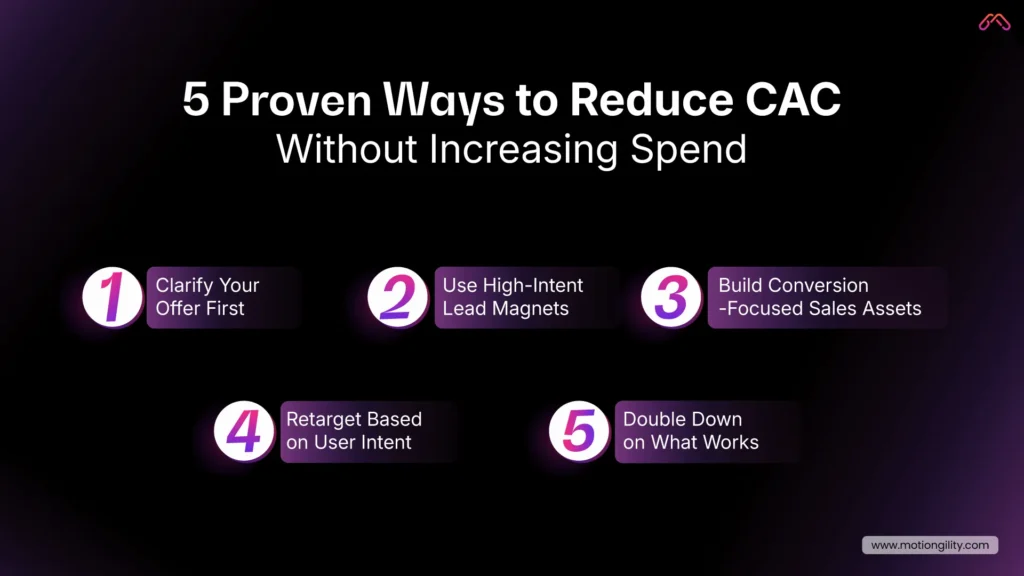
#1: Fix Your Offer, Before You Touch Ads
This is non-negotiable. You cannot lower CAC with a weak or unclear offer. Your offer should clearly answer three things: who it’s for, what problem it solves, and what outcome they get. When that’s dialed in, everything else works better.
Companies that refine offer messaging before scaling see conversion lifts of 15-25%, which directly reduces customer acquisition cost. One B2B SaaS reduced sales cycle length from 120 to 85 days simply by aligning messaging with buyer pain, dropping their CAC payback period by months.
If you’re asking how to reduce CAC, start here. Fix the offer. Then optimize traffic.
#2: Use High-Intent Lead Magnets
Most lead magnets are useless. Generic PDFs attract low-intent leads who never buy. That inflates your CAC and destroys follow-up efficiency. High-intent lead magnets solve a specific problem immediately. Think of ebooks, calculators, audits, or assessments tailored to one pain point.
These types of interactive lead magnets convert traffic and dramatically lower CAC because they qualify leads upfront. Referral-driven magnets have been shown to acquire users at a fraction of the average CAC.
If your goal is to reduce CAC score, stop giving away information. Start giving solutions.
#3: Create Sales Assets, Not Just Content
Content informs. Sales assets convert. Most companies confuse the two. A blog post explains. An explainer video sells. A case study convinces. A product walkthrough removes doubt.
Landing pages with video explanations can increase conversion rates by up to 80%. That directly answers how to lower CAC, because a higher conversion means fewer dollars per customer.
This is where explainer videos shine. They do what static content can’t. They create clarity, build trust, and move buyers forward faster. When used across landing pages, email nurtures, and sales follow-ups, they consistently reduce customer acquisition cost across channels.
#4: Retarget Based on Consumption, Not Impressions
Retargeting works when it’s based on intent. Instead of retargeting everyone who “saw” something, focus on people who consumed it. Video watch time over 75%. Scroll depth past 80%. Pricing page visits.
Retargeting brings back up to 26% of lost users and converts them 70% more efficiently than top-of-funnel traffic. That’s a direct path to lower CAC without increasing spending.
When you pair this with explainer videos, retargeting becomes surgical. You’re following up with people who already understand your value, which is exactly how to reduce CAC at scale.
#5: Scale What Works, Don’t Chase Shiny Objects
Most CAC problems come from distraction. New platforms. New formats. New trends. Meanwhile, proven channels get underfunded.
The rule is simple. Scale what works until it breaks. Track LTV to CAC ratios. Anything under 3x is a warning sign. One HR SaaS cut CAC by 35% simply by removing broad targeting and doubling down on high-intent keywords and referral loops.
Less noise. More signals. If you want to reduce CAC, discipline beats novelty every time.
Best Channels to Drive Hot Leads at Lower CAC
Not all channels impact customer acquisition costs equally. Some bring volume. Others bring intent. The goal isn’t to choose one, it’s to stack the right channels so each one helps reduce CAC instead of inflating it.
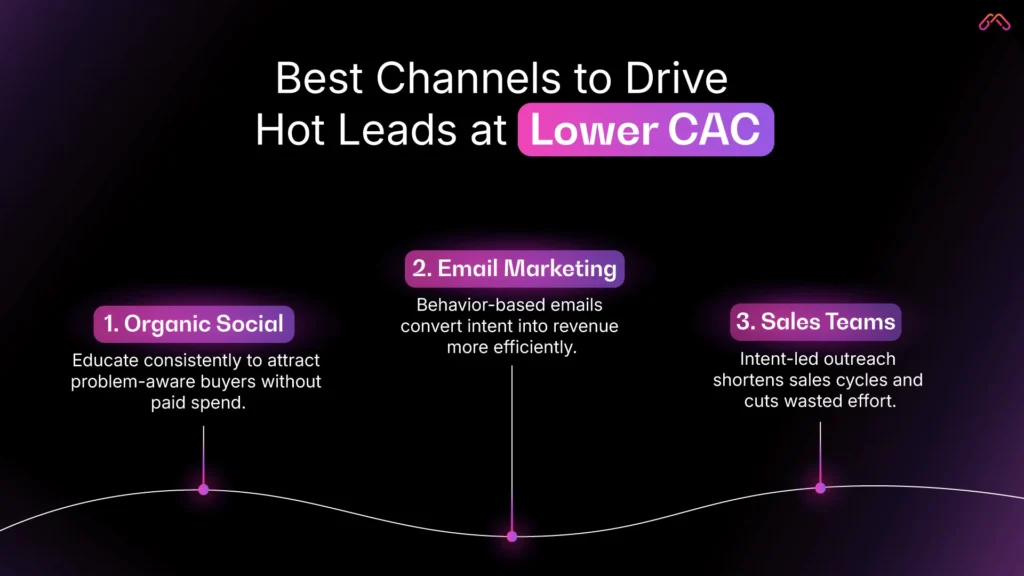
Organic Social
Organic social works because it builds trust before the click. Platforms like LinkedIn and X reward consistency and usefulness, which directly help reduce CAC over time.
Notion grew by sharing short-form templates and use cases, turning comment threads into product invites. Airtable posted tactical tutorials for operations teams, sparking conversations that led to shared bases and paid upgrades.
When organic content educates and proves value, it attracts buyers already problem-aware, lowering CAC without paid spend.
Email Marketing
Email marketing remains one of the most efficient ways to lower CAC. Automated sequences triggered by behavior, not time, deliver higher conversions. The key is segmentation by behavior, not time.
ConvertKit built a creator-focused newsletter that nurtured subscribers with practical playbooks, converting readers through embedded product previews. Mailchimp segmented users by engagement level, triggering automation guides and win-back sequences that revived dormant accounts.
When emails respond to intent signals, they consistently reduce customer acquisition cost across the funnel.
Sales Teams
Sales teams only reduce CAC when they stop chasing everyone. The biggest gains come from aligning outreach with intent data.
Outreach trained reps to send personalized Loom-style videos tied to CRM signals, solving specific pipeline gaps in the first touch. ZoomInfo used enriched data and account-based targeting to focus reps on high-fit buyers, supported by demo walkthroughs.
This approach shortened sales cycles and helped reduce CAC score by prioritizing quality over activity.
Tools & Systems to Lower CAC
Lowering customer acquisition cost doesn’t happen through effort alone. It happens through systems. The right tools remove friction, surface intent, and help you reduce CAC across every touchpoint, without relying on more spend.
Offer & Funnel Tools
Offer and funnel tools exist to eliminate confusion, which is one of the fastest ways to lower CAC. Platforms like Unbounce allow teams to build focused landing pages that guide prospects instead of overwhelming them.
Optimizely helps test headlines, CTAs, and layouts so messaging aligns with buyer intent before scaling. Hotjar then reveals where users hesitate or drop off.
When funnels guide instead of confuse, conversion rates rise, and average CAC drops naturally.
High-Intent Lead Magnets
High-intent lead magnets qualify prospects before sales ever get involved. Tools like Typeform enable quizzes, audits, and calculators that segment leads by pain point, not just email address.
SparkLoop turns newsletters into referral engines, compounding growth at a fraction of the average CAC. Outfunnel gates checklists and audits while tagging users based on responses, making follow-ups more relevant.
This approach consistently helps reduce customer acquisition cost by filtering out low-intent leads early.
Retargeting & Behavior Tracking
Behavior tracking tools are essential if you’re serious about how to reduce CAC. Google Tag Manager allows teams to track scroll depth, video watch time, and CTA clicks instead of vanity metrics.
Mixpanel then maps user journeys and triggers follow-ups when intent spikes, like pricing page visits. Heap automatically captures every interaction, enabling cohort-based retargeting without manual setup.
When retargeting is driven by behavior, not impressions, you lower CAC without increasing spend.
Video Creation & Optimization Tools
Video is one of the highest-leverage tools to reduce CAC because it compresses trust and speeds decisions. Loom enables quick, personalized walkthroughs for sales and support, increasing close rates without extra outreach.
Descript helps repurpose long videos into short clips optimized for retargeting and email.
Professional explainer video services take this further by clearly communicating value, use cases, and differentiation, turning complex offers into scalable sales assets that consistently reduce customer acquisition cost across channels.
3 Common Mistakes That Keep CAC High
Even strong businesses struggle to reduce CAC because they repeat the same avoidable mistakes. These issues don’t look dramatic on dashboards, but they quietly drive customer acquisition costs up over time.
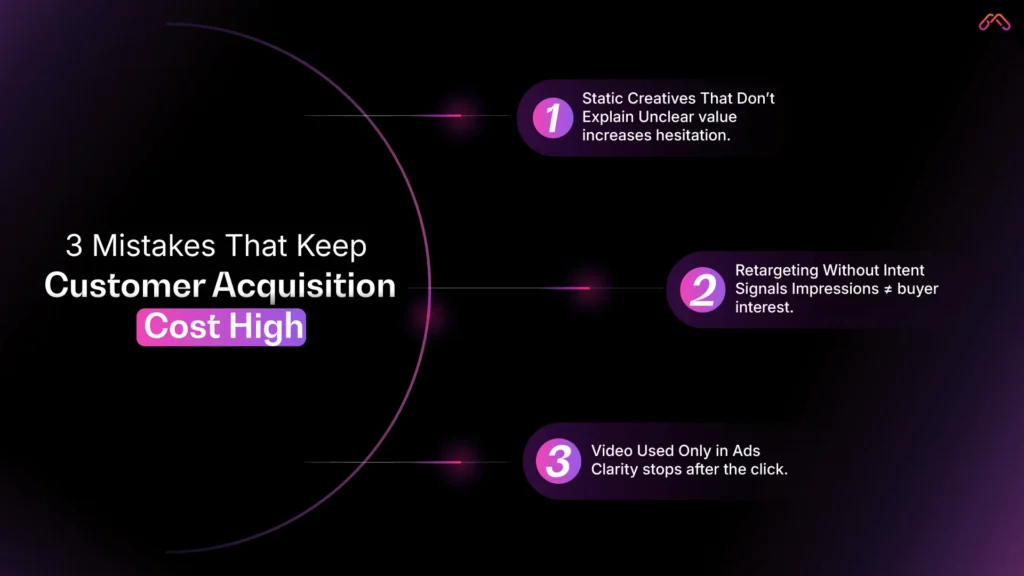
#1 Static Creatives That Don’t Explain Value
One of the biggest reasons companies fail to reduce CAC is relying on static creatives that don’t explain value. A single image and headline rarely answer the real questions buyers have.
What does this do? Who is it for? Why should I trust it?
Motion, narrative, and proof outperform static visuals because they remove uncertainty. When prospects don’t understand the offer quickly, they hesitate, and hesitation always increases customer acquisition cost.
#2 No Behavior-Based Retargeting
Another costly mistake is retargeting based on impressions instead of behavior. Seeing an ad doesn’t equal interest. Yet many teams retarget anyone who “viewed” content, flooding warm audiences with irrelevant follow-ups.
When you ignore signals like video watch time, scroll depth, or CTA clicks, you waste spend on people who were never qualified.
Behavior-based retargeting consistently lowers CAC because it focuses effort where intent already exists.
#3 Video Used Only in Ads
A third issue is limiting video usage to ads only. Video shouldn’t stop at the click. It should live across landing pages, email nurtures, sales follow-ups, onboarding, and even retention flows.
Many companies overlook this, forcing prospects to interpret text-heavy pages on their own. That friction compounds over time, pushing average CAC higher with every touchpoint. Retention costs are 5-25x lower than reacquisition, yet skipping video beyond ads inflates long-term customer acquisition cost.
Explainer videos and walkthroughs shorten decision cycles, build trust faster, and improve conversions. If you’re serious about how to lower CAC, eliminating these mistakes isn’t optional; it’s foundational.
Conclusion
Customer acquisition cost doesn’t spiral because ads stop working. It climbs because clarity breaks down as you scale. When prospects don’t immediately understand your value, trust slows, conversion drops, and CAC quietly creeps up.
The fastest way to reduce CAC is to fix what happens before and after the click: your offer, your messaging, and how clearly you explain the transformation. When clarity improves, every channel performs better and margins stabilize.
That’s exactly where MotionGility’s explainer video services come in. We help SaaS teams turn complex products into simple, compelling stories that reduce friction across the entire funnel.
By clearly explaining the value upfront and reinforcing it through onboarding and nurture flows, our videos improve retention and lower CAC as trust builds faster.
Want the exact system we use?
Get “The 3-Video Funnel We Perfected After Testing 67+ Variations” – a proven TOFU, MOFU, BOFU explainer framework designed to generate cheap warm traffic, turn it into hot leads, and deliver your lowest CAC.
FAQs
What is the CAC strategy?
A CAC strategy defines how you attract, convert, and retain customers efficiently, aiming to reduce CAC by improving funnels, messaging, retention, and overall acquisition efficiency.
How to reduce CAC score?
To reduce CAC score, focus on clearer offers, better targeting, and intent-based follow-ups so you reduce customer acquisition cost and consistently lower CAC across channels.
What is the CAC to LTV ratio?
The CAC to LTV ratio compares customer acquisition cost to lifetime value; a healthy benchmark is 3:1, meaning returns comfortably exceed the average CAC.
What formula is used for CAC?
The CAC formula is total sales and marketing spend divided by new customers acquired, clearly showing customer acquisition cost and helping track changes in average CAC.
What’s one of the most effective strategies to reduce CAC?
One of the most effective ways to reduce CAC is by using an explainer video to clarify value early; MotionGility offers affordable explainer video services that help reduce customer acquisition cost and lower CAC.