Imagine pouring six months of sweat, equity, and caffeine into building a flawless software as a service (SaaS) product. Your code is clean, your user interface is intuitive, and your features solve a massive primary market pain point. You launch on Product Hunt, post organic content on LinkedIn, and wait for the sign-ups to roll in. Instead, you get crickets.
When you look at your analytics dashboard, your website traffic is flat, and your Monthly Recurring Revenue (MRR) is stuck in neutral. If this situation sounds all too familiar, the problem doesn’t lie within your product’s workflow. You are actually dealing with a major low brand awareness issue.
In today’s hyper-saturated B2B and software ecosystem, simply deploying an excellent product isn’t enough. If your target audience doesn’t even know your platform’s name or exact functionality exists, generating a sales pipeline is impossible.
Designing a distinctive, recognizable SaaS brand identity is the exact difference between bleeding your pipeline into market obscurity and scaling your business sustainably.
This comprehensive master guide breaks down the major structural causes behind low brand awareness, how to diagnose them using key growth metrics, and a solid framework to rebuild your presence, featuring the ultimate conversion weapon for software marketing: Explainer Videos.
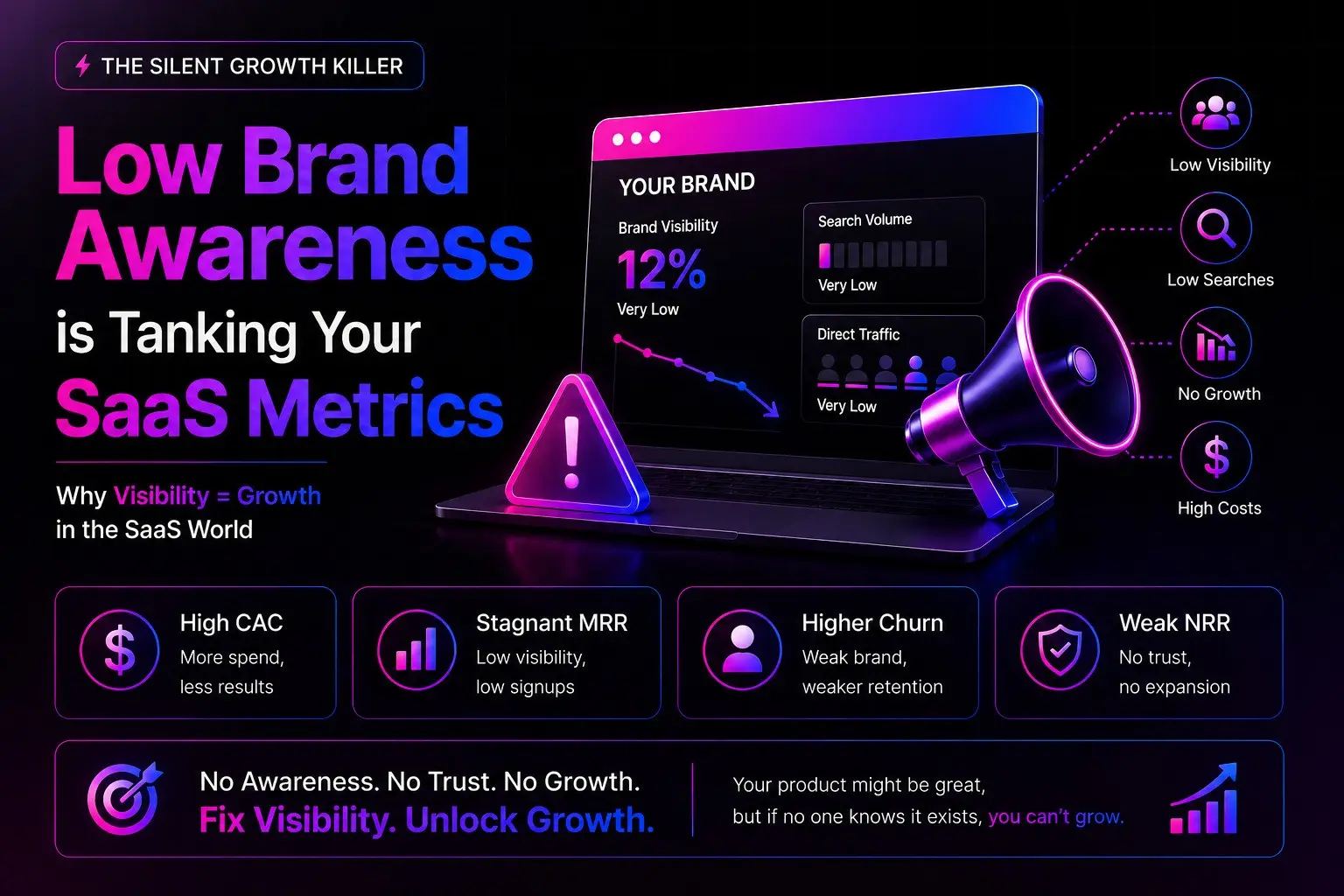
The Silent Growth Killer: Why Low Brand Awareness is Tanking Your SaaS Metrics
Many tech founders treat brand awareness as a vague or non-measurable marketing concept. They prefer to focus their attention on hard, quantitative data like paid acquisition channels or trial-to-paid conversion rates.
However, low brand visibility directly damages your acquisition funnel and essential growth loops at an internal level. When decision-makers and enterprise software buyers do not recognize your brand name, user onboarding and top-of-funnel customer flows lose their operational efficiency.
1. Skyrocketing Customer Acquisition Costs (CAC)
If prospective target users have never heard of your software or platform, your performance marketing ads (Google Ads, LinkedIn Campaigns) have to work twice as hard to convert them. This causes your Click-Through Rate (CTR) to drop, your Cost-Per-Click (CPC) to rise directly, and your structural unit economics to degrade due to a lack of organic distribution.
2. Stagnant Monthly Recurring Revenue (MRR)
To scale a SaaS MRR pipeline at a consistent pace, a steady inflow of high-intent demo requests and trial sign-ups is mandatory. When your platform remains completely anonymous, that user volume is blocked. Conversely, a highly aware market is a responsive one when prospects experience a specific lifecycle pain point; your solution immediately pops up as their first choice.
3. Elevated Churn Rates and Weak Net Revenue Retention (NRR)
Building a brand identity isn’t just about feeding the top of the acquisition funnel; it is about securing long-term enterprise retention loops. A robust, structured branding approach establishes security and stability within active customer accounts.
When users feel they are aligned with an enterprise-grade market leader, lifecycle drop rates are minimized, expanding account growth, and boosting your Net Revenue Retention (NRR) through organic upgrades.
How to Diagnose Your Brand Visibility Problem
Before shifting your software positioning or narrative identity, you must map out your real-time performance baseline. You can easily measure your market validation by analyzing quantitative traffic analytics and key performance indicators:
- Direct Traffic Deficit: Check your Google Analytics reports. If your direct web visitor traffic is virtually non-existent, it is a clear indication that the market is at a zero standalone recall stage.
- Low Branded Search Volume: Track your data using Google Search Console or authoritative platform SEO dashboards (Ahrefs, SEMrush). If recurring monthly search volume for your exact corporate brand name or product query is low, your market visibility is missing.
- Depressed Share of Voice (SOV): Monitor how often your business operations and software niches are mentioned across LinkedIn communities, professional technical forums (Reddit, Stack Overflow), and standard industry directories compared to your direct competitors.
The Conversion Bottleneck: If your traffic numbers look healthy across dynamic distribution pages but initial user conversion metrics are down, it means customer retention is taking a hit due to a missing onboarding workflow visualization.
The Ultimate Solution: Demystifying Complex Software with Explainer Videos
If your brand awareness is low, it’s usually driven by one of two factors: either people aren’t finding your website, or they are landing on your page but leaving immediately because they cannot understand what your software actually does. B2B and SaaS products are inherently complex. If a visitor has to read through text-heavy landing pages to grasp your value proposition, you’ve already lost them.
The single most effective antidote to this problem is a high-converting SaaS explainer video.
[Visitor Lands on Page] ➔ [Views 60-Sec Explainer Video] ➔ [Understands Value] ➔ [Converts]
│
(Boosts Brand Recall by 85%)
Why Video Assets Act as the Core of Modern SaaS Onboarding & Identity
The human brain processes visual vectors and kinetic movement modules significantly faster than plaintext logs or heavy text iterations. A well-scripted, high-fidelity, single-minute explainer video can easily stream your entire complex software infrastructure and cloud operation matrices into a fluid, understandable visual story.
- Humanizing Enterprise Product Workflows: Advanced animation styles, clean interface typography accents, and custom visual storytelling convert sterile engineering steps into relatable software journeys.
- Search engine algorithms prioritize long organic user dwell time as a key ranking signal. In a Dynamic Video-Led SEO Strategy, embedding a high-quality product explainer video above the fold increases session duration and engagement, which naturally improves overall SEO performance.|
Multi-Channel Creative Fuel: You don’t have to keep this asset restricted to your website homepage. These storytelling assets function as a dynamic conversion engine across programmatic LinkedIn campaigns, cross-network target display frameworks, cold outreach sequences, and your visual knowledge bases.
A Step-by-Step Framework to Build a Powerful SaaS Brand Identity
To rectify structural visibility errors, you must move away from simply increasing random marketing content volume and instead design a tactical, visual positioning methodology:
1. Anchor Your Exact Narrative Positioning
Stop trying to build scale systems using vague semantic trends like Next Gen Automated Productivity Engine. Deploy clear, direct core clarity that explicitly identifies your operational target and precise customer niche. Strategic Messaging Example: The automated billing infrastructure built exclusively for subscription-based B2B SaaS companies.
2. Engineer High-Impact Visual Video Explainer Assets
Scale your asset distribution across multiple lifecycle layers of your entire distribution funnel:
- The Hero Landing Placement: Create inline responsive video windows (60 to 90 seconds in depth) right in the main fold area of your organic pages. Before showcasing your product mechanics, display an immediate callout of your primary customer’s dynamic frustrations.
- Micro Social Visual Assets: Slice your original high-end master assets into short, 15-to-30-second hook structures. Adapt these slices specifically for feed consumption on professional platforms (like LinkedIn or Twitter ecosystems) using suitable captions and high-impact visual layers optimized for sound-off viewing.
3. Establish Multi-Platform Design Uniformity
Recognition is tracked through structural familiarity and repetitive visual asset behavior loops. Your brand identity’s tone configuration charts, typography guidelines, strict color scale sets, and motion template parameters must maintain flawless parity across all cross-channel visibility zones to ensure a smooth, friction-free client touchpoint experience.
4. Execute Strategic Video Content Distribution
Synchronize your functional video creation cycles along multiple multi-dimensional delivery vectors to maximize user traction:
Visual Content Distribution Matrix: Maximizing Digital Reach
Marketing | Target Video Format Structure | Primary Campaign Objective | Key Branding Asset Leverage |
SaaS Core Homepage | Hero Structural Explainer (60-90s Master) | Controls landing conversion drops and drives immediate bounce reduction. | Instantly boosts page dwell time parameters and signals core trust value elements. |
Professional LinkedIn Networks | Micro Feature Accents & Visual Slices (15-30s) | Engages key enterprise decision-makers and software platform leaders. | Achieves high-velocity viral reach across professional stakeholder groups. |
High-Intent Search Engines | Structured Video Explainer Embeds on Resource Hubs | Captures high-converting transactional intent keywords organically. | Drives superior domain visibility via rich organic structural video snippet displays. |
Performance Marketing Ad Units | Hook-Driven Iteration Creative Sets (15s Loop) | Drastically drops global CAC metrics by building deep user engagement pools. | Substantially improves system ad-spend efficiency compared to standard static text cards. |
Overcoming Common Pitfalls in SaaS Video Production
While implementing a video-driven design workflow yields highly productive ROI metrics, minor strategy errors can heavily affect your ability to scale:
- Over-Indexing on Engineering Mechanics (Features vs. Outcomes): Enterprise clients do not track your application code components; they calculate your metrics based on direct workflow hours saved or cost leakage protection efficiency. Keep your script Writing parameters focused strictly on user business outcomes.
- Trading Down Aesthetic Vector Polish: Compromised animation outputs, distorted voiceover sound systems, or unpolished design layouts instantly drop your internal brand trust indicators. Maintaining flawless output optimization is a standard system rule for keeping your high-tier architecture validation intact.
Undefined Action Funnels (Missing Call to Action): Every single deployed piece must execute a mandatory tracking design flow. Guide viewers with dynamic, clear actions at the conclusion of your script loops, whether that involves triggering an alpha pre-registration link pipeline, booking a live demo, or tracking an interactive system validation process.
Conclusion
Transforming a low-visibility brand identity profile is not about running random amplification cycles into a digital void; it is about aligning your structural performance mechanisms with extremely transparent, high-velocity visual context maps.
When your system configurations begin executing user visual design layers, onboarding resistance points naturally vanish from your data records.
Optimize your structural actions immediately if your landing interactions reveal a context transfer failure within the first 5 seconds; it is time to trigger a visual parameter update, switch up your execution cycle, and optimize your corporate identity trajectory using clear visual storytelling.
Early Bird Access – Join the Waitlist
We are building the exact Living Video infrastructure that this 2026 report demands. Don’t let your marketing lag behind your product updates.
Priority Access: Skip the queue and be the first to automate your video production before the public launch.
Founder’s Pricing: Secure exclusive, lifetime discounts that will never be offered to the public again.
Strategy Support: To ensure your success, early members receive a free video marketing audit from our expert strategy team.
FAQs
1. What is low brand awareness in SaaS?
Low brand awareness in SaaS means your target audience does not recognize, remember, or search for your software product, making customer acquisition and growth more difficult.
2. Why is brand awareness important for SaaS companies?
Brand awareness helps SaaS companies build trust, improve customer acquisition, increase trial signups, reduce CAC, and grow Monthly Recurring Revenue (MRR) consistently.
3. How can explainer videos improve SaaS brand awareness?
Explainer videos simplify complex software concepts, improve user understanding, increase engagement, and make your SaaS product more memorable across digital channels.
4. What type of explainer video works best for SaaS products?
Short animated product walkthroughs, onboarding videos, feature demos, and problem-solution explainer videos perform best for SaaS marketing.
5. What causes low conversion rates for SaaS websites?
Low conversions are often caused by unclear messaging, weak branding, lack of trust signals, poor onboarding, or failure to explain the product value quickly.
6. What is the fastest way to increase SaaS product awareness?
The fastest way to increase SaaS product awareness is through engaging explainer videos that quickly showcase your product’s value, improve brand recall, and boost conversions.