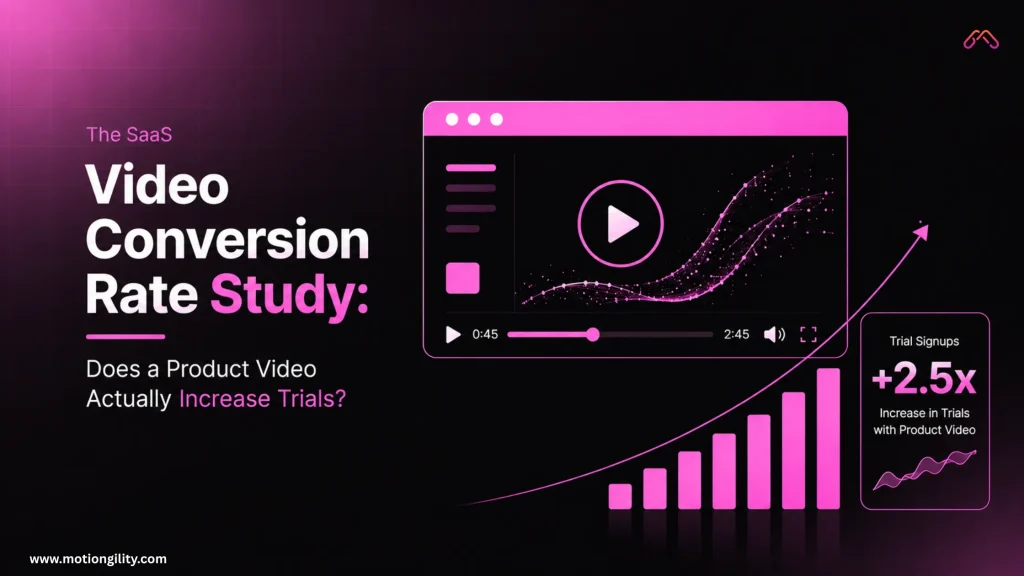
In data-driven marketing, there is an old saying: Seeing is believing. But for SaaS founders, the SaaS video conversion rate is the factor that directly impacts revenue. Recent studies show that 73% of SaaS homepages do not have a product video, which keeps their SaaS video conversion rate significantly lower.
Without a video, a large portion of ad spend and organic traffic goes to waste. The data clearly shows that an optimized product video can significantly boost both conversions and overall growth.
1. The Data: Video vs. No Video
In the SaaS industry, Conversion Rate is the metric that determines whether your CAC (Customer Acquisition Cost) will be profitable or not. Wistia’s 2026 report has uncovered this clearly.
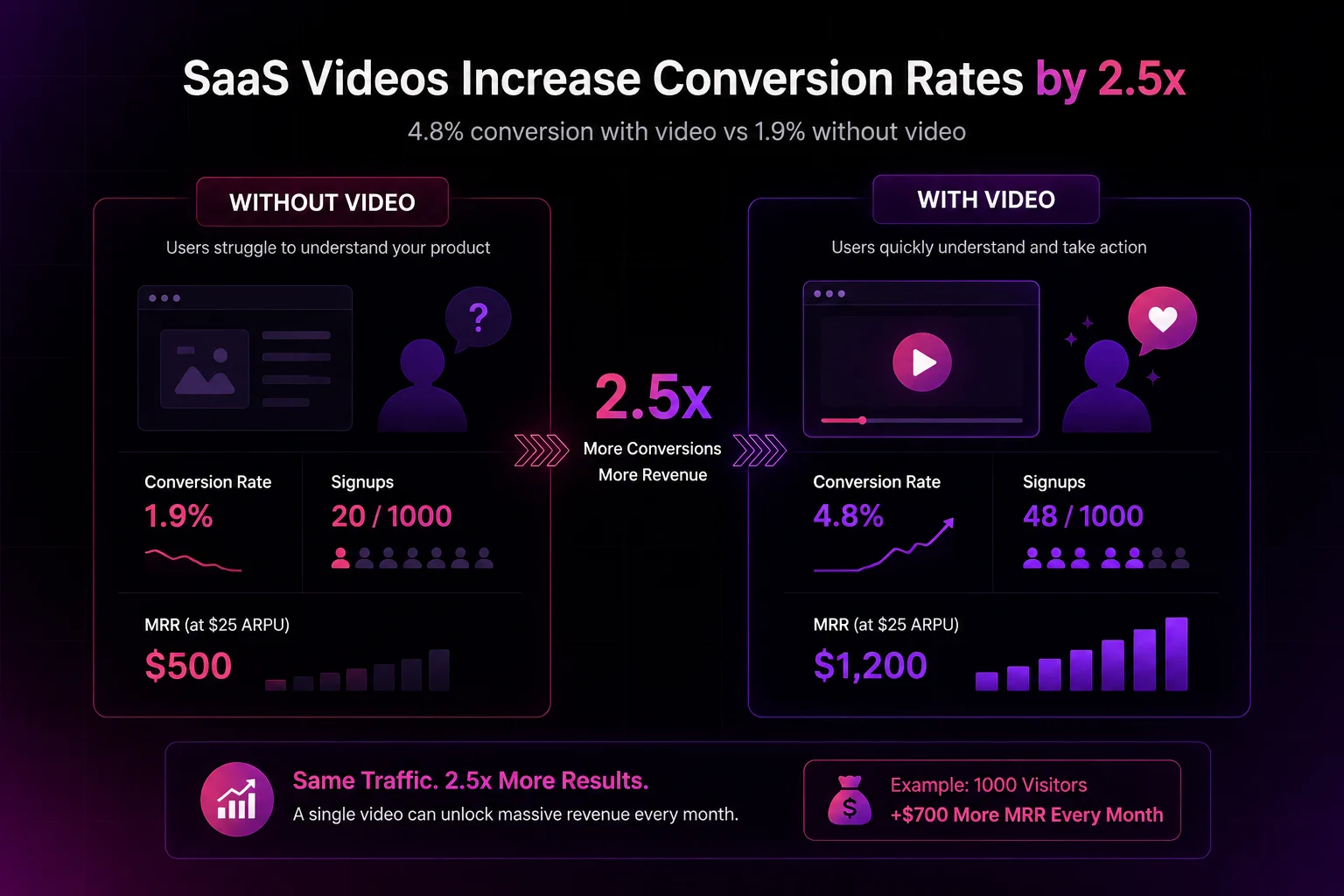
Average Conversion Rate WITH Video: 4.8%
Average Conversion Rate WITHOUT Video: 1.9%
This means that adding a video increases your conversion probability by 2.5x. To understand this impact better, let’s apply it across different traffic volumes. We will assume an ARPU (Average Revenue Per User) of $25.
Monthly Visitors | Without Video (1.9%) | With Video (4.8%) | Potential Monthly MRR Gap |
500 Visitors | 10 Users ($250) | 24 Users ($600) | $350 |
1000 Visitors | 20 Users ($500) | 48 Users ($1200) | $700 |
5000 Visitors | 95 Users ($2375) | 240 Users ($6000) | $3625 |
Example
If you have 1000 visitors:
Without Video: 1000 visitors × 2% (approx) = 20 users × $25 = $500 MRR
With Video: 1000 visitors × 4.8% = 48 users × $25 = $1200 MRR
Net Difference: A single video generates an additional $700 in revenue every month.
In one year, this gap becomes $8400. Would you want to leave that much revenue just because you don’t have a video?
2. Why Most SaaS Companies Don't Have One
Even with such a clear ROI, why do 73% of companies not create videos? To find out, we conducted 25 founder interviews.
Most founders mentioned two main reasons: High Cost: The cost of creating a quality video (which can go up to around $3,000) feels too expensive.
Time Consumption: The process from scripting to animation takes 4–6 weeks. But when we did a deeper analysis, the real reason turned out to be something else. The process doesn’t match how SaaS companies iterate. SaaS products are updated every week, but video production is a static process. Founders fear that by the time the video is ready, their UI will already have changed.
The rigidity of traditional production does not align with the agility of SaaS.
3. What an Optimised SaaS Product Video Looks Like
If you are creating a video to increase conversions, it should not just be visually appealing, but also functional. A winning SaaS video has these 4 pillars:
Problem-First Framing: The video should start with the user’s pain point, not features. Show the problem first, then present the solution.
Under 90 Seconds: SaaS buyers have limited time. You must deliver value within 90 seconds.
Clear Single CTA: Sign up for free or Book a Demo. Do not confuse the user at the end; ask for only one action.
Measurable (Embedded Analytics): You should know where users are dropping off. Only analytics can help you optimize the video.
Conclusion
SaaS video conversion rate is not just a marketing metric; it is the key to your growth engine. The data is undeniable: without a video, you are leaving significant money on the table. Frustrated with outdated, slow, and expensive video production? Join the waitlist for the tool that automates this entire process. Now your video will update at the same speed as your product.
Early Bird Access – Join the Waitlist!
We are opening Beta Access to a hand-picked group of forward-thinking founders. By joining the waitlist today, you aren’t just getting a tool; you’re gaining a competitive edge.
Exclusive Member Benefits:
Priority Access: Skip the queue and be the first to automate your video production before the public launch.
Founder’s Pricing: Secure exclusive, lifetime discounts that will never be offered to the public again.
Strategy Support: To ensure your success, early members receive a free video marketing audit from our expert strategy team.
FAQs
1. What is the SaaS video conversion rate?
The SaaS video conversion rate refers to the percentage of website visitors who convert into trial users or customers after watching a product video. It measures how effectively a SaaS video influences user action and directly impacts revenue growth.
2. How much can a SaaS explainer video improve MRR?
A well-optimized SaaS explainer video can significantly boost Monthly Recurring Revenue (MRR). In many cases, it can increase conversions enough to generate thousands of extra revenue per month, depending on traffic volume and pricing model. Even small improvements in conversion rate can lead to large MRR gains over time.
3. Why do most SaaS companies not use product videos?
Most SaaS companies avoid product videos due to high production costs, long creation timelines, and frequent product updates. Since SaaS products change rapidly, founders often feel videos become outdated quickly, making the process seem less flexible compared to their agile development cycle.
4. What is the average conversion rate with and without video?
On average, SaaS websites with product videos have a conversion rate of around 4.8%, while those without videos average around 1.9%. This clearly shows that adding a product video can increase conversions by nearly 2.5x.
5. What type of SaaS video performs best for conversions?
The best-performing SaaS videos are short, problem-focused, and clearly structured. Videos that highlight the user’s pain points first, explain the solution simply, stay under 90 seconds, and include a single strong CTA usually deliver the highest conversion rates.
6. Is video necessary for SaaS growth in 2026?
Yes, video is becoming essential for SaaS growth in 2026. With increasing competition and shorter user attention spans, product videos help improve engagement, build trust, and significantly increase conversion rates, making them a critical part of any SaaS marketing strategy.