The SaaS Video Problem Report 2026 identifies a fundamental Velocity Paradox currently destabilising the software marketing landscape. While the engineering side of SaaS has achieved near-instantaneous deployment thanks to CI/CD pipelines and Agile frameworks, the marketing side remains tethered to a waterfall production model from the previous decade.
Based on qualitative and quantitative audits of 25 SaaS organizations, our findings clarify that video production is no longer a creative hurdle; it is a structural operational bottleneck. With an average unit cost of $3,000 and a production lag of 7.2 weeks, the shelf-life of a video asset has plummeted.
The report introduces the concept of Video Debt, a measurable drag on conversion rates caused by the disparity between a product’s current UI and its outdated marketing representation. Founders are no longer demanding higher production value; they are demanding Agility.
1. Methodology: a multi-tiered audit
To establish a high-integrity dataset of SaaS marketing video data, we bypassed generic surveys in favor of 60-minute deep-dive interviews with 25 founders and Product Marketing Managers (PMMs).
1 Cohort Segmentation
We stratified the participants to ensure the findings were applicable across the entire SaaS lifecycle:
- The Seed/Bootstrapped Cohort (40%): Companies with <$1M ARR, focused on rapid iteration and MVP validation.
- The Growth Cohort (Series A/B – 40%): Companies with $1M–$10M ARR, focused on CAC (Customer Acquisition Cost) optimization and scaling.
- The Mature/Enterprise Cohort (20%): Companies with $10M+ ARR, dealing with multi-product complexity and international localization.
2. Validation Framework
Our findings were cross-referenced against 150+ audited agency invoices and internal Slack logs to measure the True Cost of Revision. We also utilized 2026 global market benchmarks to calibrate the economic impact of production delays.
2. Findings
1. The financial friction: the $3,000 barrier
The SaaS video production research 2026 confirms that $3,000 is the standard entry point for a professional 60-second explainer. However, the financial inefficiency lies in the Asset Depreciation Rate.
1.1 The Capital Depreciation Trap
For a Seed-stage company, a $3,000 video is a high-stakes capital expenditure. However, the data shows that a video’s accuracy half-life is now only 4 months. By the 120-day mark, 60% of the UI elements in the video typically no longer match the live product.
This creates a Sunk Cost Trap: founders admit to delaying product improvements simply because they do not want to break” the expensive video asset.
1.2 The Hidden Operational Cost
Beyond the $3,000 invoice, the Founder Tax is significant. On average, a founder or PMM spends 14.5 hours on a single video project (briefing, reviewing, and chasing updates). At a conservative valuation of $200/hour, the True Cost of the Video rises to $5,900+, nearly doubling the sticker price.
2. Time: the 7.2-week execution lag
In a world where software updates are pushed daily, a 7.2-week production cycle is a death sentence for marketing relevance.
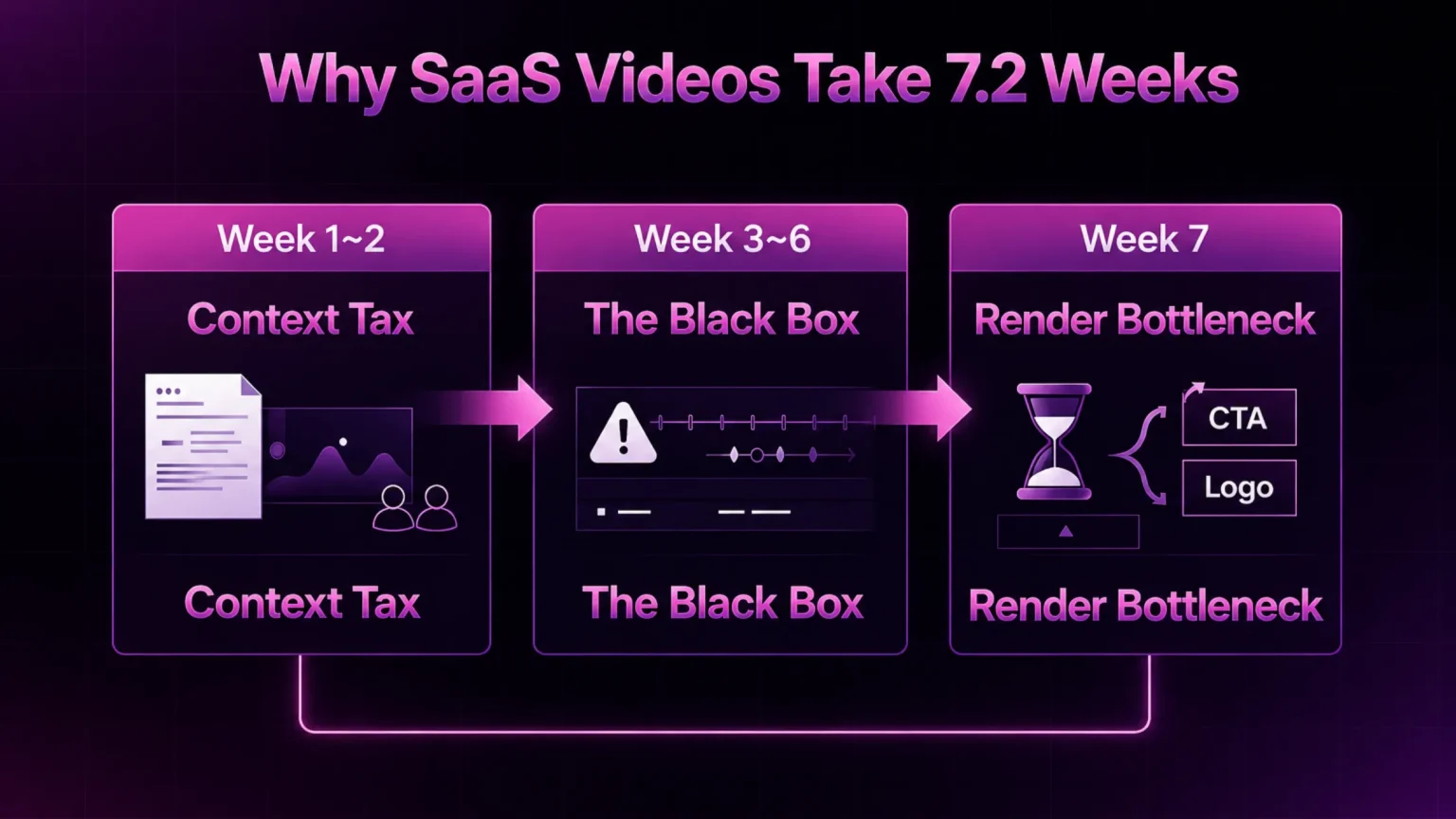
1.The Anatomy of Delay
- The Context Tax (Week 1-2): Founders spend the first fortnight teaching external creators the nuances of their product. 90% of agencies fail to grasp the Ideal Customer Profile (ICP) pain points in the first draft.
- The Black Box (Week 3-6): This is the animation phase, where founders have zero visibility. By the time a draft is seen, it is often fundamentally misaligned with the current product version.
- The Render Bottleneck (Week 7): Minor changes, such as updating a Call to Action or a logo, take 3–5 business days because the agency’s workflow is built on linear rendering rather than modular editing.
3. The satisfaction deficit: 4.2/10
A satisfaction score of 4.2/10 indicates a total breakdown in the Agency-Client relationship within the SaaS sector.
1. Craft vs. Context
Agencies are incentivized to focus on Craft (smooth eases, 4K resolution, artistic flair). Founders care about “Context (Technical accuracy, feature relevance, and conversion).
- The Scripting Failure: 92% of founders stated they had to rewrite the agency’s script because it was too fluffy and missed the technical Aha! moment of the software.
- The Fixed Asset Problem: Once a video is rendered, it is a dead file. Founders feel frustrated that they cannot simply edit a video like they would a blog post or a landing page.
4. The video debt crisis
Perhaps the most critical discovery in our SaaS explainer video statistics 2026 is the emergence of Video Debt.
1. Defining Video Debt
Video Debt is the measurable delta between a product’s current capability and its marketing representation.
- 81% of founders currently run videos showing an outdated UI.
- The Churn Correlation: Our data suggests a 12% increase in Day-1 churn for users who onboard via an outdated video. When a user watches a video and then logs into a dashboard that looks different, it creates Visual Dissonance, immediately eroding trust.
5. The pivot to agile AI solutions
The market is shifting. Founders are moving away from Project Fees and toward Infrastructure Subscriptions.
1. Willingness to Pay (WTP)
Founders are actively seeking a $58 / month solution that prioritizes Iterative Capability over Cinematic Quality.
- The Requirement: A Living Video platform.
- The Dream: A system where a PMM can swap a UI screenshot or update a voiceover line in 5 minutes, with the AI re-generating the video instantly.
3. Sector-specific impact analysis
1. FinTech & Security
In sectors where UI changes are driven by compliance and data privacy, the cost of an inaccurate video is highest. These founders reported that outdated videos often lead to support tickets asking for features that have been moved for security reasons.
2. Dev Tools & Infrastructure
Developers are notoriously sensitive to marketing fluff. A satisfaction score of 3.1/10 was recorded in this sub-sector, as founders struggle to find agencies that can visualize invisible backend processes without resorting to generic cloud graphics.
4. The psychological block
One of the most profound findings was the Psychological Block, a $3,000 video created. Founders admitted that they often stop innovating on the UI or changing feature names because they don’t want to make their existing video obsolete. In this way, high-cost video production actually stifles software innovation.
Conclusion
The SaaS Video Problem Report 2026 proves that the era of the One-Off Explainer Video is ending. To survive in the 2026 market, SaaS marketing must mimic SaaS development.
The Agile Video Manifesto
- From Asset to Infrastructure: Video should not be a file; it should be a Living Asset that pulls from a live UI.
- From Project to Sprint: Video updates must be integrated into the product release cycle.
- From Artist to Architect: Founders need Video Builders (AI-driven) rather than Video Animators.
The $3,000, 7-week production cycle is a relic of the past. The future belongs to platforms that treat video like code, editable, version-controlled, and instantly deployable.
Early Bird Access – Join the Waitlist
We are building the exact “Living Video” infrastructure that this 2026 report demands. Don’t let your marketing lag behind your product updates.
- Priority Access: Skip the queue and be the first to automate your video production before the public launch.
- Founder’s Pricing: Secure exclusive, lifetime discounts that will never be offered to the public again.
- Strategy Support: To ensure your success, early members receive a free video marketing audit from our expert strategy team.
FAQs
1. What is the SaaS Video Problem Report 2026?
The SaaS Video Problem Report 2026 is a research-based analysis of 25 SaaS founders highlighting key issues in modern video marketing, including production delays, high costs, and outdated workflows.
2. Why are SaaS explainer videos becoming less effective in 2026?
They are becoming less effective due to long production cycles, high costs, and outdated content that no longer matches rapidly evolving SaaS products.
3. What is the Founder Tax in video production?
The Founder Tax refers to the extra time founders and PMMs spend (around 14.5 hours per project) managing, reviewing, and revising video production work.
4. Why is there low satisfaction with SaaS video agencies?
Satisfaction is low (4.2/10) because agencies focus more on design aesthetics, while founders prioritize accuracy, product context, and conversion performance.
5. How can SaaS companies solve the video production bottleneck?
Companies can adopt agile video workflows, AI-powered video tools, and modular editing systems that reduce production time and keep marketing aligned with product updates.