A SaaS product can offer powerful features, an easy-to-use interface, and a strong value proposition, yet many businesses still struggle to turn website visitors into customers.
Visitors may explore a website, read about the product, and even compare it with other solutions, but they may leave without requesting a demo, starting a trial, or contacting the sales team.
In many cases, the challenge is not the quality of the software. The bigger challenge is communicating its value quickly and clearly. When a product has multiple features, workflows, integrations, or technical capabilities, a simple block of website copy may not be enough to explain how everything works.
This is where a SaaS product video can help. Instead of asking potential customers to read several sections of content, a product video can visually demonstrate the software, explain its benefits, and show how it solves a specific problem.
By combining visuals, narration, product demonstrations, and storytelling, SaaS companies can make complex software easier to understand.
Video has also become an important part of modern marketing. According to Wyzowl’s 2026 research, 91% of businesses use video for marketing, while 93% of video marketers say video helps users understand a product or service better.
However, the purpose of a product video should not be limited to promoting software. A successful video should help the audience understand the product, recognize its value, build confidence, and take the next step.
What Is a SaaS Product Video?
A SaaS product video is a marketing or communication video created to explain a software product, its features, use cases, benefits, or overall value proposition.
Depending on the objective, it can use different formats, including product demonstrations, animated explainers, screen recordings, motion graphics, or a combination of these approaches.
For example, a SaaS product demo video can focus on showing how a user completes a particular task inside the software. In comparison, a SaaS product explainer video may focus more on the customer’s problem, the solution, and the reason the product is useful.
The video can also change depending on where the viewer is in the buying journey. A first-time website visitor may need a short introduction to understand what the software does.
A prospect who has already shown interest may need a detailed product demonstration, while an existing trial user may need a video explaining a particular feature.
Therefore, every SaaS product video should have a clear communication objective. The goal should not simply be to display as many features as possible. Instead, the video should explain the information that the specific audience needs to move forward.
5 Benefits of Using a SaaS Product Video
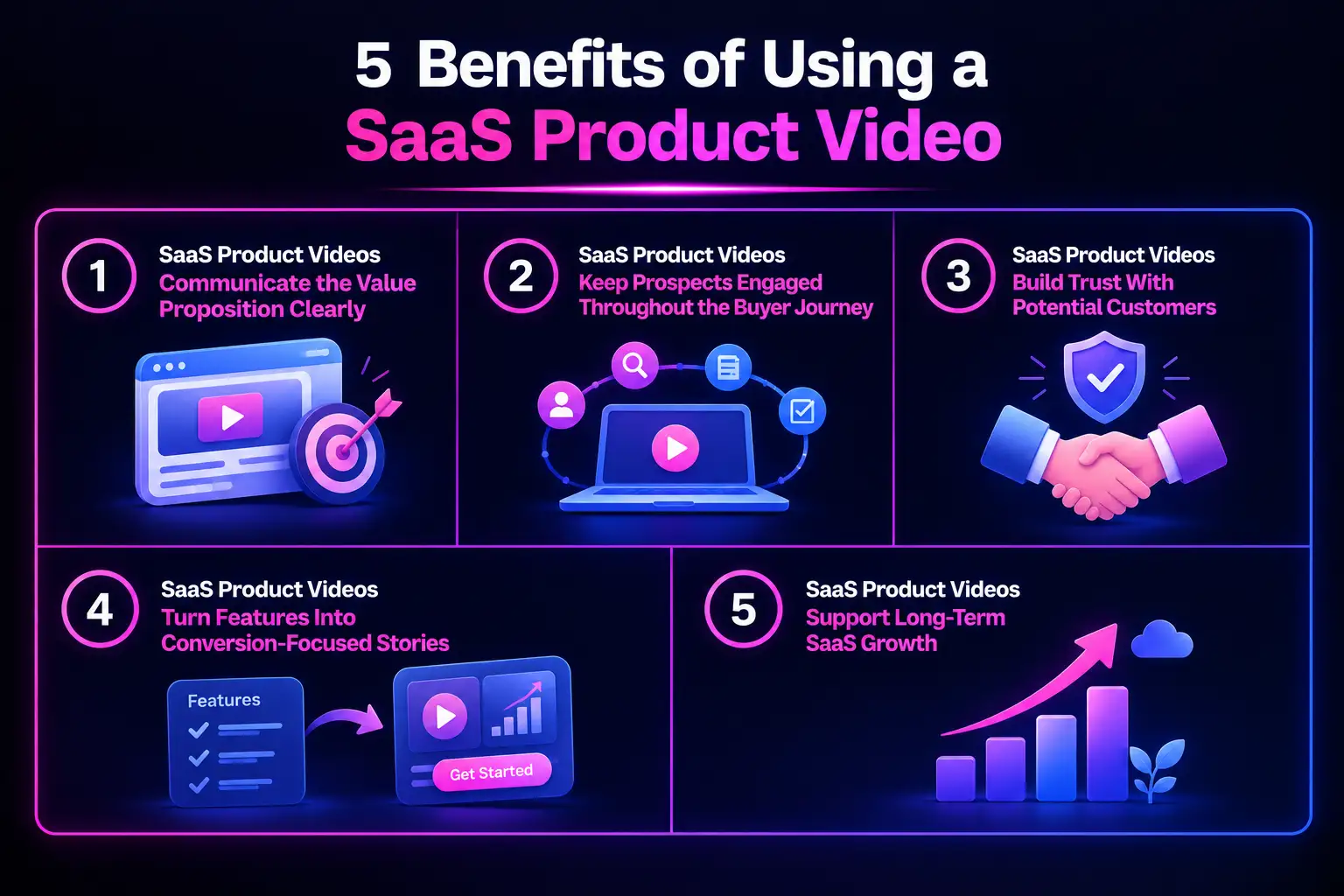
1. SaaS Product Videos Communicate the Value Proposition Clearly
One of the biggest challenges SaaS companies face is explaining why their product matters. SaaS software can be complex, and its benefits may not always be obvious to someone seeing the product for the first time.
A visitor may understand individual features but still fail to see how those features solve their actual problem.
A well-planned SaaS product video can make this explanation much easier.
Instead of relying entirely on written descriptions, the video can combine visuals, narration, and product demonstrations to explain the product in a more natural way.
Show the Value, Not Just the Features
Many SaaS companies make the mistake of creating feature-focused videos. Although product features are important, simply listing them does not necessarily convince a prospect to take action.
For example, a project management platform may have real-time collaboration and remote task management. A feature-focused video might simply explain that these functions are available.
A stronger video would show how those features help a distributed team assign work, communicate with colleagues, track deadlines, and complete projects more efficiently. The second approach gives the feature a purpose because it connects the software capability with a real business problem.
This is especially important for a SaaS software product video because potential customers are usually interested in outcomes rather than features alone. They want to know how the software can make their work easier, solve an existing problem, or improve their current process.
When the product story focuses on benefits, viewers can understand the reason behind the product instead of simply memorizing a list of features.
2. SaaS Product Videos Keep Prospects Engaged Throughout the Buyer Journey
Attracting visitors to a SaaS website is only the beginning. The next challenge is keeping those visitors engaged long enough to understand the product and decide whether they want to take the next step.
Long website pages can contain valuable information, but not every visitor will read every paragraph. Some people may prefer a visual explanation, especially when the product involves complex workflows or technical processes.
A SaaS product video can make this experience more engaging by combining product visuals, narration, demonstrations, and storytelling. Instead of presenting all the information through written content, the video gives visitors a more direct way to understand the software.
According to Wyzowl’s 2026 research, 82% of marketers reported that video helped keep website visitors engaged, while 85% said video marketing increased lead generation.
These results do not mean that every video will automatically increase conversions, but they demonstrate why video has become an important part of the marketing journey.
Where Should You Place a SaaS Product Video?
The best placement depends on what the visitor needs to understand.
A homepage video can introduce the product and communicate its main value proposition.
A feature page can use a product demonstration to explain a particular capability. A pricing page can use a short video to explain the value of different plans or help users understand what they receive.
The same video can also support other marketing channels. SaaS companies can use product videos in email campaigns, social media posts, paid advertisements, sales presentations, product launches, and customer education.
This means the video does not have to perform only one job. With the right planning, it can support different stages of the customer journey.
Turn One Product Video Into Multiple Marketing Assets
A well-produced product video can also be repurposed into shorter pieces of content. For example, a longer product video can provide short clips for LinkedIn, YouTube Shorts, Instagram, email campaigns, or paid advertising.
This approach can be especially useful for startups that do not have the resources to create completely different videos for every platform. One central product story can be adapted into several formats while maintaining consistent messaging and branding.
The important thing is to adapt the content according to the platform rather than simply uploading the exact same video everywhere.
3. SaaS Product Videos Build Trust With Potential Customers
Before choosing a SaaS product, prospects often conduct significant research. They may explore the website, compare competitors, request a product demo, read reviews, and speak with the sales team before making a decision.
A product video can support this research process by giving prospects a clearer understanding of how the software actually works. When viewers can see the product in action, they can better understand what they can expect from the software.
Demonstrate How the Software Works
One of the best ways to reduce uncertainty is to show the product instead of only describing it.
For example, a CRM company can create a video showing how sales teams store customer information, update records, track deals, monitor the sales pipeline, and identify problems.
This gives prospects a practical understanding of how the software fits into their daily work.
For B2B SaaS companies, this type of demonstration can be particularly useful because business buyers often need more information before choosing a new software solution.
The more clearly the video demonstrates the product’s actual use, the easier it becomes for prospects to evaluate whether the software is relevant to their needs.
Professional Quality Strengthens Brand Credibility
The production quality of a product video also affects the viewer’s overall experience. A confusing script, inaccurate product information, poor audio, or distracting visuals can make it harder for the audience to understand the software.
On the other hand, a professionally planned video can present the product in a clear and consistent way. The script, animation, voiceover, product visuals, pacing, and branding should all work together to communicate the same message.
According to Wyzowl’s 2026 research, 89% of consumers report that video quality affects their perception of a brand, while 63% prefer learning about a product or service through a short video.
For SaaS companies, this means production quality should support communication rather than exist only for visual appeal.
4. SaaS Product Videos Turn Features Into Conversion-Focused Stories
A product video can show dozens of features, but showing more features does not automatically make the video more persuasive.
If viewers cannot understand why those features matter, they may finish the video without seeing the product’s real value.
A better approach is to connect important features with specific customer problems and benefits.
Connect Features With Real Benefits
Suppose an analytics SaaS company has developed an intelligent reporting module. A feature-focused video might simply tell viewers that the software includes advanced reporting.
A conversion-focused video could show a marketer using the reporting module to monitor campaign performance, identify an underperforming campaign, and make better decisions based on the available data.
The second approach creates a story around the feature. It helps the audience understand how the product can support their work instead of simply telling them that the feature exists.
This is particularly important for a B2B SaaS product video, where buyers often want to understand the practical business value behind the software.
Give Viewers One Clear Action
Even a well-produced product video needs a clear call to action. Without a CTA, viewers may understand the product but still be unsure about what they should do next.
The CTA should match the viewer’s position in the buyer journey.
A first-time visitor may be encouraged to explore the product or learn more.
A highly interested prospect may be ready to request a demo or schedule a sales call.
A visitor on a pricing page may be encouraged to select a plan or start a trial.
The CTA should also match the platform. Someone watching a video on YouTube may need to visit the website, while someone watching the same video on a product page may already be ready to request a demo.
A focused CTA gives the video a clear business purpose and connects the content with the next stage of the conversion journey.
5. SaaS Product Videos Support Long-Term SaaS Growth
A SaaS product video can continue providing value after its initial publication. Instead of using it only on a homepage, companies can repurpose it across marketing, sales, product education, and customer communication.
For example, a product video can appear on a website, be included in an email campaign, support a sales presentation, or be divided into shorter clips for social media.
This makes a product video a reusable marketing asset rather than a one-time campaign piece.
According to Wyzowl’s 2026 research, 92% of marketers plan to increase their video marketing budget in 2026, while 83% of video marketers report that video marketing has directly contributed to increased sales.
However, these results should not be interpreted as a guarantee that every SaaS product video will generate sales. Performance depends on factors such as the audience, product, messaging, distribution, landing page, and CTA.
When Should a SaaS Company Create a Product Video?
A SaaS company should consider creating a product video when its software is difficult to explain through text or static images. Video can also be useful when sales teams repeatedly spend time explaining the same product concepts to prospects.
Another useful situation is when a company is receiving website traffic but visitors are not engaging with the product or moving toward conversion.
A product video can also support a product launch, investor presentation, social media campaign, email marketing, or sales enablement strategy.
Startups can use it to introduce a new software product, while established SaaS companies can use it to explain a major product update or promote a new feature.
The important point is to start with a specific business need rather than creating a video simply because video is popular.
What Does a SaaS Product Video Cost?
The cost of a SaaS product video depends on several factors, including animation complexity, video length, script development, product complexity, voiceover, design, editing, and the number of revisions required.
According to MotionGility’s published guidance, the average cost of a SaaS product video is between $5,000 and $10,000 per minute. The final cost can vary depending on the project’s animation style, product requirements, video length, and editing needs.
This should be treated as a project guideline rather than a fixed industry-wide price. A simple screen-recording-based video and a highly customized animated product video will naturally have different production requirements.
Therefore, SaaS companies should evaluate the expected business value alongside the production cost. The right budget depends on the target audience, marketing objective, product complexity, and how many channels the final video will support.
How to Create a High-Converting SaaS Product Video
Creating a high-converting product video starts with the message rather than the animation.
Before choosing a visual style, a SaaS company should identify its ideal customer and understand the main problem that customer is trying to solve.
A technical buyer may want detailed product information, while a business decision-maker may care more about efficiency, outcomes, and business value.
Once the audience and problem are clear, the video can follow a simple structure:
Problem → Solution → Product → Benefits → CTA
This structure helps the audience understand why the product exists, how it works, what value it provides, and what they should do next.
Choose the Right Visual Style
The visual approach should depend on the product and audience.
An animated SaaS product video can be useful when the software is difficult to explain visually, when the company needs greater creative freedom, or when the product story requires concepts that cannot easily be shown through a screen recording.
A screen recording, on the other hand, can be more effective when the actual software interface is the most important part of the explanation.
The choice should therefore depend on the product’s complexity, audience, budget, and communication objective rather than simply choosing the most visually impressive style.
How Long Should a SaaS Product Video Be?
There is no single ideal length for every product video. A short homepage video may only need to explain the core value proposition, while a detailed product demo may require considerably more time.
According to Wyzowl’s 2026 research, 71% of marketers believe the ideal video length is between 30 seconds and two minutes. However, the appropriate length should ultimately depend on the video’s purpose and the amount of information the audience needs.
The priority should always be clarity. A video should be long enough to explain the important information but short enough to avoid unnecessary details.
SaaS Product Video Examples: What Should You Look For?
When researching SaaS product video examples, companies should look beyond animation quality and special effects.
A visually impressive video may still fail if the audience cannot understand the product, its benefits, or the next step they should take.
When evaluating examples, ask:
- Does the opening immediately explain the problem or value?
- Is the product information easy to understand?
- Are the benefits clearly explained?
- Does the video focus on customer needs rather than only features?
- Are the product visuals relevant to the message?
- Does the video have a clear CTA?
- Does the CTA match the target audience?
- Is the structure easy to follow?
- Are special effects used only when they support the message?
MotionGility’s SaaS video services feature product and explainer videos for SaaS brands, including Timely, Plutus, Vybe, and Incedo.
These examples demonstrate how different SaaS products can be presented through different visual storytelling approaches.
Why Work With a SaaS Product Video Production Company?
Producing a professional SaaS product video involves several stages. The process can include audience research, messaging, script development, storyboarding, visual design, animation, voiceover, editing, and revisions.
For a complex SaaS product, handling all these stages internally can require significant time and specialized skills. A professional production company can help translate technical product information into a story that is easier for the target audience to understand.
This can be particularly valuable when the product has complicated workflows or when the internal team spends a significant amount of time explaining the same concepts to prospects.
MotionGility’s SaaS video services focus on product and explainer videos, marketing videos, and product onboarding. The company also showcases SaaS video examples and provides pricing guidance for SaaS video production.
The goal should not simply be to create a visually polished video. The production should support the actual business objective by communicating product value, addressing customer needs, and encouraging the right next action.
Conclusion
A SaaS product may have excellent features, but those features only create value when potential customers understand them.
A well-planned SaaS product video can make that communication easier by combining product demonstrations, storytelling, visuals, and clear messaging.
It can help explain complex software, engage website visitors, build trust, connect features with customer benefits, and guide prospects toward the next stage of the buying journey.
The key is to create the video around a specific business objective rather than simply showcasing the software. Start by understanding the audience, identify the problem they want to solve, communicate the product’s value clearly, and finish with a relevant CTA.
When these elements work together, a product video becomes more than a marketing asset. It becomes a useful part of the SaaS company’s overall sales and marketing strategy.
If your SaaS product is difficult to explain through text alone, a professional product video can help turn that complexity into a clear and engaging story.
FAQs About SaaS Product Videos
What Is a SaaS Product Video?
A SaaS product video is created to demonstrate a software product, explain its benefits and features, or communicate its overall value proposition. It can take different forms, including animated explainer videos, product demo screen recordings, marketing videos, or a combination of these formats.
How Can a SaaS Product Video Help Increase Conversions?
A SaaS product video can help visitors understand the software, see its benefits, build confidence in the product, and take a specific action. However, its performance depends on the audience, message, product, distribution strategy, landing page, and CTA.
What Should a SaaS Product Video Contain?
A SaaS product video should generally explain the audience’s problem, introduce the product as a solution, communicate relevant benefits, demonstrate important features when necessary, and provide a clear CTA. The exact structure should depend on the video’s purpose and target audience.
How Long Should a SaaS Product Video Be?
There is no fixed duration that works for every SaaS product video. A homepage video may be short, while a detailed product demo can require more time. Wyzowl’s 2026 research reports that 71% of marketers consider 30 seconds to two minutes an ideal range, but the appropriate length depends on the video’s objective.
How Much Does a SaaS Product Video Cost?
The cost depends on factors such as animation style, product complexity, script, voiceover, video length, design, and editing. MotionGility’s published guidance places the average cost at approximately 5,000–10,000 per minute, although the final price can vary according to individual project requirements.