Getting people to notice a brand is becoming harder. Every day, audiences scroll through social media posts, advertisements, emails, product videos, and content from competing brands.
With so much information competing for attention, businesses need a way to communicate their message quickly without making it feel rushed or confusing.
This is where visual storytelling can make a difference.
Instead of relying only on long paragraphs or static graphics, businesses can use video to explain what they offer and why it matters.
Animated marketing videos are particularly useful because they allow brands to turn complex ideas into simple visual stories.
A SaaS company, for example, can show how its software works without filming an entire office or product demonstration.
A financial company can use animation to simplify complicated processes. A startup can introduce its product through characters, illustrations, motion graphics, and storytelling.
Video has also become a major part of modern marketing. Wyzowl’s 2026 video marketing research reports that 91% of businesses use video as a marketing tool, while 93% of video marketers say video helps increase brand awareness.
However, animation alone does not make a marketing campaign successful. The message, audience, visual identity, distribution, and call to action all matter.
So, how can businesses use animation to make their brands easier to recognize and remember?
What Makes Animated Marketing Videos Different?
Animated marketing videos use animation, illustrations, motion graphics, characters, typography, or visual effects to communicate a marketing message.
Their biggest advantage is creative flexibility.
With live-action video, production often depends on physical locations, actors, products, cameras, and other elements.
Animation removes many of these limitations. A creative team can build almost any environment needed to explain an idea.
For example, a software company can show data moving through different parts of its platform. A fintech company can visually explain a payment process.
An AI company can represent an invisible technology through simple graphics and motion.
This makes animation especially useful for businesses selling products or services that are difficult to demonstrate through traditional footage.
Animated content can also be adapted for different marketing purposes, including:
- Brand introduction videos
- Product promotion videos
- Marketing explainer videos
- Social media content
- Paid advertisements
- Product launch campaigns
- Website videos
- Corporate communication
- Educational marketing content
The important thing is to choose animation because it helps communicate the message—not simply because it looks attractive.
Where Can Brands Use Animated Marketing Videos?
One reason businesses invest in animated video marketing is its flexibility. The same core idea can often be adapted for different stages of the customer journey.
On the Website
A website visitor may not read every paragraph on a product page. A short animated video can introduce the product and explain its main value proposition in a more visual format.
For example, a SaaS company could place an animated product video near its main website content.
Instead of asking visitors to understand the software through screenshots and technical descriptions, the video can show the problem, introduce the solution, and demonstrate the basic workflow.
This can make the first interaction with a brand easier to understand.
On Social Media
Social media is built around fast-moving content. Brands often have only a few seconds to communicate why something is worth watching.
Animated marketing videos for social media can highlight a product feature, answer a common customer question, share an educational idea, or introduce a campaign.
A longer video can also be divided into several shorter clips. This gives marketers multiple pieces of content while keeping the central message consistent.
However, the video should be adapted to each platform. A horizontal website video may need different framing, pacing, captions, and composition when converted into a vertical social media video.
In Digital Advertising
Animation can also be useful in paid advertising campaigns.
Animated advertising videos can introduce a customer problem, present a solution, and end with a clear CTA.
Since advertisements compete heavily for attention, the message should be focused instead of trying to explain every product feature.
For example, a business software company could create a short advertisement showing how its platform helps reduce repetitive manual work.
The goal is not to explain the entire software. It is to create enough interest for the viewer to visit the website or request more information.
During Product Launches
Launching a new product often requires explaining something unfamiliar.
An animated promotional video can introduce the product, highlight its benefits, and establish a visual identity for the campaign.
This is particularly useful when the product is technical, digital, or difficult to demonstrate through traditional footage.
A consistent animation style can also be reused across launch advertisements, landing pages, presentations, and social media content.
Choosing Between 2D, 3D, and Motion Graphics
There is no single animation style that works for every business.
The right approach depends on the product, audience, brand identity, and marketing objective.
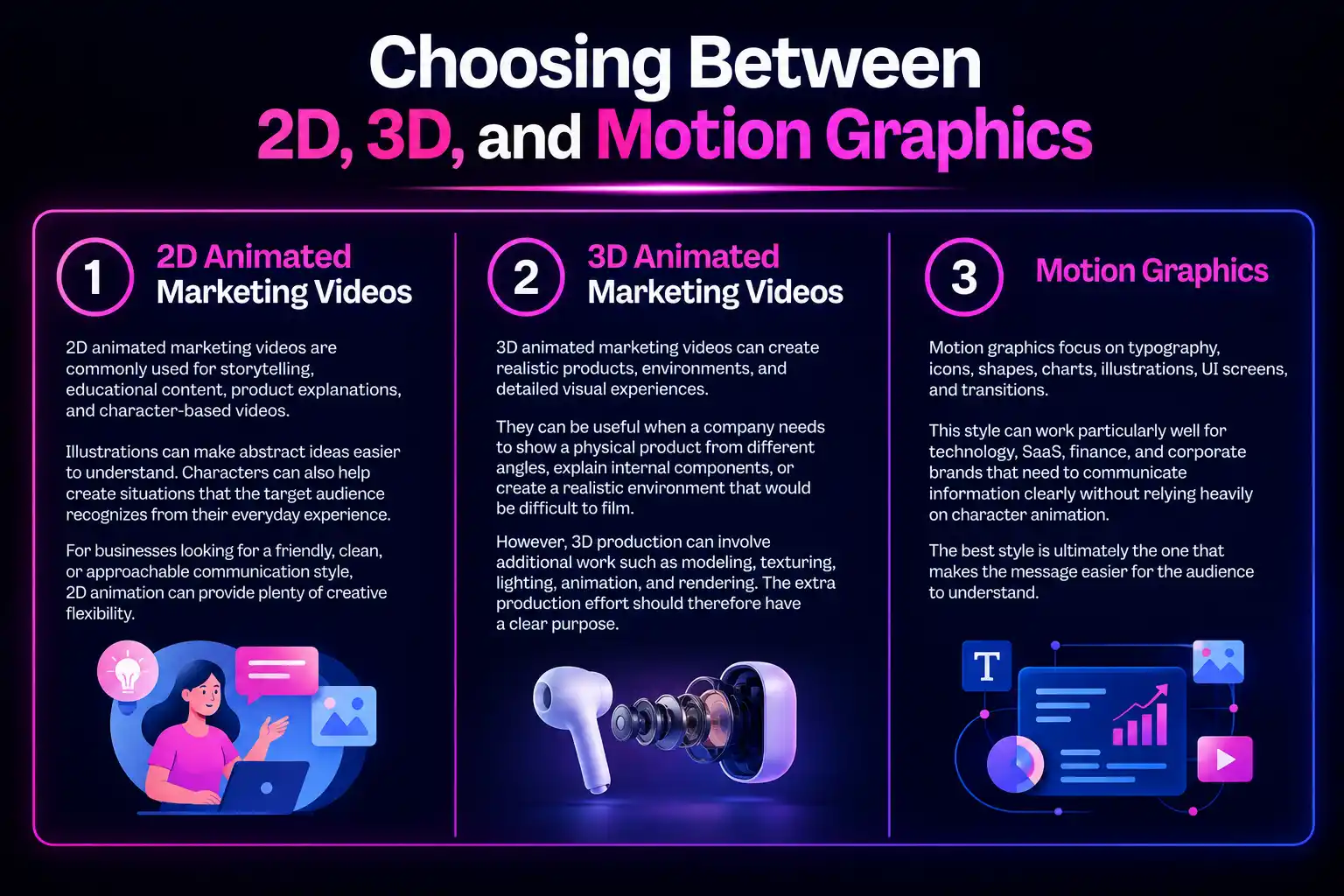
2D Animated Marketing Videos
2D animated marketing videos are commonly used for storytelling, educational content, product explanations, and character-based videos.
Illustrations can make abstract ideas easier to understand.
Characters can also help create situations that the target audience recognizes from their everyday experience.
For businesses looking for a friendly, clean, or approachable communication style, 2D animation can provide plenty of creative flexibility.
3D Animated Marketing Videos
3D animated marketing videos can create realistic products, environments, and detailed visual experiences.
They can be useful when a company needs to show a physical product from different angles, explain internal components, or create a realistic environment that would be difficult to film.
However, 3D production can involve additional work such as modeling, texturing, lighting, animation, and rendering.
The extra production effort should therefore have a clear purpose.
Motion Graphics
Motion graphics focus on typography, icons, shapes, charts, illustrations, UI screens, and transitions.
This style can work particularly well for technology, SaaS, finance, and corporate brands that need to communicate information clearly without relying heavily on character animation.
The best style is ultimately the one that makes the message easier for the audience to understand.
How to Create an Animated Marketing Video
A professional marketing video starts long before the animation stage.
Planning the message first can prevent unnecessary production changes later.
Start With the Marketing Goal
Begin by deciding what the video needs to achieve.
The goal could be to:
- Increase brand awareness
- Introduce a new product
- Generate leads
- Explain a service
- Increase website engagement
- Promote a campaign
- Support a sales presentation
A brand awareness video may focus more on identity and storytelling, while a product video may focus on customer problems and product benefits.
Defining the goal also makes it easier to measure the video’s performance later.
Understand the Audience
The same message can sound completely different depending on who is watching.
A B2B software company may need a professional and information-focused tone.
A consumer brand may prefer a faster and more entertaining style.
Audience research can influence the language, pacing, characters, visuals, and even the length of the video.
Write a Focused Script
A marketing video should not try to explain everything at once.
A simple structure can be:
Audience Problem → Brand/Product → Solution → Key Benefits → CTA
Imagine a SaaS company that helps businesses automate repetitive tasks.
Instead of starting with a list of software features, the video could first show how much time employees lose performing repetitive work.
The software is then introduced as the solution. Finally, the video explains the key benefit and directs viewers toward the next step.
This turns the product into part of a story instead of making the video feel like a feature list.
Develop the Visual Concept
After the script is approved, the visual direction can be planned.
This can include storyboards, character designs, illustrations, UI screens, product visuals, typography, transitions, and brand elements.
At this stage, visual consistency is important. Colors, fonts, illustration style, and overall tone should support the existing brand identity.
Animate and Add Sound
The final stage combines animation with voiceover, music, and sound effects.
Good sound design should support the visuals without overpowering the narration.
When the visual and audio elements work together, the video feels like one complete marketing experience.
How to Make Animated Marketing Videos More Effective
Attractive visuals can capture attention, but a marketing video also needs to communicate something meaningful.
Keep One Main Message
If viewers finish the video without understanding what the brand offers, the animation has not solved the communication problem.
Choose one central message and build the video around it. Remove information that does not directly support that message.
Show Benefits Instead of Only Features
A feature tells people what a product does. A benefit explains why that feature matters.
For example, instead of simply saying Automated reporting dashboard, the video could explain that customers can receive weekly performance reports without manually collecting data.
The second approach connects the feature to a real outcome.
Maintain Brand Consistency
Use brand colors, typography, visual language, and tone consistently.
This becomes especially important when the video is part of a larger campaign.
Ideally, viewers should be able to recognize the brand’s visual identity even before the logo appears.
End With a Clear CTA
A marketing video should give viewers a logical next step.
Depending on the campaign, that could be:
Learn More | Book a Demo | Start a Free Trial | Visit the Website | Contact Us
A clear CTA connects attention with a measurable business action.
Animated Marketing Videos for Different Businesses
Animation is useful across many industries because the visual approach can be adapted to different products and audiences.
SaaS Companies
SaaS brands can use animation to explain software features, workflows, integrations, and use cases.
Animated marketing videos for SaaS companies can also support product launches, landing pages, sales presentations, onboarding campaigns, and social media.
Instead of showing only screenshots, animation can demonstrate how the software solves a customer’s actual problem.
Small Businesses
For small businesses, one of the biggest challenges can be explaining what makes their service different.
Animated marketing videos for small businesses can introduce the company, explain its services, or show how it solves a customer problem.
The video does not need to be complicated. A simple and focused story can communicate more effectively than a production filled with unnecessary visual effects.
Technology Companies
Technology products can sometimes be difficult to explain using traditional footage.
Animation can visualize software, cloud systems, artificial intelligence, automation, data, and digital workflows.
This makes it easier to communicate technical concepts to audiences who may not have a technical background.
Corporate Brands
Businesses can also use corporate animated videos for internal communication, employee education, customer-facing campaigns, and brand messaging.
The animation style can be designed around the company’s existing visual identity so that the content feels consistent with other communication materials.
Common Mistakes to Avoid
Not every animated video delivers strong marketing results.
One common mistake is focusing more on visual effects than the actual message. Animation should support communication rather than distract from it.
Another mistake is trying to include every product feature in a single video. Too much information can make the story difficult to follow.
Businesses should also avoid publishing exactly the same video format across every platform. A website video may need different dimensions, captions, pacing, or editing for social media.
Finally, avoid producing a video without defining its success metric.
Before production begins, decide whether success will be measured through views, watch time, engagement, website traffic, leads, demo requests, or conversions.
How Much Does Animated Marketing Video Production Cost?
The cost of animated marketing video production can vary depending on the scope of the project.
Factors that can influence pricing include:
- Video duration
- Animation style
- Script complexity
- Number of scenes
- Custom illustrations
- Character design
- 2D or 3D production
- Voiceover
- Sound design
- Revision rounds
- Production timeline
A simple motion graphics video will require a different production process from a detailed 3D animation.
For this reason, businesses should compare the complete production scope rather than looking only at the price.
If you are looking for affordable animated marketing video production, ask the production company what is included in the quote.
A clear proposal should explain the scope for scripting, storyboarding, design, animation, voiceover, music, sound effects, and revisions.
How to Measure the Impact of Animated Marketing Videos
Brand awareness cannot always be measured through one number.
For awareness campaigns, businesses can monitor metrics such as:
- Video views
- Reach
- Watch time
- Completion rate
- Social engagement
- Website traffic
- Branded search activity
For conversion-focused campaigns, additional metrics can include click-through rate, leads, demo requests, trial sign-ups, and conversion rate.
The most useful metric depends on the video’s role in the marketing funnel.
For example, a brand awareness video may focus on reach and watch time, while a product advertisement may focus more heavily on clicks and conversions.
Why Professional Animated Marketing Video Services Can Help
Businesses can create basic animated content using templates and DIY software. However, professional production can become valuable when the video represents an important product, campaign, or brand.
A professional team can bring together scriptwriting, storyboarding, illustration, animation, voiceover, sound design, and post-production.
This helps ensure that the visual story supports the marketing objective instead of becoming a collection of unrelated effects.
For example, MotionGility provides marketing video production services for businesses looking to communicate products, services, and brand messages through video. Its work covers technology, SaaS, fintech, and other business categories.
When evaluating an animation company, businesses should look beyond its ability to create attractive visuals.
It is also useful to consider its understanding of storytelling, audience communication, marketing goals, and brand requirements.
Conclusion
Animated marketing videos give businesses a flexible way to communicate their brands, products, and ideas through visual storytelling.
Their value comes from more than attractive animation. Strong marketing videos combine a clear audience, focused message, appropriate visual style, consistent branding, and a defined marketing goal.
A SaaS company can use animation to explain software. A small business can introduce its services. A technology company can simplify complex concepts.
A corporate brand can create consistent communication across different marketing channels.
When planned as part of a wider marketing strategy, animated videos can support brand awareness, engagement, product promotion, and customer communication.
For brands considering animation, the first question should not be “What animation style should we use?”
It should be:
“What does our audience need to understand, remember, or do after watching this video?”
That answer should guide the script, visuals, production style, distribution strategy, and CTA.
FAQs About Animated Marketing Videos
What are animated marketing videos?
Animated marketing videos use animation, illustrations, motion graphics, characters, typography, or other visual techniques to communicate a company’s marketing message.
How do animated marketing videos increase engagement?
They combine movement, storytelling, visuals, sound, and messaging into one format. This can make complex information easier to consume and provide audiences with a more engaging way to understand a product or brand.
Are animated marketing videos good for brand awareness?
Yes. They can help businesses communicate a consistent visual identity while making brand messages easier to understand and remember.
How can businesses use animated videos in marketing campaigns?
Businesses can use them on websites, social media, paid advertisements, product launch campaigns, presentations, landing pages, and other marketing channels.
Are 2D animated marketing videos better than 3D?
Neither style is automatically better. 2D can work well for illustration-based storytelling, while 3D can be useful for realistic products and detailed environments. The right choice depends on the marketing objective.