Artificial Intelligence is evolving and is changing the way we see the reality around us. These revolutionary intelligent computer systems are helping us with everything from simple calculation tasks to creating catchy eye visuals.
The evolution of cloud infrastructures and tech communities like Google Colab, Github, AWS, etc has made the development ecosystem an engineer’s paradise.
The cost-effective computation resources have AI training easier and encouraged brilliant minds to lay a foundation for Neural Networks in computing.
Neural Networks, Also called Artificial Neural Networks(ANN) or Simulated Neural Networks(SNN), enabled users to create AI that can learn and evolve like humans.
This led to the creation of tons of AI models that can detect images, read texts, converts texts-to-voices and voice-to-text dynamically, create images based on texts, recommend content, chat with customers, and now even create content based on users’ queries.
These models are rapidly growing and have created an ecosystem where they are helping professionals with tons of tasks like transcriptions, competitor analysis, chat support, marketing research, and content writing
Interesting Fact
ChatGPT, Content Writing AI by OpenAI, achieved A Million users in a short span of 5 days.
Recently, With Google’s User-First Content Algorithm update, the need for content updation and validation on existing sites has grown by 43% which leads to a 56% hike in content job postings and up to a 40% hike in average salary.
But Something still doesn’t make sense!
The need for content updates has grown by 43% and with rising competition, the need to create content is now at its peak. But the hike in the number of jobs still doesn’t quite add up to the requirement.
Do content creators find a magic wand to improve productivity by 300%?
Well, It’s quite similar. The AI Content writers have made it possible for content writers to create content rapidly and save tons of time researching multiple sources across the web, which is being criticized by some users as a replacement to entry-level content jobs but others have boosted productivity by up to 300%
This lead to a threat to existing search engines, as the number of searches across the web, is rapidly decreasing leading to a lowering in traffic for content and resource sites.
The AI content writers became a big hit with ChatGPT, a pre-trained language processing model based on GPT3 by Open AI.
These language models led the foundation for tons of content alternatives like Jasper, WriteSonic, Elsa Speak, Bloom, etc.
but the biggest challenger to ChatGPT came into existence recently and was revealed by Alphabet INC as BARD AI, on Feb 6, 2023.
Bard AI vs ChatGPT: The Battle for AI-Powered Search
BARD AI was introduced by Google as its answer to the rapidly growing popularity of ChatGPT. While ChatGPT had already captured the attention of millions of users with its ability to generate human-like responses, write content,
summarize information, brainstorm ideas, and assist with coding, Google had something different to bring to the table — its massive search ecosystem.
Unlike traditional search engines that provide a list of links, AI chatbots attempt to understand the user’s intent and provide a direct response. This created a major shift in the way people searched for and consumed information online.
And this is where the real competition between Bard AI and ChatGPT began.
What Makes Bard AI Different?
Google’s biggest advantage was its experience in search and access to a massive information ecosystem. Bard was designed to provide conversational answers while leveraging Google’s understanding of information and search behavior.
For content creators and marketers, this created an interesting question:
If users can get their answers directly from AI, why would they still visit multiple websites?
This question became increasingly important as AI-generated answers started becoming more common.
ChatGPT, on the other hand, became popular because of its conversational capabilities and ability to assist users across a wide range of tasks.
From writing blog posts and social media captions to creating code and developing marketing strategies, ChatGPT quickly became a productivity tool rather than simply a search alternative.
The difference was becoming clear.
Google had the search ecosystem.
OpenAI had the conversational AI advantage.
The Impact on Content Creators
The rise of AI didn’t simply change how people searched. It also changed how content was produced.
A task that previously required hours of research, outlining, drafting, editing, and optimization could now be accelerated with AI assistance.
But this created a new challenge.
If everyone can create content faster, content volume is no longer the biggest competitive advantage.
Quality, originality, expertise, credibility, and user experience become much more important.
This means content creators cannot simply rely on AI to produce thousands of articles. They need to use AI as a productivity tool while adding human expertise, real-world experience, unique insights, and accurate information.
Is AI Replacing Search Engines?
Not exactly.
Instead, AI is changing the way search engines work.
Search is gradually moving from “find information” toward “understand information.”
Users don’t always want ten blue links anymore. They increasingly want a clear answer, an explanation, a comparison, or a recommendation.
This doesn’t necessarily mean traditional search will disappear. Instead, search engines are evolving into more intelligent systems where AI becomes an important layer between the user and the information available across the web.
And this evolution has created a completely new battlefield.
Google, OpenAI, Microsoft, and other technology companies are competing to determine what the future of information discovery will look like.
For businesses and content creators, one thing is already clear:
The future won’t belong to the companies that create the most content.
It will belong to the companies that create the most useful, trustworthy, and discoverable content and know how to adapt it for both humans and AI.
The rise of Bard AI and ChatGPT was only the beginning.
The real question is no longer:
“Which AI chatbot is better?”
The bigger question is:
“How will AI completely change the way the internet searches, discovers, and consumes information?”
Meet BARD AI
BARD AI is an evolving AI that combines the power of knowledge across the globe with the conversational capabilities of Google’s experimental conversational AI services, powered by the Language Model for Dialogue Applications (LaMDA).
BARD draws information from the web and shares the knowledge with the power, creativity, and intelligence of a human-like conversation. BARD can be a creative outlet for information needed by a 9-year-old and a research writer for references to writing from multiple sources.
As Per Google’s CEO Sundar Pichai, in a recent announcement, Google searches are now shifting from factual questions to people looking for deeper insights and understanding of the topic, which takes a lot of effort for the user to figure out from multiple sources. Thus an AI like BARD is more of a necessity than a luxury.
Does that mean the end of other search engines?
Well, this is not the case. Microsoft has announced to include ChatGPT in its search engine Bing and Chinese search giant Baidu is in the race and is moving fast with ‘Ernie’.
This creates curiosity as to what differentiates BARD from its successor ChatGPT
Let’s move forward to understand that…
Bard AI v/s ChatGPT: Why We Believe BARD Will Win Over ChatGPT!
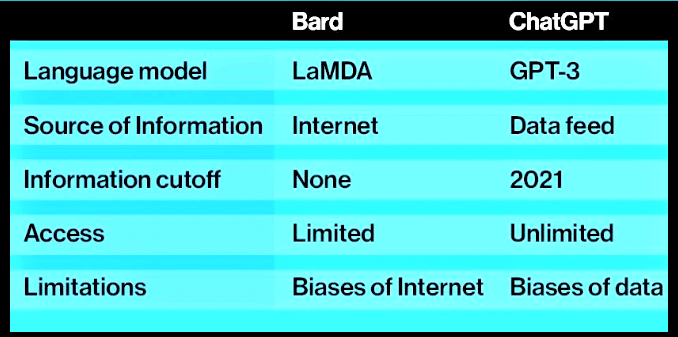
The most considerable question heating up across the internet since the announcement has reached us and we are finally ready with an answer that will help you decide why present-day BARD is better than the current version of ChatGPT.
Unlike the pre-trained AI model in ChatGPT, BARD AI searches real-time data across the web and delivers accurate results. Similarly, tools like OpenAI Sora can assist content creators by summarizing research, generating drafts, and spotting insights quickly, boosting productivity while complementing human creativity
BARD is built on LaMDA(Language Model For Dialogue Applications), compiled with the power of search across web claims to include an ability to express emotions and feelings through content (Maybe A Rumor) which can be true as sentiment analyzers in tools like Grammarly is making significant progress in detecting an emotional tone of the content analyzed.
Although, BARD is still in close test mode, as a developer I feel safe to back up the fact that BARD AI will revolutionize the way people search across the web. The world will now be available at the tips of every finger including the ones that are not familiar with the concept of research.
Conclusion: AI Writers Will Revolutionize The Content Search Landscape
Its been a heated argument in the past few months since the launch of ChatGPT that AI writers will kill content jobs. While some were scared to lose their jobs, others hugged the AI writer to help them with content research and create content on a scale.
No matter what tool you embrace and what the future might hold for the battle between BARD and GPT, the fact that AI writers’ integration with search engines will revolutionize the way we research content on the web.