You are a SaaS company looking for an AI video tool. The market has exploded. As we hit the middle of 2026, creating a high-quality product video no longer requires months of coordination or a massive production budget.
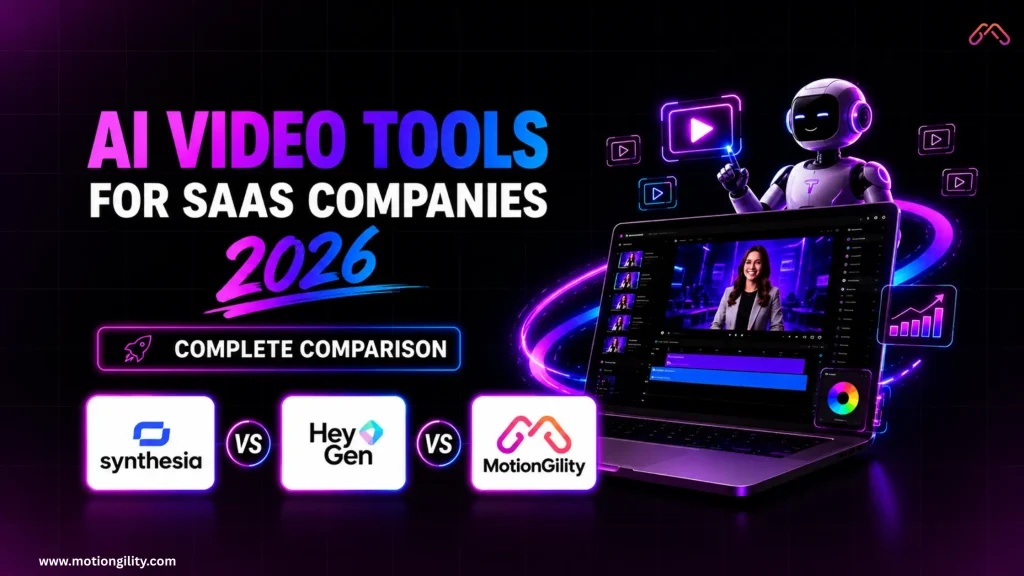
Today, AI has democratized the process, allowing founders and marketers to generate video content in minutes. However, as the options multiply, the choice becomes harder. The growing landscape of AI Video Tools for SaaS Companies 2026 offers more possibilities than ever, but it also makes selecting the right platform increasingly challenging.
While features like lip-sync accuracy and avatar realism were the focus last year, they aren’t the most important factors for a B2B software company today. This is an honest comparison of the leading options in the market and why the difference in positioning matters far more than individual features.
If you are building a complex SaaS product, you don’t just need a video; you need a strategic asset that explains value, reduces churn, and converts trials. Choosing the wrong tool often leads to generic-looking content that fails to resonate with high-intent technical buyers in a crowded 2026 market
1 What Most AI Video Tools Are Actually Built For
When you look at the feature lists of the top-tier AI video generators in 2026, a clear pattern emerges. These tools are engineered for volume and velocity in general content creation. Their primary use cases are social media clips, internal corporate training, personalized sales outreach, and general digital marketing.
Their feature sets reflect this:
- Massive Avatar Libraries: Hundreds of human-like avatars designed to act as spokespeople.
- Multi-language Translation: The ability to dub content into 80+ languages instantly with perfect emotional tone.
- Template-Based Editing: Simple drag-and-drop interfaces for quick social ads and reels.
While impressive, these features are often misaligned with the specific needs of SaaS product marketing. A SaaS product video isn’t about a talking head; it’s about the interface, the workflow, and the problem-solving logic of the software.
Most general AI tools struggle to visualize complex UI walkthroughs or abstract technical concepts.
Their example outputs are often dominated by presenter-style videos where a human avatar stands in front of a static background. For a SaaS company, this often results in a cheap feel that doesn’t do justice to a sophisticated software solution.
2. Synthesia: The Corporate Standard
Synthesia remains the established pioneer of the AI video space. As of 2026, it has solidified its position as the Gold Standard for enterprise-level communication.
- What it is: A web-based platform that allows you to create videos with AI avatars simply by typing text.
- Who it is for: Primarily L&D (Learning and Development) teams, HR departments, and large-scale customer success teams.
- Pricing: Synthesia typically operates on a tiered model, with professional plans starting around a certain credit limit and customised Enterprise pricing for unlimited scale.
- Strengths: Unrivalled avatar stability and a massive library of high-quality, professional presenters. Their Custom Avatar feature is excellent for brands that want their own team members to become the face of their automated content.
- Weaknesses for SaaS: Synthesia is still largely a talking head tool. While you can upload screen recordings, the platform isn’t built to animate them natively.
For a SaaS company needing to show a complex dashboard in motion, Synthesia can feel restrictive. You are often left with a small avatar in the corner, talking over a static slide.
3. HeyGen: The Creative Disruptor
HeyGen has seen massive growth leading into 2026, positioning itself as the more creative and agile alternative for modern marketing teams.
- What it is: A versatile AI video generator known for its industry-leading video translation and Instant Avatar capabilities.
- Who it is for: Content creators, social media marketers, and sales teams focused on personalized video prospecting and Video Sales Letters.
- Pricing: Offers a credit-based system, which is flexible for smaller teams or those with fluctuating monthly needs.
- Strengths: HeyGen’s Video Translate is arguably the best in the industry, maintaining the speaker’s original voice across languages. Their interface is highly intuitive, making it easy to create visually engaging content quickly.
Weaknesses for SaaS: Similar to Synthesia, HeyGen is avatar-centric. It excels at making a person look and sound real, but it doesn’t understand software logic. It lacks the built-in ability to take a technical script and automatically turn it into a functional UI walkthrough with relevant zoom-ins and transitions.
4. The SaaS-Specific Gap
Here is the reality that many SaaS founders in 2026 discover too late: General AI tools are not Product Explainer tools.
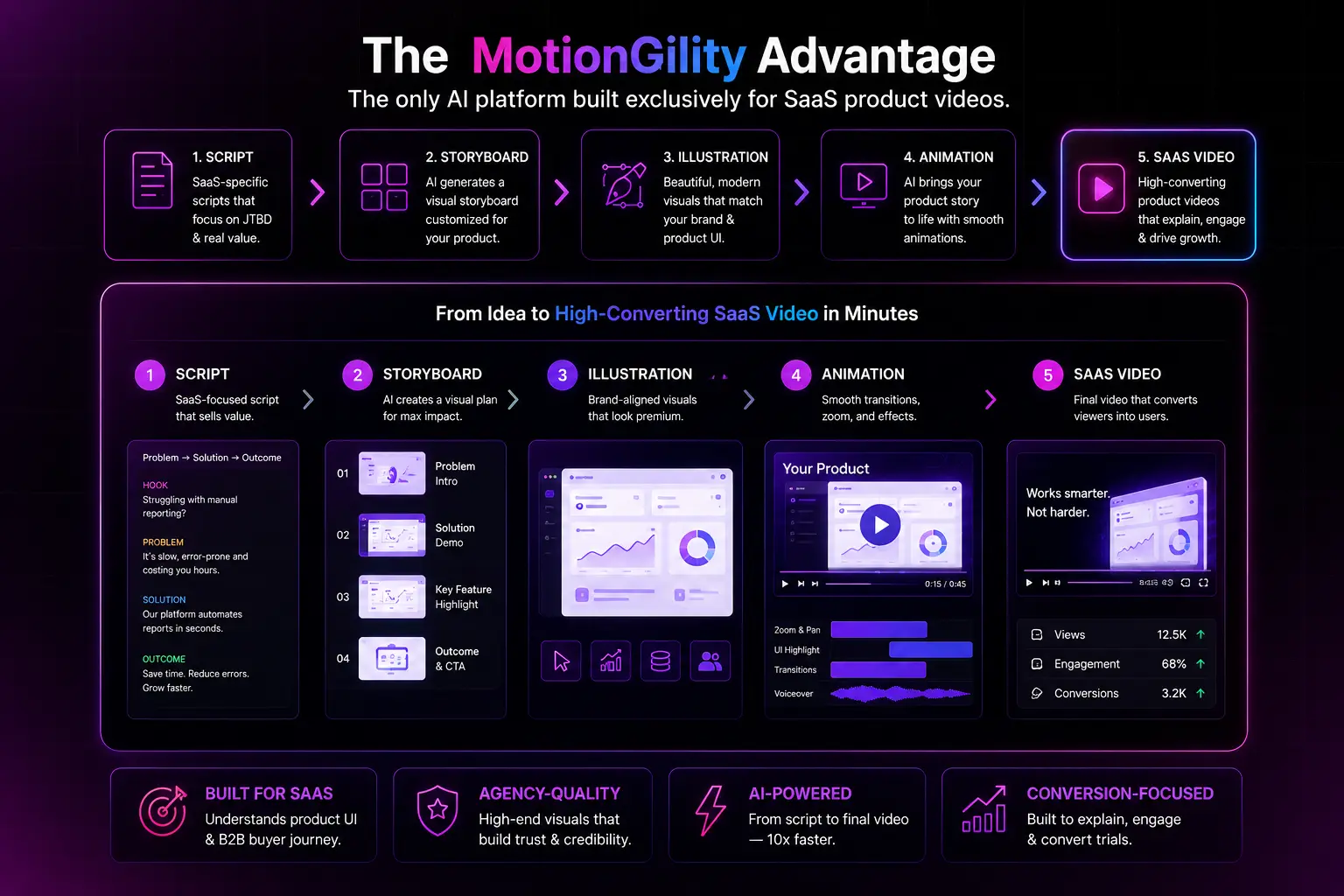
There is a massive gap in the current workflow. Neither Synthesia nor HeyGen handles the critical Script → Storyboard → Illustration → Animation pipeline that defines high-converting SaaS product videos. SaaS product videos require:
- SaaS-Specific Scripts: SaaS-specific scripts should focus on Jobs to Be Done (JTBD) rather than generic marketing fluff.
- Visual Style: Visual Style Clean, modern, and tech-appropriate aesthetics that match your software’s branding.
- Conversion-Focused Structure: Logic designed to move a user from problem awareness to product trial.
Most tools require you to bring your own assets. You have to record the screen, edit the UI, design the icons, and then use the AI just for the voiceover. In 2026, the AI part of the process should do more than just talk.
5. The MotionGility Approach
This is where MotionGility is changing the narrative for 2026. Unlike general-purpose tools, MotionGility is building a platform specifically for the SaaS ecosystem. We aren’t just giving you an avatar; we are automating the entire SaaS video production cycle.
By focusing strictly on the SaaS use case, our early-access tool understands the nuances of product UI and B2B messaging. Instead of a generic presenter, the tool focuses on your software’s value proposition, creating visual narratives that look like they were made by a high-end agency, but at the speed of AI. We are currently bridging the gap between cheap-looking AI clips and expensive traditional agency videos.
Stop settling for general-purpose tools that don't understand your product.
FAQs
1. What is the best AI video tool for SaaS companies in 2026?
The best AI video tool depends on your goal. If you need corporate training videos, Synthesia is a strong choice. For multilingual marketing videos, HeyGen performs well. But for SaaS explainer videos, UI walkthroughs, and conversion-focused product storytelling, MotionGility is designed specifically for SaaS businesses
2. What are the limitations of Synthesia and HeyGen for SaaS marketing?
Both Synthesia and HeyGen are primarily avatar-centric platforms. In SaaS marketing, UI/UX clarity and product workflow visualisation are extremely important. These tools are not specifically designed to natively animate complex software interfaces, which can make the final content feel too basic for technical or B2B audiences.
3. Are AI-generated SaaS videos cheaper than traditional agencies?
Yes. AI video tools significantly reduce production costs compared to traditional video agencies. However, low-cost AI videos can sometimes look generic. SaaS brands often need a balance between automation, storytelling quality, and conversion optimization.
4. What makes a high-converting SaaS product video in 2026?
A successful SaaS product video should include:
Problem-focused messaging
Clear UI walkthroughs
Fast-paced storytelling
Conversion-focused scripting
Strong onboarding logic
Product-led visuals
5. Can AI replace traditional SaaS video agencies?
AI can automate large parts of the production process, but strategy, storytelling, branding, and conversion optimization still require creative expertise.