A great product can still struggle if customers do not understand what it does.
Many businesses invest heavily in developing products, improving features, and building strong marketing campaigns.
However, when the product is complex, explaining its value can become a challenge. Long product descriptions may provide information, but they do not always show how the product works or why customers should care.
This is where a product explainer video can help.
Instead of asking potential customers to understand complicated features through text alone, businesses can use visual storytelling to explain their products more clearly.
A well-produced video can introduce a problem, demonstrate the product, explain important features, and show the value in a short and engaging format.
For SaaS businesses, startups, software companies, technology brands, and B2B businesses, product explainer videos can become an important part of product marketing and customer education.
What Is a Product Explainer Video?
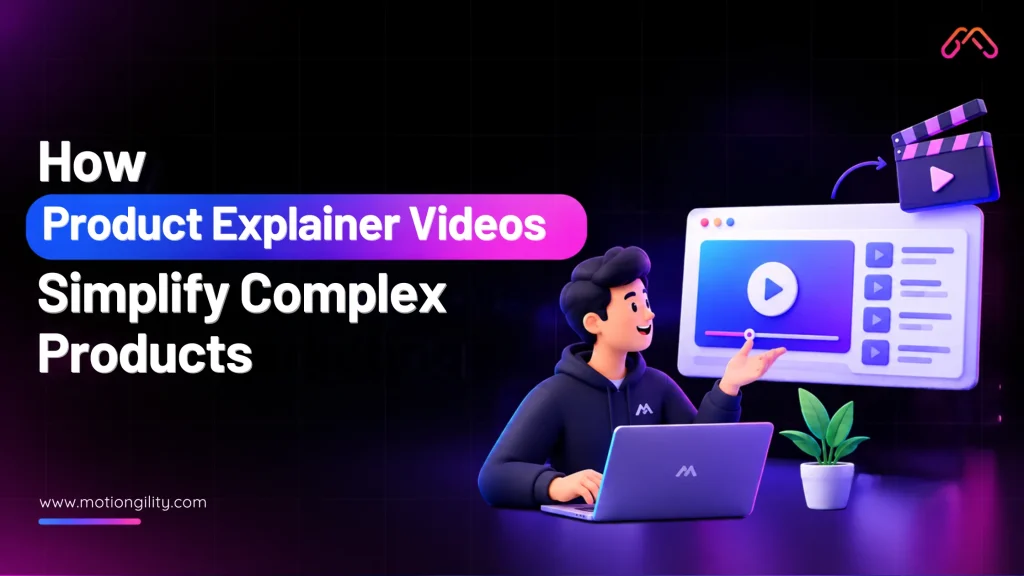
A product explainer video is a short video designed to explain what a product does, how it works, and how it solves a particular customer problem.
These videos can use animation, screen recordings, motion graphics, product interfaces, illustrations, voiceover, or a combination of different visual techniques.
The goal is not simply to show the product.
The goal is to help the viewer understand the product and its value.
For example, imagine a SaaS company offering an automation platform. The website may list integrations, dashboards, workflows, and automation features.
A visitor may understand each term individually but still not understand how the complete solution works.
A product explainer video can connect those features into one visual story.
It can show the problem, introduce the software, demonstrate the workflow, and explain the outcome.
That makes the product easier to understand without requiring the viewer to read a large amount of technical information.
Why Do Complex Products Need Visual Explanation?
Product complexity is not always a problem.
Sometimes complexity exists because the product provides more functionality.
The challenge is communicating that functionality without overwhelming the audience.
A software platform might have dozens of features. A technology product may involve technical processes that are unfamiliar to non-technical buyers.
A business service may require several steps before customers understand how it delivers results.
Traditional text can explain these details, but visual communication adds another layer.
When customers can see how something works, they do not have to imagine every step.
For example, instead of writing:
“Users can connect multiple data sources, automate reporting, and monitor performance through a centralized dashboard.”
A video can visually show different data sources entering the platform, automated processes running in the background, and the final information appearing on one dashboard.
The concept becomes easier to follow.
How Product Explainer Videos Simplify Complex Products
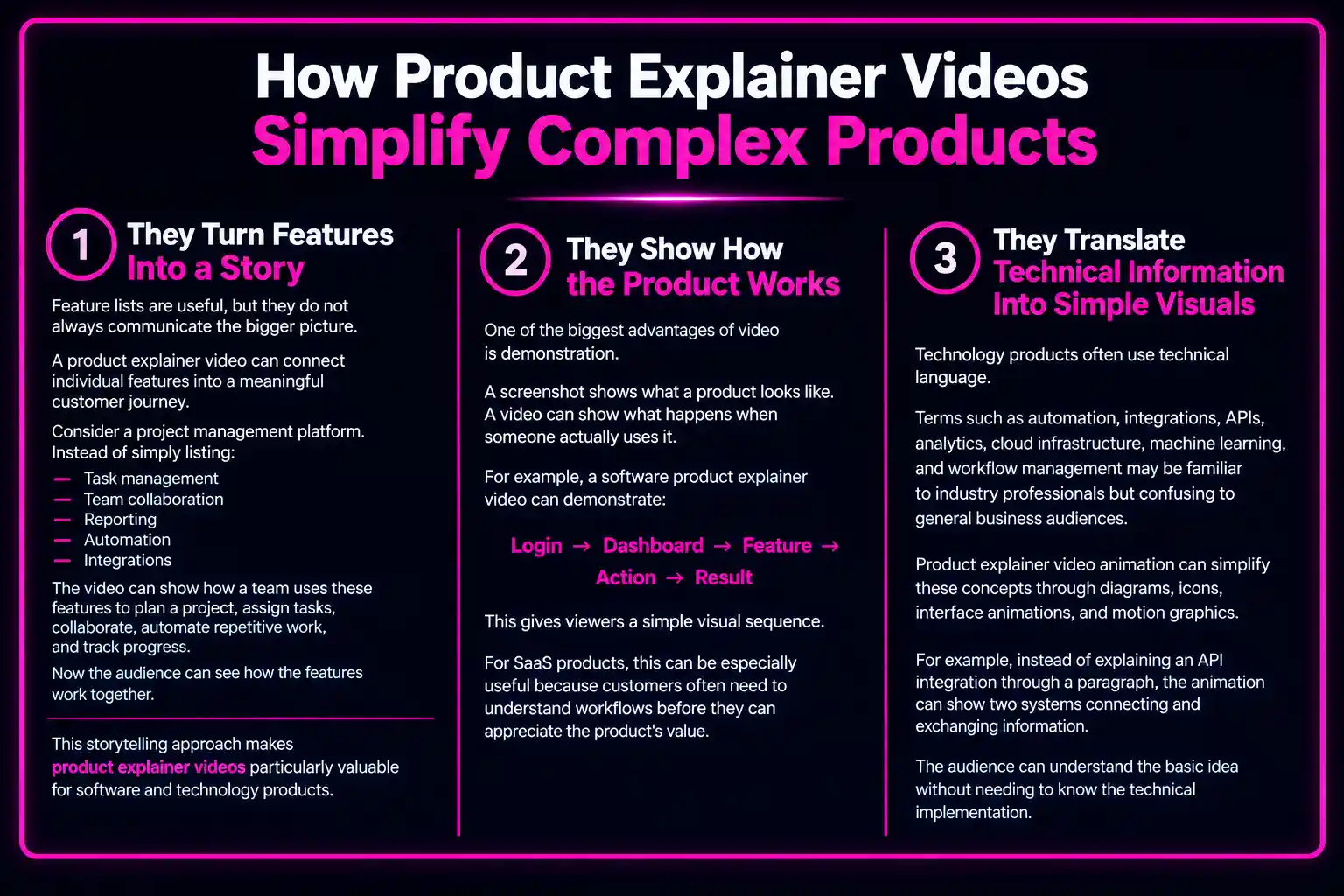
1. They Turn Features Into a Story
Feature lists are useful, but they do not always communicate the bigger picture.
A product explainer video can connect individual features into a meaningful customer journey.
Consider a project management platform.
Instead of simply listing:
- Task management
- Team collaboration
- Reporting
- Automation
- Integrations
The video can show how a team uses these features to plan a project, assign tasks, collaborate, automate repetitive work, and track progress.
Now the audience can see how the features work together.
This storytelling approach makes product explainer videos particularly valuable for software and technology products.
2. They Show How the Product Works
One of the biggest advantages of video is demonstration.
A screenshot shows what a product looks like. A video can show what happens when someone actually uses it.
For example, a software product explainer video can demonstrate:
Login → Dashboard → Feature → Action → Result
This gives viewers a simple visual sequence.
For SaaS products, this can be especially useful because customers often need to understand workflows before they can appreciate the product’s value.
3. They Translate Technical Information Into Simple Visuals
Technology products often use technical language.
Terms such as automation, integrations, APIs, analytics, cloud infrastructure, machine learning, and workflow management may be familiar to industry professionals but confusing to general business audiences.
Product explainer video animation can simplify these concepts through diagrams, icons, interface animations, and motion graphics.
For example, instead of explaining an API integration through a paragraph, the animation can show two systems connecting and exchanging information.
The audience can understand the basic idea without needing to know the technical implementation.
Where Can Product Explainer Videos Be Used?
A product explainer video can support more than just a homepage.
Different video formats can be used across the customer journey.
Website and Landing Pages
A product page needs to communicate value quickly.
Visitors may not read every section of a long webpage. A video near the top of the page can provide an immediate overview.
It can answer three important questions:
What is the product?
How does it work?
Why should I care?
This makes product videos useful for landing pages, product pages, and campaign pages.
Product Launches
New products often require additional explanation.
A launch announcement may tell people that a product exists, but a video can show why it matters.
Product introduction videos can introduce the product, demonstrate important features, and communicate the main value proposition.
Businesses can also reuse launch videos across social media, email campaigns, presentations, and sales outreach.
Sales Presentations
Sales teams often need to explain the same product repeatedly.
A professional video can support these conversations by providing a consistent explanation.
Instead of spending the first part of every sales meeting explaining basic functionality, sales representatives can use a video to establish the foundation and spend more time discussing the prospect’s specific requirements.
Customer Onboarding
Product education should not stop after a customer purchases.
A series of shorter videos can help customers learn important features and workflows.
This can make video useful for onboarding, training, support, and feature adoption.
Social Media and Digital Marketing
Short product videos can also be adapted for marketing channels.
A business might create one detailed explainer and then develop shorter clips around individual features, customer problems, or use cases.
This allows the same core product story to support multiple content formats.
What Types of Product Explainer Videos Can Businesses Create?
There is no single format that works for every product.
The right style depends on the audience, product, message, and distribution channel.
Animated Product Explainer Videos
Animation is useful when a product involves abstract ideas, technical workflows, or concepts that are difficult to film.
Custom illustrations, characters, icons, motion graphics, and interface elements can be combined to create a visual explanation.
Software Product Explainer Videos
Software products often benefit from a combination of screen recordings and animation.
The video can show the actual interface while using motion graphics to explain the larger workflow.
This approach can be useful for SaaS platforms, business software, productivity tools, and technology products.
Product Demo Videos
A product demo focuses more heavily on showing the actual product in action.
For example, a video may demonstrate how users complete a particular task inside a software platform.
While a demo and an explainer video can overlap, the main difference is usually the level of focus. Explainers often emphasize the problem and value proposition, while demos tend to focus more on product functionality.
Product Marketing Videos
Product marketing videos can combine explanation with persuasion.
They may introduce a product, highlight important benefits, show use cases, and encourage viewers to take the next step.
These videos can be used during product launches, campaigns, sales processes, and conversion-focused marketing.
Product Explainer Video vs Product Demo Video
Although these terms are sometimes used interchangeably, they can serve different purposes.
Feature | Product Explainer Video | Product Demo Video |
Main purpose | Explain the product and value | Demonstrate functionality |
Focus | Problem, solution, benefits | Features and workflow |
Storytelling | Usually stronger | Usually more direct |
Animation | Often used | Optional |
Best for | Awareness and understanding | Product evaluation |
Typical audience | New prospects | Interested prospects/users |
A business may use both.
For example, an explainer can introduce the product on the website, while a more detailed demo can help prospects evaluate the product before purchasing.
What Makes a Product Explainer Video Effective?
Professional production is not only about creating attractive animation.
The communication strategy matters.
Start With One Clear Objective
Before production begins, determine what the video should accomplish.
Is the goal to:
- Introduce a new product?
- Explain a complex feature?
- Generate demo requests?
- Support sales?
- Educate customers?
- Improve product adoption?
One video can support multiple goals, but it should have one primary objective.
Understand the Target Audience
The same product may need different explanations for different audiences.
A developer may want technical details, while a business decision-maker may care more about efficiency, cost, scalability, and business outcomes.
The language and visuals should reflect the audience.
Build a Logical Script
A strong script gives the video structure.
A common framework is:
Problem → Product → How It Works → Benefits → Call to Action
However, this should not be treated as a fixed formula.
A product launch video may begin with the new product. A feature video may begin directly with a customer problem. An onboarding video may start with the first action the user needs to take.
The structure should match the video’s purpose.
Keep the Visuals Relevant
Every visual should help explain something.
If the narration discusses a dashboard, show the dashboard.
If it describes automation, visualize the automation.
If it explains a customer problem, show the problem before introducing the solution.
This connection between narration and visuals makes the explanation easier to follow.
How to Choose a Product Explainer Video Company
Choosing a product explainer video company requires more than checking whether its animations look good.
Start by reviewing the portfolio.
Look for examples involving complex products, SaaS platforms, software, technology, or B2B services.
Next, understand the production process.
A professional team should ideally be able to support areas such as:
- Concept development
- Scriptwriting
- Storyboarding
- Visual design
- Animation
- Voiceover
- Sound design
- Revisions
- Final delivery
Communication also matters.
The production team needs to understand your product before creating the visual story.
If a company starts designing immediately without understanding the product, audience, and objective, the final video may look attractive but still fail to communicate the right message.
What Does Product Explainer Video Production Cost?
The cost of product explainer video production depends on several factors.
These can include:
- Video duration
- Animation complexity
- Number of scenes
- Custom illustrations
- Character design
- Product UI animation
- Voiceover
- Sound design
- Scriptwriting
- Revision rounds
- Production timeline
A simple motion graphics video will usually require a different level of production than a highly detailed animated video with custom characters and complex product interactions.
Businesses looking for an affordable product explainer video company should compare the complete scope of work instead of comparing only the quoted price.
A lower price may include fewer services, while a higher quote may include strategy, scripting, design, animation, voiceover, and multiple revision stages.
The best choice depends on the business objective and required quality.
Product Explainer Videos for SaaS and Technology Companies
SaaS companies often have particularly strong use cases for explainer content.
A software product may solve a complicated problem, but customers still need to understand the workflow before they can see its value.
For example, a SaaS company might offer an analytics platform that collects data from several systems.
A product explainer video for SaaS companies can show:
- Where the data comes from.
- How the platform connects different sources.
- How the information is processed.
- What the dashboard looks like.
- How customers use the insights.
This creates a visual journey from problem to solution.
The same approach can work for cybersecurity platforms, fintech software, AI tools, project management systems, CRM platforms, HR software, and other technology products.
Product Explainer Videos for Startups
Startups face a different challenge.
They often need to explain a new product to an audience that has never seen it before.
A product explainer video for startups can help establish the basic product story quickly.
It can be used on the homepage, during investor or sales presentations, in product launches, and across digital marketing campaigns.
For an early-stage company, a strong video can also create consistency.
The same core message can be adapted across multiple channels instead of every team member explaining the product differently.
Common Mistakes to Avoid
Even a professional production can become ineffective if the strategy is unclear.
Trying to Explain Everything
One video does not need to explain every feature.
Trying to cover too much information can make the video feel rushed and difficult to follow.
Focusing Only on Features
Customers usually care about outcomes, not just feature names.
Instead of only showing what the product contains, explain what those features help users accomplish.
Using Too Much Technical Language
Technical terms can create unnecessary barriers.
Use terminology when the audience understands it, but simplify the explanation wherever possible.
Creating Beautiful but Meaningless Animation
Visual quality matters, but animation should support the message.
Every scene should have a communication purpose.
Forgetting the Call to Action
After explaining the product, tell the viewer what to do next.
The CTA could be:
Book a demo.
Start a free trial.
Explore the product.
Contact the team.
The right CTA depends on the stage of the buyer journey.
How Can Businesses Measure Product Video Performance?
A product explainer video should have measurable goals.
Useful metrics can include:
- Video views
- Average watch time
- Completion rate
- Click-through rate
- Demo requests
- Trial sign-ups
- Landing page engagemen
The most important metric depends on where the video is used.
For example, an awareness video may focus on views and watch time, while a landing-page explainer may be evaluated based on engagement and conversions.
Tracking these results can help businesses understand whether their video is actually supporting the intended business objective.
Conclusion
Complex products do not have to be difficult to explain.
A well-planned product explainer video can transform technical information, complicated workflows, and long feature lists into a simple visual story.
By combining clear scripting, relevant visuals, animation, product demonstrations, and storytelling, businesses can help potential customers understand what their products do and why they matter.
This makes explainer videos useful across websites, product launches, sales presentations, onboarding, social media, and product marketing.
For SaaS companies, startups, software businesses, and technology brands, professional video production can also create a consistent way to communicate product value across the customer journey.
The key is not simply to create a visually impressive video.
The goal is to create a video that makes the product easier to understand and gives the viewer a clear reason to take the next step.
FAQs About Product Explainer Videos
What is a product explainer video?
A product explainer video is a video designed to explain what a product does, how it works, what problem it solves, and why customers should consider it.
Why should businesses use product explainer videos?
Product explainer videos can simplify complex products, demonstrate workflows, communicate product value, support sales conversations, and improve customer education.
Are animated product explainer videos suitable for software?
Yes. Animation is particularly useful for software products because it can demonstrate interfaces, workflows, integrations, abstract concepts, and product benefits.
How long should a product explainer video be?
There is no universal duration. The ideal length depends on the product, audience, platform, and amount of information that needs to be communicated.
How much does product explainer video production cost?
Pricing varies based on video length, animation style, script complexity, custom design, voiceover, sound design, revisions, and production requirements.