You’ve spent six months pulling 80-hour workweeks. The codebase is clean, the UI is crisp, and the beta testers are quiet, which, in product development, is the ultimate compliment. Your team is buzzing. The launch date is circled in red on the calendar.
You queue up. We are officially live! post on LinkedIn, hit publish on your email blast, and wait for the traffic chart to spike. And then nothing.
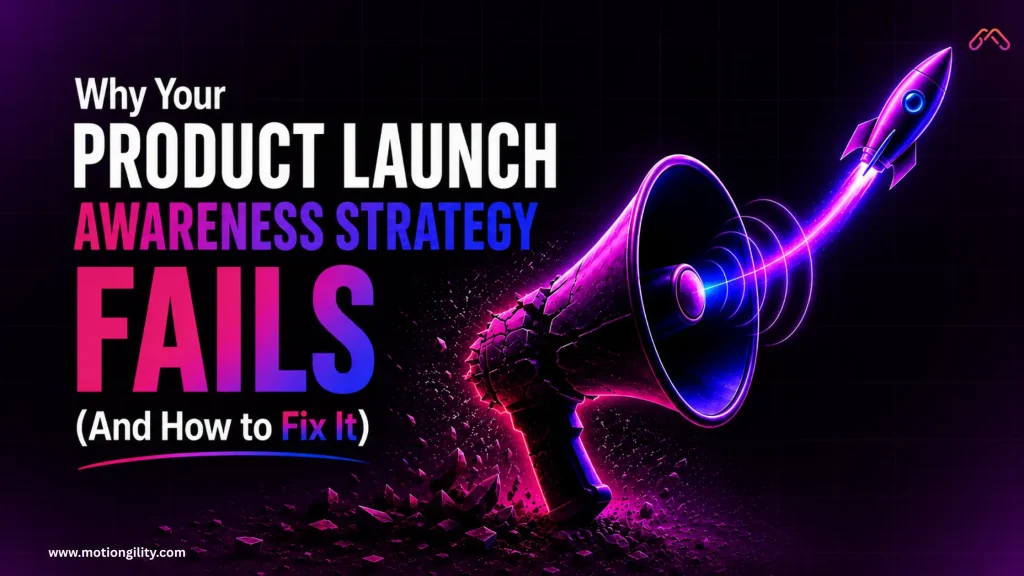
A few clicks from your mom, a pity-like from a former colleague, and a deafening silence from the market. If your product launch awareness strategy is weak, this is exactly what happens. According to Harvard Business School Professor Clayton Christensen, a staggering 95% of new products fail every year.
Most companies treat awareness like a ribbon-cutting ceremony. They assume that because they built something exceptional, the world will automatically care. But in a hyper-crowded, attention-deficit B2B and SaaS landscape, Build it, and they will come is a fast track to stagnation.
If your pre-launch buzz feels more like a faint hum, it’s time to fix the leaks. Let’s break down exactly why traditional product launch strategies fail, how to build a pre-launch validation system that works, and how to execute an awareness campaign that turns cold traffic into an eager waitlist.
1. The Anatomy of a Failed Launch: Why Great Products Die in Silence
To fix a broken awareness strategy, we first have to understand where the gears are grinding. When a product falls flat on its face on launch day, it’s usually due to one of three systemic tactical errors:
The Big Bang Fallacy
The Big Bang fallacy is the old-school marketing mentality where you keep your product entirely under wraps in Stealth Mode until Launch Day, hoping to shock and awe the market with a sudden surprise. This worked in 1998. It doesn’t work in 2026. When you rely on a single moment in time to generate all your sales pipeline, you place a massive, high-risk bet on an algorithmic whim.
If a major global news event breaks on your launch day, or if the LinkedIn algorithm decides to throttle text-heavy posts that morning, your entire marketing investment is wiped out in a single flash. Modern awareness isn’t an explosion; it’s a slow, compounding burn.
Feature-Thumping vs. Problem-Solving
Look at your current landing page copy or draft social media posts. Are you yelling about your AI-powered, multi-threaded, real-time sync architecture? Or are you talking about the fact that your user is currently losing 4 hours a week to manually copy and paste data between legacy tools?
The Trap Feature-Thumping: Our platform offers a 10Gbps data pipeline. The Fix Problem-Solving: Stop waiting for reports to load. Get your data instantly. Software buyers don’t buy features; they buy a permanent cure for their current headaches. If your launch awareness strategy focuses on what your product is rather than what your product solves, you will lose your buyer’s attention to a competitor who speaks their language.
Total Lack of Pre-Launch Validation
The absolute worst time to find out if people actually want your product is the day it launches, after you’ve already spent hundreds of thousands of dollars on software development.
Too many teams build a marketing plan based entirely on internal assumptions. They skip the critical phase of getting qualitative feedback from actual target buyers before the final code is locked in. Without validation, your launch messaging is just guesswork, and guesswork doesn’t convert.
2. Shift to a Build in Public and Pre-Launch Validation Framework
The most successful modern launches don’t start on Product Hunt or TechCrunch. They start months in advance in public forums, Slack communities, and LinkedIn feeds. Shifting from a secretive stealth mode to a transparent Build in Public model creates an organic groundswell of attention that makes launch day a mere formality, not a gamble.
The 90-Day Pre-Launch Validation System (The 90-Day System)
If you want to ensure your product has a long line out the door on day one, you need a structured timeline dedicated strictly to validation and narrative building:
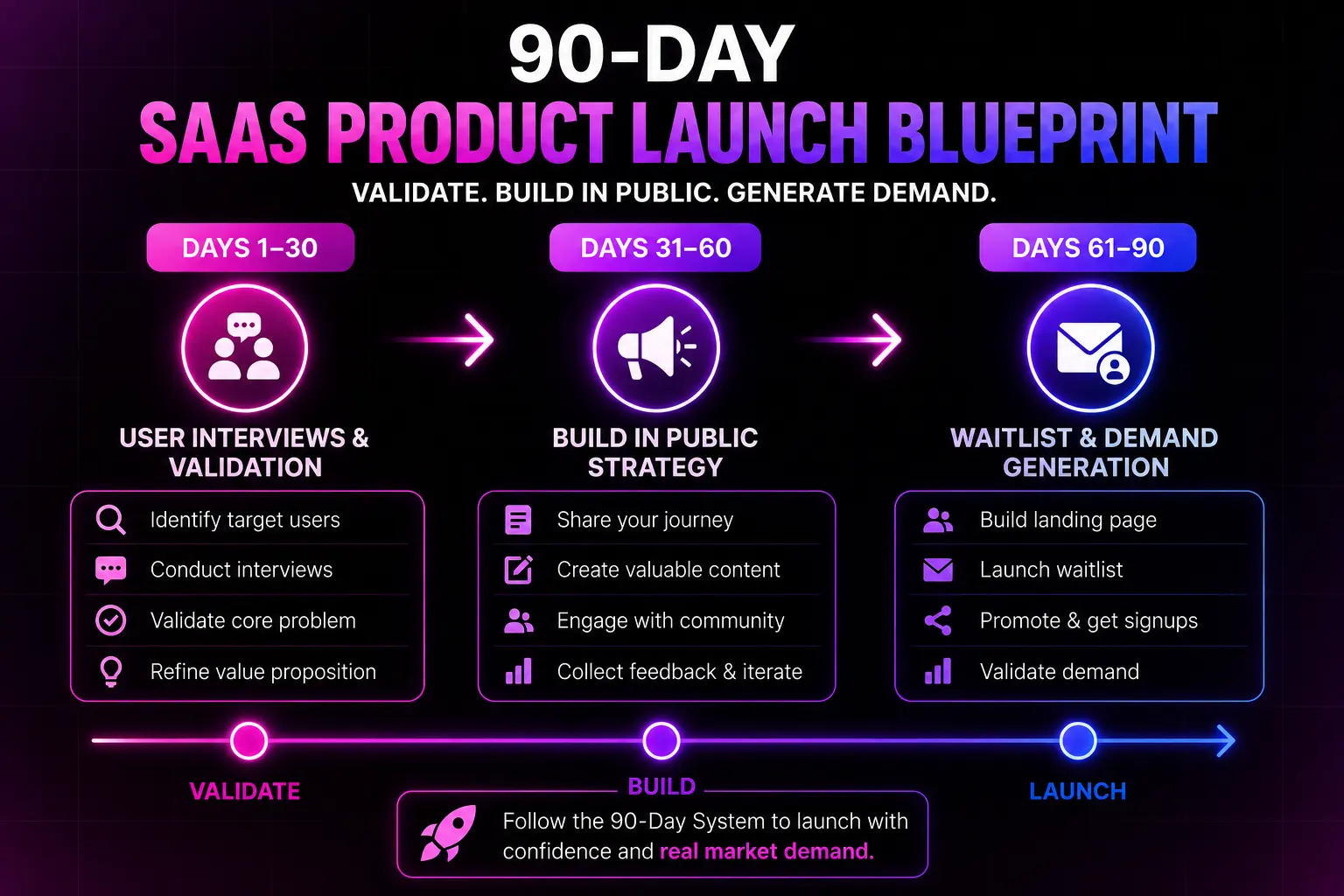
- Days 1–30: The Qualitative Deep Dive: Conduct intensive, non-sales interviews with your target users. Do not pitch your product. Instead, ask open-ended questions about their workflows, current tool limitations, and daily operational bottlenecks. Your goal here is to steal their exact vocabulary and phrases for your copywriting.
- Days 31–60: The Open Narrative & Build in Public Phase: Begin sharing the journey of building the product on your social channels. Share early UI mockups, talk openly about technical challenges you’ve encountered, and publish snippet summaries of the insights gained from your month-one interviews.
- Days 61–90: The Waitlist Friction Test: Launch a high-converting landing page with a singular call to action (CTA): joining an exclusive waitlist. Introduce subtle qualification friction into the waitlist form (e.g., asking for their job title or team size) to ensure your list consists of high-intent buyers, not just curious browsers.
3. The Multi-Channel Distribution Engine: Moving Beyond a Single Post
An incredible article or a beautiful video asset is completely useless if it sits isolated on your company blog. To build real, unavoidable brand awareness, you must deploy a multi-layered distribution engine across different formats and contexts.
The Anchor Content Model
Do not try to create thirty different pieces of social media content from scratch every week. It’s an exhausting, unsustainable strategy that dilutes your messaging. Instead, leverage the Anchor Content Model.
Start by producing one highly authoritative, data-backed piece of primary content. This could be an original industry report, a deep-dive interview with a recognized expert, or a comprehensive case study. Once this anchor piece is finalized, slice it up systematically to repurpose it:
- The Data Slide-Deck: Turn the core statistics from your report into a scannable LinkedIn carousel.
- The Text Brief: Convert individual sections of the report into short, punchy thought-leadership posts for your executive team’s personal profiles.
- The Tactical Video: Record a 60-second Loom video or an automated UI walkthrough showcasing the exact workflow breakdown discussed in the report.
4. Bridging the Gap: Turning Brand Awareness into a Concrete Pipeline
Awareness is a vanity metric if it stays trapped in the form of impressions and likes. A million views on a social post won’t pay your engineering team’s salaries. Your awareness strategy must have clear, low-friction off-ramps designed to convert passive consumption into measurable pipeline intent.
The Explainer Video: The Ultimate High-Converting Solution Asset
When a potential buyer lands on your pre-launch page or encounters your brand on LinkedIn, you have less than 10 seconds to explain what your product does before they bounce. Long walls of text completely fail here. Instead, the most effective conversion mechanism is a tightly scoped, 90-second animated explainer video or an automated UI walkthrough.
A high-converting product explainer video doesn’t just show off slick graphics; it follows a highly structured, psychology-driven narrative arc:
- The Hook (0–15s): Immediately open the video by stating the exact, painful operational problem your target audience faces daily.
- The Agitation (15–30s): Explain why current workarounds (like messy spreadsheets or fragmented legacy tools) make this problem incredibly frustrating and costly.
- The Solution (30–60s): Introduce your product. Show a simplified, high-impact dynamic UI visualization demonstrating exactly how your tool solves that specific problem in just two clicks.
- The Proof & Call to Action / CTA (60–90s): Show brief validation (such as a quote from a beta tester or social proof) and drive them directly to your waitlist with a clear, time-sensitive incentive.
Investing in a professional, custom-animated explainer video asset (typically in the mid-range, around $3,000 for standard production) gives your launch a central, highly shareable asset that can be broken down into multi-channel micro-content for months to come.
Crafting the Irresistible Pre-Launch Waitlist
Your waitlist page shouldn’t just say, Enter your email to know when we launch. That offers zero immediate value to the user. Pair your explainer video with an exclusive tier that unlocks clear, tangible advantages:
The Early-Bird Advantage: Join 500+ operators getting early beta access, locked-in founder pricing for life, and a direct line to our product team to influence our feature roadmap.
5. Step-by-Step: Launching Your Awareness Campaign
Ready to move away from the chaotic, last-minute rush of traditional product marketing? Here is the exact checklist your team needs to follow to execute a structured, high-impact awareness engine:
- Deploy Your Waitlist Infrastructure (Day 1): Set up a highly optimized landing page utilizing clean formatting, visible social proof or tester quotes, and an airtight tracking setup (Google Analytics, LinkedIn Pixel) to measure your incoming baseline conversion rates.
- Publish Your Core Anchor Content (Day 7): Drop your primary research piece, deep-dive teardown, or industry problem report on your main site. This acts as the foundational home base for all incoming referral traffic.
- Activate Organic Executive Channels (Days 8–30): Have your founders, product heads, and growth leads consistently post personal, conversational takes based on the anchor content data across LinkedIn or X. Link directly to the waitlist page in the featured sections or comments.
- Amplify with Targeted Paid Ads (Days 15–45): Take the organic social posts that generated the highest engagement and click rates and put ad spend behind them. Target custom audiences built around your Ideal Customer Profiles (ICPs) to predictably scale up your traffic.
Conclusion
A successful product launch is no longer about a single announcement or a last-minute marketing push; it is about building a sustained product launch awareness strategy long before the product goes live. In today’s crowded SaaS and B2B landscape, even the most powerful products fail if they don’t have visibility, validation, and a consistent narrative behind them.
The traditional build it, and they will come mindset is broken. Instead, winning teams focus on pre-launch validation, build-in-public storytelling, multi-channel distribution, and high-converting assets like explainer videos to create demand before launch day even arrives.
When awareness is treated as a structured system, not an afterthought, launch day stops being a gamble and becomes a predictable growth event. The real advantage doesn’t come from building better products alone, but from ensuring the right audience is already waiting, engaged, and ready to convert the moment you go live.
Early Bird Access – Join the Waitlist
We are building the exact Living Video infrastructure that this 2026 report demands. Don’t let your marketing lag behind your product updates.
Priority Access: Skip the queue and be the first to automate your video production before the public launch.
Founder’s Pricing: Secure exclusive, lifetime discounts that will never be offered to the public again.
Strategy Support: To ensure your success, early members receive a free video marketing audit from our expert strategy team.
FAQs
1. Why do most product launches fail?
Most launches fail due to a lack of awareness, poor messaging, and no pre-launch validation, rather than product quality issues.
2. How long should a pre-launch strategy take?
A structured pre-launch strategy usually takes around 90 days for effective validation and awareness building.
3. What is the best way to convert awareness into a pipeline?
Using explainer videos, landing pages, and targeted CTAs helps convert attention into measurable leads and signups.
4. What should a SaaS explainer video include?
It should include a hook, problem agitation, solution demonstration, and a clear call-to-action.
5. How does multi-channel distribution help product launches?
It spreads awareness across different platforms like LinkedIn, ads, and email to maximize reach and engagement.
6. Why is problem-solving messaging more effective than feature-based messaging?
Because customers connect more with their pain points and practical solutions rather than technical features.