Getting traffic to a SaaS website is only the beginning.
The bigger challenge is turning that traffic into qualified prospects who are genuinely interested in the product. A company may have a good website, useful content, and an impressive software platform, yet still struggle to generate consistent sales opportunities.
This is why SaaS lead generation needs a clear strategy.
SaaS businesses operate differently from many traditional businesses. Customers often research products online, compare alternatives, read reviews, watch product videos, explore pricing, and sometimes sign up for a free trial before speaking with sales.
A successful lead generation strategy should therefore connect marketing, content, product education, sales, and customer acquisition.
The goal is not simply to generate more leads.
The goal is to attract the right leads, educate them, build interest, and move them toward a meaningful action such as booking a demo, starting a trial, or contacting the sales team.
What Is SaaS Lead Generation?
SaaS lead generation is the process of attracting potential customers and encouraging them to provide their contact information or take an action that indicates buying interest.
For a SaaS company, this could happen through:
- Organic search
- Content marketing
- Paid advertising
- Social media
- Email marketing
- Product demos
- Webinars
- Video marketing
- Free trials
- Referral programs
- Landing pages
For example, someone searching for a CRM solution may discover a SaaS company’s blog through Google. After reading the article, they may download a guide, watch a product video, or request a demo.
That person has moved from being an anonymous website visitor toward becoming a potential lead.
A strong strategy creates a path for this journey.
Why SaaS Companies Need a Structured Lead Generation Strategy
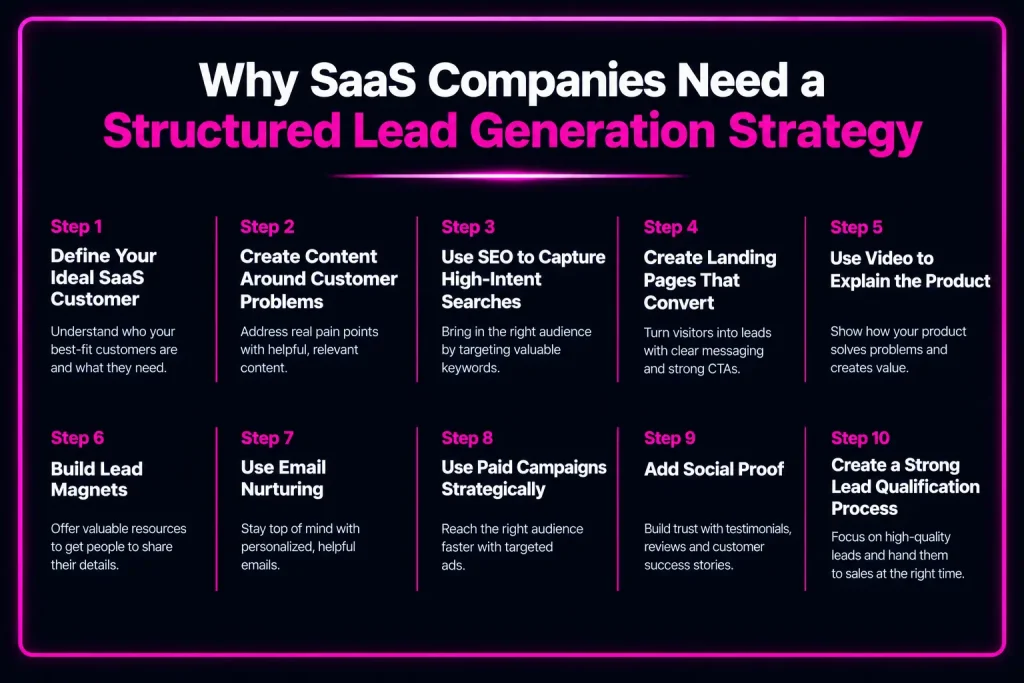
SaaS buyers rarely make decisions after seeing one advertisement.
They often move through several stages.
First, they become aware of a problem.
Then they research possible solutions.
After that, they compare products, investigate features, check pricing, and evaluate whether the software fits their needs.
This means SaaS businesses need content and campaigns that support different stages of the buying journey.
A company targeting only immediate sales may miss prospects who are still researching.
On the other hand, a company focusing only on awareness may generate traffic without enough qualified opportunities.
A structured SaaS lead generation strategy connects these stages.
Step 1: Define Your Ideal SaaS Customer
Before choosing lead generation channels, understand who you want to attract.
This sounds simple, but many SaaS businesses target audiences that are too broad.
Start by identifying factors such as:
- Industry
- Company size
- Job role
- Business problem
- Budget
- Buying authority
- Current software
- Product requirements
For example, a project management SaaS product could target marketing agencies with 10–50 employees instead of simply targeting “businesses.”
This narrower audience allows the company to create more relevant messaging.
Build an Ideal Customer Profile
An Ideal Customer Profile, or ICP, describes the type of company that is most likely to benefit from the product.
For B2B SaaS, the ICP might include:
Industry: Technology and professional services
Company size: 20–200 employees
Decision-maker: Operations Manager or Founder
Problem: Too much manual workflow
Goal: Improve team productivity
Once this is clear, your content, landing pages, advertisements, and sales messages become easier to align.
Step 2: Create Content Around Customer Problems
One of the most effective approaches to SaaS inbound marketing is creating content around the problems customers are already searching for.
Instead of constantly writing about your own product, answer questions that potential customers have.
For example, an accounting SaaS company could create content around:
- How to automate invoice management
- How to reduce manual accounting work
- How businesses can track expenses
- How to manage recurring payments
These topics attract people who may eventually need the company’s software.
Build Different Types of Content
A strong SaaS content strategy can include:
Educational content
Helps prospects understand a problem.
Comparison content
Helps buyers compare different solutions.
Product-focused content
Shows how the software solves a specific problem.
Case studies
Demonstrates real-world applications.
Video content
Explains products, workflows, features, and use cases visually.
This creates multiple opportunities to attract and educate potential customers.
Step 3: Use SEO to Capture High-Intent Searches
Search engines can become a powerful source of SaaS leads when content is aligned with search intent.
Not every keyword has the same value.
For example:
“What is CRM?”
may indicate early research.
But:
“Best CRM software for small businesses”
shows stronger commercial intent.
A SaaS company should build content around different stages of the buyer journey.
Informational Keywords
These answer questions.
Examples:
- What is sales automation?
- How does CRM software work?
- What is SaaS analytics?
Commercial Keywords
These indicate product research.
Examples:
- Best CRM software
- CRM software for startups
- CRM alternatives
Transactional Keywords
These indicate stronger buying intent.
Examples:
- CRM software pricing
- CRM demo
- CRM free trial
Combining these keyword types can create a more complete SaaS lead generation marketing strategy.
Step 4: Create Landing Pages That Convert
Driving traffic to a generic homepage does not always produce the best results.
Instead, create landing pages designed around specific audiences, problems, or campaigns.
For example:
CRM Software for Startups
is more specific than:
CRM Software
The landing page should quickly communicate:
- What the product does
- Who it is for
- What problem it solves
- Key benefits
- Supporting proof
- Call to action
Make the CTA Clear
A visitor should understand what to do next.
Depending on the stage of the buyer journey, the CTA could be:
Start Free Trial
Book a Demo
Get Started
Request a Demo
See How It Works
Avoid presenting too many competing actions on a focused landing page.
Step 5: Use Video to Explain the Product
SaaS products can be difficult to understand from text and screenshots alone.
This makes SaaS lead generation through video marketing particularly useful.
A short product video can explain:
- The customer problem
- The software solution
- How the product works
- Important features
- Key benefits
- The next step
For example, a SaaS landing page could include an explainer video above the fold.
A prospect who does not want to read a long product description can watch the video and understand the basic value proposition quickly.
Video can also be repurposed for social media, email campaigns, sales presentations, and product launches.
Step 6: Build Lead Magnets
Not every visitor is ready to book a sales call.
Some people are still researching.
Lead magnets give these visitors a reason to share their contact information.
Examples include:
- Industry reports
- Templates
- Checklists
- Ebooks
- Guides
- Webinars
- Product comparison sheets
- Free tools
- Research reports
For example, a marketing automation SaaS company could offer:
“The Complete Marketing Automation Checklist for B2B Teams.”
A visitor downloads the resource by providing their email address.
The business can then continue the relationship through email marketing.
Step 7: Use Email Nurturing
Generating a lead is not the end of the process.
Many SaaS leads are not ready to purchase immediately.
Email nurturing can keep the company connected with those prospects.
A simple sequence might look like:
Email 1: Deliver the resource
Email 2: Address a common customer problem
Email 3: Share a useful educational resource
Email 4: Introduce the product
Email 5: Share a case study
Email 6: Offer a demo or trial
The goal should not be to send promotional messages every day.
Instead, provide useful information that gradually builds confidence.
Step 8: Use Paid Campaigns Strategically
Paid advertising can help SaaS businesses reach potential customers faster.
However, simply increasing advertising spend does not guarantee better leads.
Campaigns should be built around specific audiences and objectives.
For example:
Google Ads can target users actively searching for solutions.
LinkedIn Ads can help B2B SaaS companies reach specific professional audiences.
Retargeting campaigns can reconnect with visitors who previously interacted with the website.
Paid campaigns become more effective when the landing page, offer, message, and audience are aligned.
Step 9: Add Social Proof
SaaS buyers want confidence before committing to a product.
Social proof can reduce uncertainty.
Useful forms of proof include:
- Customer testimonials
- Case studies
- Reviews
- Client logos
- Product ratings
- Customer results
- Industry recognition
For example, a case study can show how a customer used the software, what problem they faced, how the product helped, and what changed afterward.
Real customer evidence can be more persuasive than generic marketing claims.
Step 10: Create a Strong Lead Qualification Process
Not every lead deserves the same level of sales attention.
Some visitors may simply be researching.
Others may have an immediate business need.
A lead qualification process helps sales teams prioritize prospects.
Possible qualification factors include:
- Company size
- Industry
- Job role
- Budget
- Product fit
- Buying timeline
- Level of engagement
For example, someone who visits the pricing page, watches a product demo, and requests a sales call may have stronger intent than someone who reads one blog article.
This helps businesses focus their resources on promising SaaS sales leads.
SaaS Lead Generation Funnel
A simple SaaS funnel can look like this:
Awareness → Interest → Evaluation → Conversion → Customer
Each stage requires different content.
Funnel Stage | User Intent | Useful Content |
Awareness | Understand a problem | Blogs, social posts, videos |
Interest | Explore solutions | Guides, webinars, explainer videos |
Evaluation | Compare options | Case studies, demos, comparison pages |
Conversion | Take action | Pricing, free trial, demo |
Customer | Use the product | Onboarding, training, support |
This approach prevents businesses from treating every visitor as if they are ready to buy.
SaaS Lead Generation Strategies for Startups
Startups often have limited budgets, so prioritization matters.
Instead of trying every marketing channel at once, focus on channels that match your audience.
For example, a B2B SaaS startup could start with:
- SEO content targeting specific problems
- LinkedIn content and outreach
- Product explainer videos
- Email nurturing
- Referral or partnership campaigns
As the company learns which channels generate qualified leads, it can increase investment in the strongest performers.
How SaaS Lead Generation Services Can Help
Some businesses manage lead generation internally, while others work with specialized SaaS lead generation services.
A professional partner may support areas such as:
- Market research
- ICP development
- SEO
- Content marketing
- Paid advertising
- Landing page optimization
- Email campaigns
- Lead qualification
- Analytics
- Conversion optimization
For businesses without a large internal marketing team, working with a SaaS lead generation agency can provide access to specialized skills and established processes.
However, businesses should evaluate agencies based on their strategy, experience, reporting, communication, and ability to understand the product—not simply the number of leads they promise.
How to Measure SaaS Lead Generation Performance
Generating a large number of leads does not necessarily mean the strategy is working.
The quality of those leads matters.
Important metrics include:
Website Conversion Rate
Measures how many visitors complete the desired action.
Marketing Qualified Leads
Shows how many leads meet specific marketing criteria.
Sales Qualified Leads
Measures leads considered ready for sales engagement.
Cost Per Lead
Shows how much the business spends to generate each lead.
Customer Acquisition Cost
Measures the overall cost of acquiring customers.
Lead-to-Customer Rate
Shows how many generated leads eventually become customers.
Pipeline Value
Measures the potential revenue associated with qualified opportunities.
These metrics provide a more complete picture than lead volume alone.
Common SaaS Lead Generation Mistakes
Targeting Everyone
A broad audience can create lots of traffic but few qualified leads.
Focusing Only on Traffic
More visitors do not automatically mean more customers.
Ignoring Existing Leads
Businesses often focus heavily on generating new leads while neglecting prospects already in the database.
Creating Generic Content
Content should address specific customer problems and search intent.
Using Weak CTAs
A visitor should always have a clear next step.
Not Tracking Lead Quality
Lead volume without quality analysis can produce misleading results.
How Much Does SaaS Lead Generation Cost?
The cost of SaaS lead generation services in India can vary depending on the channels, campaign scope, target audience, competition, and level of service required.
An SEO-led strategy may involve content creation, technical SEO, link building, and conversion optimization.
A paid acquisition strategy may involve advertising budgets, campaign management, landing pages, and creative production.
An integrated strategy can combine several channels.
Therefore, businesses should evaluate pricing alongside expected deliverables, reporting, lead quality, and business objectives.
For startups and small businesses, an affordable approach may begin with a focused set of channels rather than a large multi-channel campaign.
SaaS Lead Generation Through Content and Video Marketing
Content and video can work particularly well together.
A blog can attract search traffic.
An explainer video can communicate the product.
A case study can build trust.
A landing page can convert the visitor.
An email campaign can continue the relationship.
For example, a SaaS company could publish a blog about a common industry problem and embed a short product video within it.
The visitor gets educational information first and then has an opportunity to learn about the company’s solution.
This creates a natural transition from content consumption to product discovery.
Conclusion
A successful SaaS lead generation strategy is not based on one marketing channel.
It is a connected system that attracts the right audience, provides useful information, demonstrates product value, builds trust, captures leads, and moves qualified prospects toward conversion.
SEO can capture people searching for solutions. Content can educate them. Video can simplify the product. Landing pages can convert interest into action. Email can nurture prospects. Sales teams can qualify opportunities and turn strong leads into customers.
For startups, software companies, and B2B SaaS businesses, the best strategy is usually the one that connects these activities around a clearly defined customer and measurable business goals.
Start with your ideal customer, understand their problems, choose the channels they actually use, and continuously measure which activities generate qualified opportunities.
That is how SaaS lead generation becomes a repeatable growth system rather than a collection of disconnected marketing campaigns.
Frequently Asked Questions (FAQs)
1. What does a SaaS explainer video creator do?
A SaaS explainer video creator develops videos that explain how software works, what problems it solves, and why customers should choose it. These videos help SaaS companies communicate product value, simplify complex features, and engage potential buyers.
2. How can a SaaS explainer video creator help win customers?
A SaaS explainer video creator helps businesses present their products in a clear and engaging way. By showing key features, benefits, and real-world use cases, explainer videos can build trust, answer customer questions, and encourage viewers to book a demo or start a free trial.
3. What should businesses look for in a SaaS explainer video creator?
Businesses should evaluate a creator’s portfolio, SaaS industry experience, storytelling skills, animation quality, production process, communication, and pricing. The right creator should understand the target audience and translate complex software features into an easy-to-understand message.
4. What is the difference between a SaaS explainer video creator and a SaaS explainer video agency?
A SaaS explainer video creator may be an individual or a team that develops explainer videos. A SaaS explainer video agency typically offers a broader production process, including scripting, storyboarding, animation, voice-over, sound design, and project management.
5. How much does SaaS explainer video production cost?
SaaS explainer video production costs depend on video length, animation style, script complexity, voice-over requirements, and customization. Businesses should request a detailed quote based on their goals, creative requirements, timeline, and expected deliverables.