A SaaS product can offer powerful features, solve important business problems, and deliver real value to customers. However, even an excellent product can struggle to attract attention when potential customers do not understand what it does or why they need it.
Today, SaaS companies compete across search engines, social media platforms, online marketplaces, and crowded digital advertising channels. Simply publishing a website or listing product features may not be enough to make a brand stand out. Businesses need a clear and engaging way to communicate their product’s value.
This is where SaaS company videos can make a difference. Through visual storytelling, product demonstrations, animation, and concise messaging, businesses can introduce their software to potential customers and make complex features easier to understand.
According to Wyzowl’s Video Marketing Statistics 2026, 91% of businesses use video as a marketing tool, while 93% of consumers surveyed said they had watched an explainer video to learn about a product or service. These findings highlight why video deserves consideration in a modern SaaS marketing strategy.
For SaaS companies looking to improve brand awareness, attract qualified prospects, and communicate product value, video can become an important part of the customer journey.
1. SaaS Company Videos Make Your Product Easier to Discover
Product visibility starts with helping potential customers notice your brand and understand what it offers. When people search for software solutions, they may encounter dozens of companies claiming to solve similar problems. Your product needs a clear message that helps it stand out.
A well-planned video can introduce your software, explain its main purpose, and show how it addresses a specific customer challenge. Instead of relying entirely on written descriptions, you can use visuals and narration to communicate your product’s value.
For example, imagine a SaaS company offering project management software. Its website might list task management, team collaboration, reporting, and workflow automation as its main features.
However, a short video can demonstrate how a team assigns tasks, tracks progress, identifies delays, and manages projects from a single dashboard. Prospective customers can see the software in action rather than trying to imagine how its features work together.
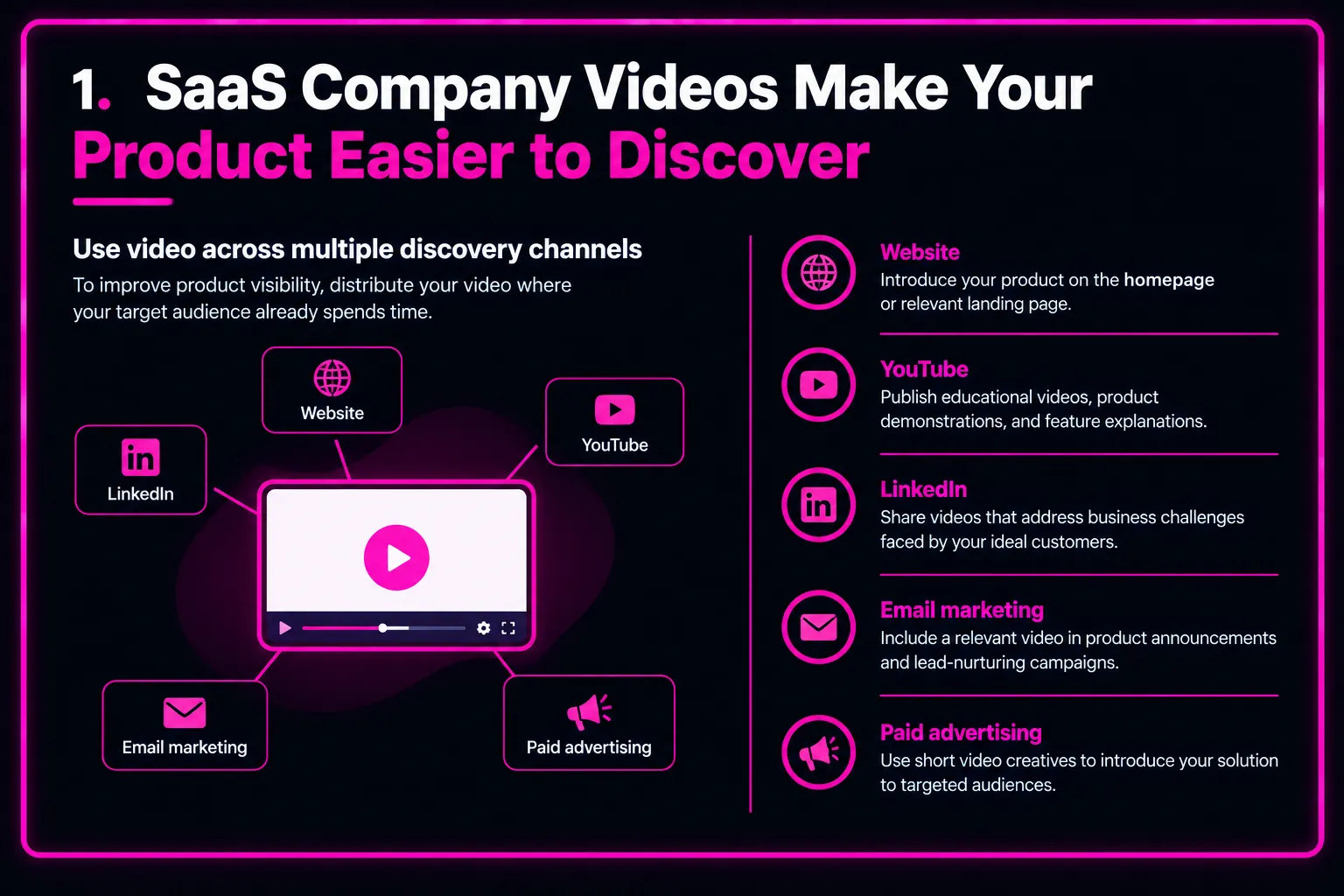
Use video across multiple discovery channels
To improve product visibility, distribute your video where your target audience already spends time.
- Website: Introduce your product on the homepage or relevant landing page.
- YouTube: Publish educational videos, product demonstrations, and feature explanations.
- LinkedIn: Share videos that address business challenges faced by your ideal customers.
- Email marketing: Include a relevant video in product announcements and lead-nurturing campaigns.
- Paid advertising: Use short video creatives to introduce your solution to targeted audiences.
The important point is consistency. Your video should communicate the same core value proposition across channels while adapting its format to each platform.
2. Videos Help Simplify Complex SaaS Features
Many SaaS products contain technical features, integrations, automation workflows, dashboards, and AI-powered capabilities. Although these functions may be valuable, explaining them through lengthy descriptions can make the buying process more difficult.
When prospects struggle to understand a product, they may postpone a decision or explore a competitor with a clearer message.
A SaaS explainer video can simplify this process by turning technical information into a visual story. It can introduce a problem, demonstrate the software’s solution, and explain the benefits in a logical sequence.
For instance, an AI analytics platform might use a video to show how data enters the system, how the platform identifies patterns, and how users turn those insights into business decisions.
This approach connects individual features with practical outcomes. Instead of simply saying that the software offers predictive analytics, the video demonstrates how that capability helps users identify trends and make informed decisions.
Choose the right video format
Different video formats support different communication goals:
- Explainer videos: Introduce the product and explain its core value.
- Product demo videos: Demonstrate the interface and important workflows.
- Animated SaaS videos: Illustrate abstract concepts, technical processes, or invisible software functions.
- Feature videos: Highlight a particular capability and its practical benefits.
- Product launch videos: Introduce new products, updates, or major features.
The right format depends on your audience, product complexity, and marketing objective.
If your software is difficult to explain through text alone, professional SaaS video production can help transform technical information into a clearer, more engaging visual experience.
3. Product Videos Strengthen Brand Awareness and Recognition
Product visibility is not only about reaching more people. It is also about helping audiences remember your brand after they have seen it.
A potential customer might encounter your SaaS company through a LinkedIn post, visit your website later, and compare your solution with several alternatives before making a decision. Consistent video messaging can help create a recognizable brand experience throughout this process.
Videos combine visual identity, voice, storytelling, and product imagery. When these elements remain consistent, they can help audiences associate your brand with a particular problem or solution.
For example, a cybersecurity SaaS company could develop a series of videos explaining threat detection, secure access, and compliance workflows. Each video could use consistent colors, typography, animation, and messaging while covering a different customer need.
Over time, this approach gives the company multiple opportunities to communicate its expertise and introduce its product to relevant audiences.
Create a consistent video identity
To strengthen brand recognition:
- Use consistent brand colors, typography, and visual elements.
- Keep the tone and messaging aligned with your brand personality.
- Focus each video on a clear audience problem or product benefit.
- Develop related videos around your main product categories.
- Repurpose key video segments into shorter social media content.
Avoid making every video look identical. A consistent brand identity should still allow creative variation based on the message and audience.
For additional ideas, explore how animated marketing videos boost brand awareness.
4. SaaS Videos Improve Website Engagement and Support SEO
Attracting visitors to your website is only the first step. You also need to help them understand your offering and guide them toward useful next actions.
A relevant product video can give visitors another way to explore your software. Someone who does not want to read a long feature page may prefer watching a short demonstration that explains the product’s purpose and capabilities.
Video can be especially useful on pages where visitors are evaluating a solution, such as product pages, feature pages, landing pages, and demo-request pages.
Research from Wistia’s 2026 State of Video Report examined more than 13 million videos and 79 million hours of viewing data. The report highlights that video placement matters: homepage, video gallery, and product-page videos tend to attract comparatively high play rates.
How can SaaS videos support SEO?
Video does not automatically improve search rankings simply because it appears on a webpage. However, a well-optimized video can support a broader SEO strategy in several ways.
Improve the content experience: A relevant video can help visitors understand a product without relying entirely on lengthy copy.
Support search intent: A product demonstration can answer questions that potential customers have when researching software.
Create opportunities for video discovery: Public videos with descriptive titles, useful descriptions, and appropriate metadata can be discovered through video search platforms.
Strengthen landing pages: A video that clearly explains the product can complement relevant written content and calls to action.
Support content distribution: Short clips from a main video can lead interested viewers back to your website.
For best results, include a descriptive video title, relevant surrounding copy, accurate captions, a transcript where appropriate, and a suitable thumbnail. Use video structured data when eligible and ensure that the video does not make the page unnecessarily slow.
Most importantly, keep the webpage useful even for visitors who choose not to watch the video.
5. Video Content Helps SaaS Companies Attract Qualified Leads
More visibility is useful, but visibility among the wrong audience rarely produces meaningful business results. SaaS companies need to reach people who understand the problem their product solves and have a reason to consider the solution.
Video content can support this process by addressing specific customer pain points.
For example, a customer relationship management platform might create a video explaining how sales teams can manage leads, automate follow-ups, and track opportunities. The content attracts viewers interested in those challenges while giving them a clearer understanding of the product.
A different video could target business owners searching for ways to improve reporting or reduce manual work. Each video would focus on a distinct need, helping the company communicate with different segments of its target audience.
Connect video content to the buyer journey
Your video strategy should reflect the questions customers ask at different stages.
- Awareness stage: Explain a common problem and introduce possible solutions.
- Consideration stage: Demonstrate product features and compare relevant workflows.
- Decision stage: Address product-specific questions and encourage visitors to book a demo or start a trial.
- Post-purchase stage: Provide onboarding and training videos that help customers use the product.
This approach helps your team create content with a clear purpose instead of publishing videos simply to increase views.
Turn attention into action
Every marketing video should have a relevant next step. Depending on its purpose, that could be exploring a product page, requesting a demonstration, downloading a resource, or starting a free trial.
If your SaaS company needs a video that communicates product value and supports lead generation, consider SaaS product videos designed around your target audience, product features, and marketing goals.
6. Professional SaaS Videos Help You Stand Out From Competitors
In competitive software markets, multiple brands may offer similar features. When product pages use comparable claims and technical descriptions, customers can find it difficult to identify meaningful differences.
Video gives SaaS companies another way to explain what makes their products relevant.
Instead of stating that your platform is easy to use, you can demonstrate a common workflow. Instead of describing an integration, you can show how information moves between connected tools. Rather than listing automation capabilities, you can demonstrate how a repetitive task becomes simpler.
These examples make product claims more concrete and help potential customers evaluate the solution.
Focus on customer outcomes, not just features
A common mistake is trying to fit every feature into one video. This can create an overloaded message that makes the product harder to understand.
A stronger approach is to identify the most important customer problem and build the video around it.
For example, a finance SaaS company could focus on helping finance teams consolidate reports and identify spending patterns. Its video would show the relevant workflow and explain the practical benefit rather than listing every dashboard, filter, and integration.
Professional production can also help maintain visual consistency, improve storytelling, and present the product in a polished way. For SaaS brands with complex products, this may require scriptwriting, storyboarding, interface demonstrations, animation, voiceover, and editing.
How to choose a video production partner
Before selecting a production company, evaluate whether it understands your product, target audience, and business objectives.
Consider these questions:
- Can the team explain technical products in simple language?
- Does its portfolio demonstrate relevant SaaS or technology work?
- Can it adapt the visual style to your brand?
- Does it have a clear process for scripting, production, feedback, and revisions?
- Can the final video be adapted for different marketing channels?
The goal is not simply to create an attractive video. It is to develop an asset that communicates your product’s value and supports a measurable business objective.
If you need help translating a complex software product into a compelling visual story, MotionGility offers video solutions for SaaS, AI, and technology brands.
How to Measure Whether SaaS Videos Improve Product Visibility
Publishing a video is not the end of the process. You need to measure whether it reaches the intended audience and helps them take meaningful actions.
Start by establishing a baseline before launching your video campaign. Then compare performance over a suitable period while accounting for other changes in traffic, promotion, and website content.
Track metrics that match your objective:
Goal | Useful metrics |
Brand awareness | Reach, impressions, branded search trends |
Video discovery | Views, play rate, traffic sources |
Audience engagement | Watch time, completion rate, meaningful interactions |
Website performance | Landing-page visits, engaged sessions, CTA clicks |
Lead generation | Demo requests, qualified leads, trial signups |
Business impact | Conversion rate, sales opportunities, influenced revenue |
Do not rely on video views alone. A video with fewer views but more qualified demo requests may be more valuable than one with a large audience that does not match your target market.
Use analytics to identify where viewers lose interest, which topics attract qualified visitors, and which placements encourage action. Then improve your scripts, creative approach, distribution, and calls to action based on the findings.
Conclusion
SaaS companies need more than a good product to gain attention in competitive digital markets. They also need to communicate their value clearly, reach relevant audiences, and give potential customers a reason to explore what they offer.
SaaS company videos can support these goals by making complex features easier to understand, strengthening brand recognition, improving the website experience, attracting qualified leads, and differentiating a product from competing solutions.
However, successful video marketing requires more than simply adding a video to a homepage. Each video should serve a specific purpose, reflect the audience’s needs, and connect naturally with the next step in the customer journey.
Start by identifying the most important product message you want your audience to understand. Choose a suitable video format, distribute it across relevant channels, and measure its impact on engagement and conversions.
If your software is difficult to explain or your product pages need a clearer way to communicate value, professional video production can help bridge that gap.
Ready to make your SaaS product easier to understand and more visible to your target audience? Explore MotionGility’s video production solutions and discuss a video strategy tailored to your product and business goals.
Frequently Asked Questions
1. What are SaaS company videos?
SaaS company videos are videos created to introduce software products, explain features, demonstrate workflows, communicate benefits, or educate customers. Common formats include explainer videos, product demos, onboarding videos, and product launch videos.
2. How do SaaS company videos improve product visibility?
They help companies present their products across websites, search platforms, social media, email campaigns, and paid advertising. Clear visuals and messaging can make a product easier to discover, understand, and remember.
.
3. Which type of video is best for a SaaS company?
The best format depends on your objective. Explainer videos help introduce a product, product demos show how software works, feature videos highlight specific capabilities, and onboarding videos help new customers learn the product.
4. Can SaaS videos improve website SEO?
Videos can support SEO by making pages more useful, answering product-related questions, and creating opportunities for video search visibility. However, videos alone do not guarantee higher rankings. Relevant content, technical SEO, page performance, and appropriate optimization remain important.
5. How long should a SaaS product video be?
The ideal length depends on the message and audience. A short promotional video may communicate the core value in under a minute, while a product walkthrough may need more time to explain a workflow. Keep each video focused and remove information that does not support its purpose.