Picture a patient in a waiting room, holding a printed leaflet about tomorrow’s procedure. The paragraphs are dense, the terms are unfamiliar, and within thirty seconds the leaflet is back on the chair, and the phone is out.
Now picture the same patient watching a ninety-second animation that walks through the procedure step by step, in plain language, with a calm voice and clear visuals. They watch it twice. Then they send it to their family.
That difference is why healthcare video animation services have moved from a nice extra to a core part of how hospitals, pharma teams, medical device companies, and digital health startups communicate.
Healthcare is full of ideas that are hard to explain and impossible to film: how a drug binds to a receptor, how an implant sits inside the body, how an AI model reads a scan. Animation shows what a camera cannot.
Quick answer: healthcare video animation services turn complex medical information into short, accurate, easy-to-follow videos using 2D animation, 3D medical animation, motion graphics, or whiteboard animation.
They boost engagement by making information clearer, holding attention longer, building trust, and making content easy to share across languages and channels.
In this guide, you’ll learn what healthcare video animation services include, why they work, which format fits which job, how to choose a partner, and what a good process looks like. We build these videos for a living, so expect practical detail rather than hype.
What Are Healthcare Video Animation Services?
Healthcare video animation services cover the whole journey of creating an animated video for a medical or health-related audience, from the first conversation about goals to the final file you publish.
A healthcare animation agency typically handles research, scripting, storyboarding, illustration, animation, voiceover, sound design, subtitles, and delivery in the formats you need.
The result is what most people call animated healthcare videos, or healthcare explainer videos when the goal is to explain a product, service, or condition.
You may also hear the term medical animation video, which usually points to content with a stronger clinical or scientific focus, such as a mechanism of action or a surgical technique.
The labels vary. The aim is the same: help someone understand something important, quickly.
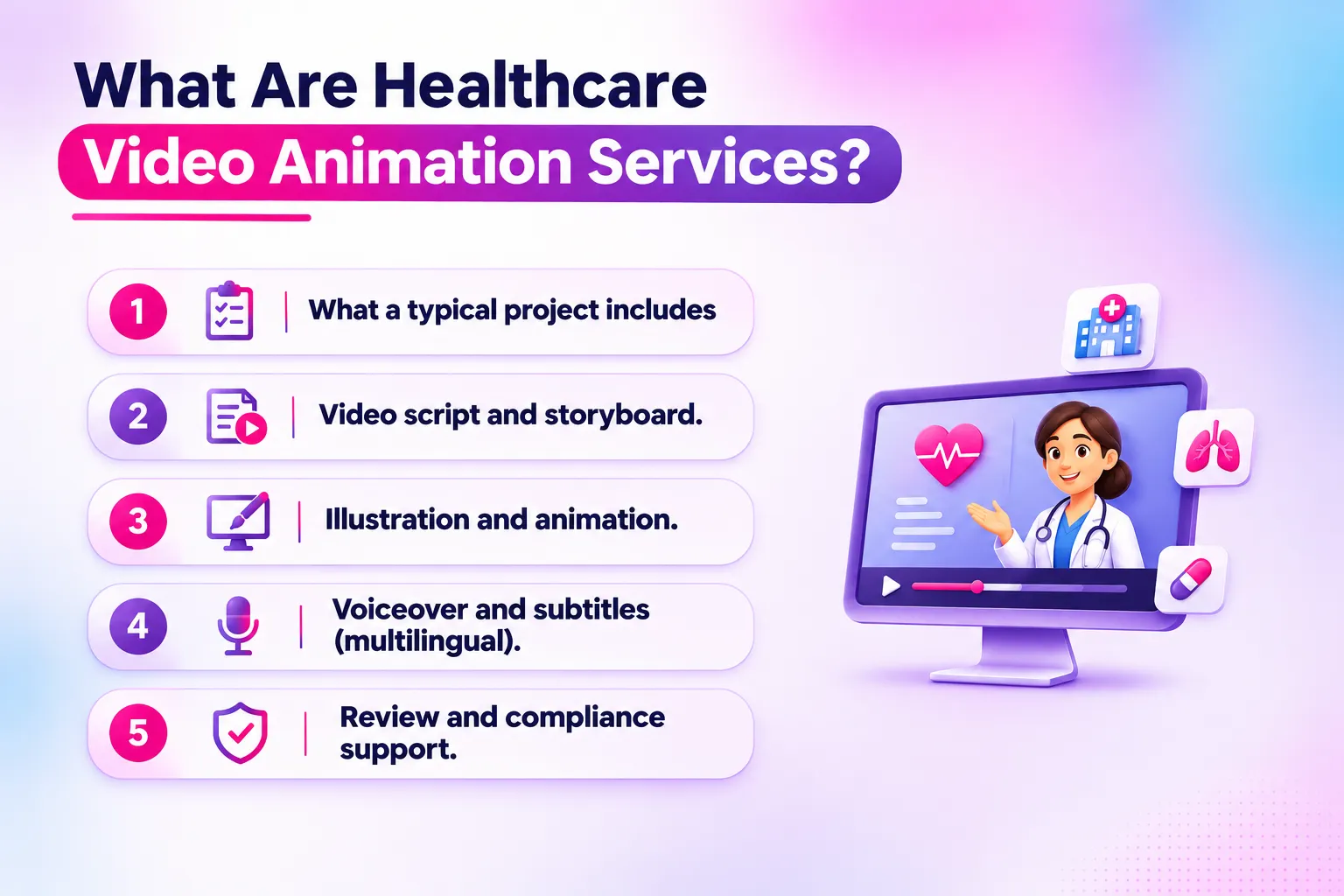
What a typical project includes
A good healthcare video production company does far more than make things move. Here is what sits inside the service.
Video script and storyboard. Everything starts with the script, which decides what the viewer learns, in what order, and in what tone.
The storyboard then turns the script into a frame-by-frame plan so everyone can approve the visuals before animation begins. Changes are cheap on paper and expensive in animation, so this step saves both time and budget.
Illustration and animation. Depending on the brief, the visuals may be 2D healthcare animation, 3D medical animation, whiteboard animation for healthcare, or a blend with motion graphics for healthcare.
Voiceover and subtitles (multilingual). A warm, clear voice makes medical content easier to follow. Subtitles make it work in noisy clinics, on silent social feeds, and for viewers who prefer to read. Multilingual voiceover and subtitles let one animation serve patients and professionals in several regions.
Review and compliance support. Accuracy matters more in healthcare than almost anywhere else. A good partner builds in review steps, so your clinical, legal, and regulatory teams can sign off before the video goes live.
Why Healthcare Communication Has an Engagement Problem
Health information is high-stakes and low-attention. Patients are often anxious, tired, or short on time when they take it in. Clinicians are busy.
Buyers at hospitals and pharma companies are weighing complex products against long lists of alternatives.In every case, the person on the other side of the message is doing you a favor by paying attention at all.
Text-heavy formats struggle here. Brochures, PDFs, and long web pages ask the viewer to translate jargon into something meaningful on their own.
Live-action video helps, but it cannot show what happens inside a cell or a blood vessel, and filming around real patients and clinical settings raises privacy and consent challenges.
This is the gap healthcare video animation services fill. Animation can show the invisible, simplify the complicated, and stay friendly even when the subject is serious. That combination is exactly what engagement needs.
How Healthcare Video Animation Services Boost Engagement
Engagement is not one thing. It is a chain: someone starts watching, keeps watching, understands, trusts, acts, and shares. Here is how well-made animation strengthens each link.
They make complex ideas easy to understand
Clarity is the foundation of everything else. Animated healthcare videos can break a complicated process into small visual steps, use metaphors that connect to everyday life, and highlight only what matters at each moment.
A viewer who understands what they are seeing is far more likely to keep watching and to remember it later.
They hold attention longer
Movement, color, and pacing are tools for guiding the eye. With motion graphics for healthcare, you can reveal information one idea at a time so the viewer never feels buried.
Short formats work especially well, and many healthcare explainer videos run between sixty and ninety seconds because that is about how long a viewer will happily give a new topic.
They build trust and reduce anxiety
Tone matters enormously in healthcare. A gentle voice, soft visuals, and a steady pace can turn a frightening topic into a manageable one.
For patients, that can mean less anxiety before a procedure and more confidence about what comes next. For buyers and partners, a polished, accurate video signals that your organization is careful and credible.
They reach more people in more languages
A single animation can be localized without reshooting anything. With multilingual voiceover and subtitles, you can serve audiences across regions while keeping the same visuals, the same message, and the same quality.
Subtitles also support viewers who are deaf or hard of hearing, and anyone watching without sound.
They are easy to share and reuse
An animation can live on your website, in patient portals, on waiting-room screens, in sales decks, at conferences, in email campaigns, and on social media. One project can power many touchpoints, which makes each piece of content work harder.
Types of Animated Healthcare Videos: Which Format Fits?
Good healthcare video animation services offer several styles, because there is no single best one. The right choice depends on your audience, subject, budget, and how much detail you need to show.
2D healthcare animation
2D healthcare animation is the most flexible and budget-friendly style. It suits services, workflows, patient journeys, and digital health products, especially when you want an approachable look.
It also adapts easily to brand colors and characters, so the video feels like part of your identity rather than a stock clip. Many healthcare video animation services begin here for general explainers.
3D medical animation
3D medical animation shines when anatomy, devices, or molecular mechanisms need to look realistic. Think of a stent opening inside an artery or a drug interacting with a receptor.
It takes more time and budget than 2D, but the depth and realism can be worth it for device launches, clinician education, and pharma content.
Whiteboard animation for healthcare
Whiteboard animation for healthcare uses a hand-drawn look to build an idea step by step. It is simple, clear, and very good at teaching, which makes it a strong fit for patient education, staff training, and process explanations where the order of ideas matters more than visual polish.
Motion graphics for healthcare
Motion graphics for healthcare bring text, icons, data, and interface screens to life. They work
How to Choose a Healthcare Animation Agency
Not every studio offering healthcare animation services is built for healthcare. When you compare healthcare video animation services, these questions are worth asking.
Do they understand the subject, or just the software? Look for a portfolio with healthcare, pharma, or health tech work, and ask how they handle research and medical accuracy.
Do they start with strategy? A good healthcare video production company asks about your audience, goals, and where the video will live before it talks about style.
Is the process transparent? You should see the script, storyboard, and a clear review schedule before animation begins, with defined rounds of feedback.
Can they handle multiple formats and languages? If you need 2D, 3D, or a blend, plus multilingual voiceover and subtitles, confirm they can deliver all of it.
What happens after delivery? Some studios hand over a file and disappear. Others help you plan distribution and track performance, which is where engagement is actually won or lost.
Can they show results? Ask for case studies, client references, and examples of how past videos performed.
How MotionGility Approaches Healthcare Video Animation Services
At MotionGility, we create explainer videos for AI, SaaS, and tech brands, and healthcare is one of the industries we serve. Our healthcare video production work is built around one idea: simplify complex healthcare and medical concepts into clear visual stories that build trust, improve understanding, and drive adoption.
We treat healthcare video animation services as a marketing job, not just a creative one. That means we start with your audience, their pain points, and the KPIs that matter, then build the script, storyboard, and visuals around them.
Our video production process moves from strategy to script to storyboard to animation to delivery, with approvals along the way so there are no surprises.
In our healthcare video animation services, the focus is medical concept simplification, trust-driven patient storytelling, process and treatment visualization, and compliance-focused video strategy.
In practice, that means clear scripts, accurate visuals, a respectful tone, and review steps that make life easier for your clinical and regulatory teams.
You can see examples in our portfolio, including explainers for healthcare analytics and pharma analytics products such as DocNexus, and read how our work performs in our case studies.
We also do not stop at delivery. Unlike production-only agencies, we pair each video with strategic messaging, a distribution playbook, launch support, and a post-delivery growth strategy call, because a video nobody sees cannot boost anything.
If you want to talk through your project, you can book a consultation, and we will look at your goals together.To see how the same approach works in other industries, explore our explainer video services and our AI product video services.
How to Measure Whether Your Video Is Working
Decide on your success metrics before your healthcare video animation services project starts. For awareness videos, look at play rate, average watch time, and where viewers drop off.
For conversion videos, track clicks, demo requests, appointment bookings, and form fills. For patient education, look at completion rates, fewer support calls, and feedback on how well people understood the material.
The most valuable healthcare video animation services treat the first release as the start of a loop: publish, measure, learn, and improve. Even small changes, like a tighter opening or a clearer call to action, can lift results noticeably.
Common Mistakes to Avoid
Most weak healthcare videos fail for the same few reasons: they run too long, try to say everything, lean on jargon, skip subtitles, rush medical review, or launch without a distribution plan. Each is avoidable.
Keep the video focused, test the script on someone outside your field, and decide where the video will live and who will see it before you commission it.
Good healthcare video animation services will help you avoid these traps early, when fixing them is cheap.
Conclusion
Healthcare video animation services work because they respect the viewer. They take something complicated and make it clear, take something frightening and make it calmer, and take something forgettable and make it stick.
When the script is plain, the visuals are accurate, the voice is warm, and the video reaches the right people, engagement follows.
If you are planning a healthcare video and want it to do real work for your brand, start with a conversation. Explore our healthcare video animation services or browse more guides on the MotionGility blog.
Frequently Asked Questions
What are healthcare video animation services?
Healthcare video animation services are end-to-end services that create animated videos for medical and health audiences. They include scripting, storyboarding, 2D or 3D animation, voiceover, subtitles, and delivery, with review steps for medical accuracy.
How do healthcare video animation services improve patient engagement?
They make information easier to understand, hold attention with visuals and pacing, build trust through tone, and make content easy to share and translate. Patients who understand their care are more likely to stay involved in it.
How much do healthcare video animation services cost?
Cost depends on video length, animation style, level of detail, number of languages, and revision rounds. 2D animation usually costs less than 3D medical animation. The most reliable way to get a number is to share your goals and request a scoped quote.
How long does it take to make a medical animation video?
Timelines depend on style, length, and how quickly feedback and approvals arrive. A short 2D explainer often takes several weeks, while detailed 3D work takes longer. Early script approval is the biggest factor in keeping a project on schedule.
Can animated healthcare videos be made in multiple languages?
Yes. With multilingual voiceover and subtitles, healthcare video animation services can serve audiences in several regions with one animation. Planning for translation early helps, because different languages change timing and on-screen text.