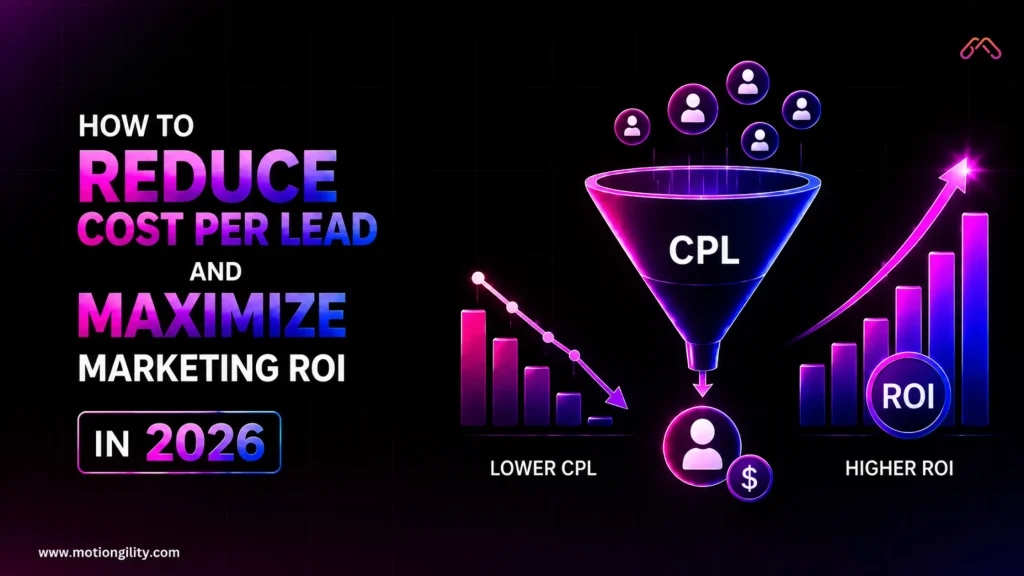
Imagine waking up on the first day of the month, opening your Ad Manager, and finding that your Cost Per Lead (CPL) has dropped by 35% compared to the previous month. Not only that, but the speed of your sales pipeline and the quality of your leads have already doubled.
For a growth marketer, SaaS founder, or business owner, this might sound like a dream. But in the digital and AI-driven market of 2026, this is entirely possible provided you stop running your marketing strategy with old, outdated methods.
The entire landscape of Digital Acquisition has now changed. The era of traditional linear sales funnels is now over. Generative Engine Optimization (GEO) and AI search engines (like ChatGPT, Perplexity, and Google AI Overviews) have completely changed the way B2B buyers and decision-makers search for a solution or service.
Along with this, privacy updates, the demise of third-party cookies, and increasing competition on ad networks have made traditional spray-and-pray paid marketing extremely expensive.
If your CPL is constantly increasing, it directly means that your potential customers are unable to understand your complex product or service in the first instance. When a user comes to your web page and cannot easily understand your solution, they bounce off without filling out the form.
For B2B and SaaS companies, video marketing is not just a means of brand awareness. It is the most powerful conversion tool in your funnel. In this comprehensive 1500+ word guide, we will understand in depth how the right video-first marketing strategy can reduce your CPL, improve lead quality, and transform your entire business growth (Growth Metrics).
1. Understand the Problem: 'Video Debt' and Rising CPL
In today’s digital market, most businesses are struggling with an unknown crisis, which we call Video Debt. This means that companies are using thousands of words of long text to explain their product features, blogs, and case studies, while their modern buyer wants precise information in just a few seconds.
When you use only text and static images on your landing page, the following problems arise:
- The Information Overload: It is difficult to explain technical or complex B2B products in words. The user gets bored and leaves the page.
- Lower Attention Span: In 2026, people have a severe shortage of time. If they do not understand within 10 seconds what problem your product solves for them, they leave.
- High Bounce Rate: A rising High Bounce Rate signals to ad platforms that users are not finding your landing page relevant or engaging. This negatively affects your Relevance Score and Quality Score, leading to higher Cost Per Click (CPC) and ultimately increasing your overall Cost Per Lead (CPL).
A customized explainer video eliminates this entire problem from the root. It presents your most complex business model or software as an easy, visual, and engaging story in just 60 to 90 seconds.
2. Video Funnel Architecture: The Right Video for Every Stage
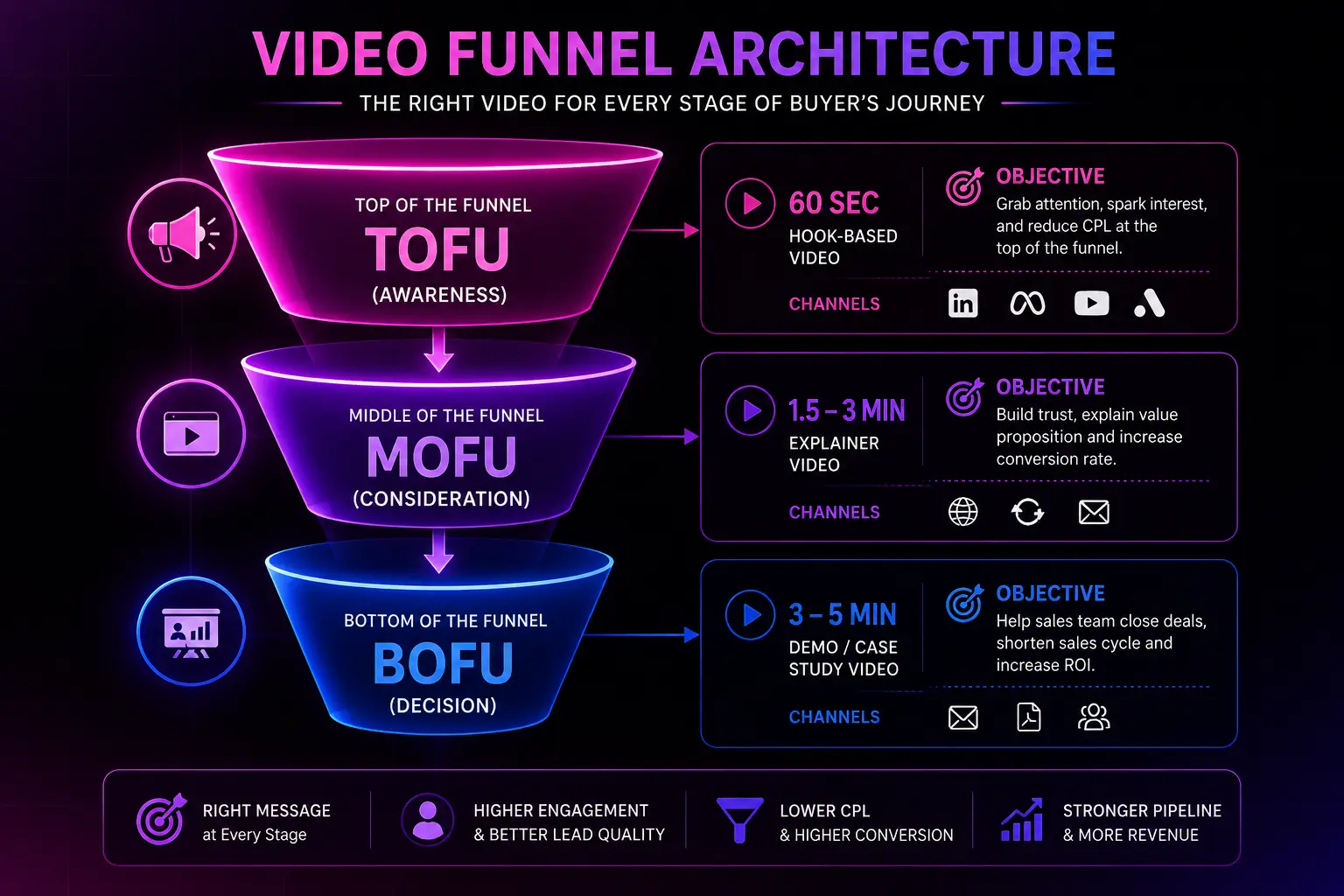
The biggest mistake in marketing is that people make a single video and try to use it everywhere. To run a successful growth engine in 2026, you need a Video Funnel Architecture. You have to divide your videos into three main parts according to the buyer’s journey:
[ Top of the Funnel (TOFU) ]
(60-Second Hook-Based Video ➔ To Reduce CPL)
│
▼
[ Middle of the Funnel (MOFU) ]
(1.5 to 3-Minute Explainer Video ➔ For Trust and Conversion)
│
▼
[ Bottom of the Funnel (BOFU) ]
(UI Walkthrough and Case Study Videos ➔ To Close Deals)
A. Top of the Funnel (TOFU) - The Hook
- Length: 30 to 60 seconds
- Main Objective: To grab the user’s attention, stop the scroll, and reduce CPL at the initial stage itself.
- Content Strategy: Here, you do not have to list the technical features of your product. This video should start with a strong pain point or hook that directly touches the biggest day-to-day problem of your target persona (such as SaaS founders, HR managers, or procurement officers).
- Channels: LinkedIn Ads, Meta Ads, YouTube Shorts, and Google Video Campaigns.
B. Middle of the Funnel (MOFU) - The Explainer
- Length: 90 to 180 seconds (1.5 to 3 minutes)
- Main Objective: To build trust and increase the conversion rate of the landing page.
- Content Strategy: This is your main customized explainer video. In this, you explain how your product or service works, what its main use-cases are, how it manages data security, and how it integrates with their existing systems. This video logically proves why you are the best choice for them.
- Channels: Landing pages, retargeting ads, and email nurture sequences.
C. Bottom of the Funnel (BOFU) - The Closer
- Length: 3 to 5 minutes
- Main Objective: To help the sales team shorten the sales cycle and close the deal.
- Content Strategy: This includes the live interface (UI walkthrough) of your actual software or service. Along with this, it shows video testimonials and visual case studies of existing clients, which give solid proof of return on investment (ROI).
- Channels: Sales pitch decks, direct sales emails, and proposal pages.
3. $3,000 Strategy-Led Video vs. $500 Template Video (ROI Analysis)
When companies decide to make a video, they often get caught in the budget trap. They think that a $500 cheap template-based video will do the same job that a $3,000 professional customized video does. But in terms of marketing ROI, this thinking proves to be completely wrong.
Let’s understand the real difference between these two and the impact on your CPL through a data table:
Features and Metrics | $500 Template Video (Generic) | $3,000 Customized Video (Strategy-Led) |
Script and Strategy | It is readymade and generic. It fails to represent the Unique Value Proposition (UVP) of your business. | It is written by researching the psychology of your target buyer and their exact pain points. |
Visuals and Animation | Stock characters and outdated assets are already present on the internet. No brand identity. | Customized motion graphics prepared according to your brand guidelines, color palette, and tone. |
User Engagement | People recognize it immediately as a cheap advertisement and skip it instantly. | It hooks the user within the first 5 seconds, resulting in a very high Video Completion Rate. |
Average Conversion Rate | Approximately 1.5% to 2% | 4% to 6% (or even higher) |
Impact on CPL | Ad spend increases, but leads are negligible, making the CPL very expensive. | Due to increased landing page conversion, your effective CPL drops directly by 30% to 40%. |
Long-Term Business Value: A $500 template video does not save your money; instead, it wastes your ad budget. Conversely, a $3,000 professional production cycle creates a long-term digital asset that keeps generating high-quality leads for you for years.
4. Practical Action Plan to Reduce CPL Through Video
If you are troubled by your rising Customer Acquisition Cost (CAC) and CPL, implement this 4-step action plan in your business starting today:
Step 1: Sync the Video with the Form on the Landing Page
Embed your 90-second explainer video right next to or above your main customized form or multi-step conversational funnel on your landing page. Statistics show that adding a relevant video to a landing page can increase the conversion rate by up to 80%. When the user’s doubt and fear are removed through the video, they do not hesitate at all to provide their corporate email ID and phone number.
Step 2: Create a 'Video Views' Custom Audience on Ad Platforms
Instead of sending cold traffic directly to the sales page on LinkedIn and Google Ads, first show them your 60-second problem-solving video. After this, create a Custom Retargeting Audience of those people who have watched your video for at least 50% or 75%.
These people who watched 50% are your ‘Warm Audience’. When you show your main form-based advertisements only to these people, your conversion rate is very high, and ad spend is not wasted, causing CPL to drop heavily.
Step 3: Include UI Automation and Real-Time Walkthroughs
If you are a SaaS company, your video should not contain just abstract things. Buyers of 2026 want to see what your software actually looks like from the inside. Include smooth, animated screen recordings and UI Walkthroughs in between your explainer video.
This transforms your promise into reality and creates “Buying Intent” in the mind of the buyer.
Step 4: Eliminate Execution Complexity (The Managed Execution Layer)
To make an excellent video, you need a scriptwriter, a storyboard artist, a voice-over professional, an animator, and a sound engineer. If you manage all of them as separate freelancers, your time will be wasted, and the quality of the video will also suffer.
Instead, work with a professional agency that acts as a Managed Execution Layer. They handle the entire production cycle themselves, from the script to the final animation. This saves your time and gives you a video that directly supports your business goals (MRR, NRR, and sales pipeline).
Conclusion
Reducing your Cost Per Lead (CPL) and increasing Marketing ROI in 2026 is not magic, but pure science. If you are still relying only on text-based blogs and boring static forms, you are falling far behind your competitors.
By adopting Video Funnel Architecture, investing in a $3,000 customized and strategy-led video production, and handing over a strong visual asset to your sales team, you not only reduce your marketing costs but also increase your brand value.
Early Bird Access – Join the Waitlist
We are building the exact Living Video infrastructure that this 2026 report demands. Don’t let your marketing lag behind your product updates.
Priority Access: Skip the queue and be the first to automate your video production before the public launch.
Founder’s Pricing: Secure exclusive, lifetime discounts that will never be offered to the public again.
Strategy Support: To ensure your success, early members receive a free video marketing audit from our expert strategy team.
FAQs
1. What is CPL in digital marketing, and why is it increasing in 2026?
CPL (Cost Per Lead) is the amount businesses spend to generate one qualified lead. In 2026, CPL is increasing due to higher ad competition, AI-driven search behavior, privacy updates, and lower engagement with traditional text-based marketing strategies.
2. How can video marketing reduce Cost Per Lead (CPL)?
Video marketing improves audience understanding, increases engagement, reduces bounce rates, and boosts landing page conversions. A strong explainer video helps users understand your product quickly, which lowers wasted ad spend and reduces CPL.
3. Can videos improve landing page conversion rates?
Yes. Studies consistently show that landing pages with relevant explainer videos can significantly improve conversion rates because videos build trust, reduce confusion, and increase user engagement.
4. Can small businesses benefit from explainer videos?
Absolutely. Explainer videos help small businesses communicate their value proposition clearly, build credibility quickly, and compete with larger brands in crowded markets.
5. Should businesses hire a professional explainer video agency?
Yes. Professional agencies manage scripting, animation, voice-over, storytelling, and strategy together. This ensures consistent quality, faster execution, and videos that align directly with business growth goals like MRR, lead generation, and ROI.